Best TIG Welding Machine for Working Pros
Every pick here does TIG, but most run it as a Lift TIG side mode. Here's which machine actually earns a spot on a working bench, and which ones are MIG units wearing a TIG label.
The best TIG welding machine for professionals here is the YESWELDER FLUX-135PRO, a 135A 3-in-1 that runs Lift TIG, stick, and flux-core MIG at just 11.4 lb. If your work is aluminum, the Sunstac TIG-250 is the better buy because it runs true AC/DC TIG with a foot pedal. Here's the fast read: the YESWELDER for a light utility machine, the ARCCAPTAIN MIG205MP for HF TIG in a real shop, and the Sunstac if aluminum drives the decision.
Why most of these are Lift TIG, not true TIG
Read the fine print before you spend. Six of these seven machines do TIG as a secondary mode, and most of that is Lift TIG, not high-frequency AC TIG.
Lift TIG works by touching the tungsten to the metal and lifting to strike the arc. It welds steel and stainless fine. It does not do aluminum, because aluminum needs alternating current to break the oxide layer.
So a listing that says "MIG/Lift TIG/Stick 3-in-1" is a MIG machine that can pinch-hit at TIG. That is not a knock. It's just a different tool than a dedicated AC/DC TIG unit. A pro shopping for a real TIG rig needs to know which is which before the box arrives.
Here's the split across this set:
- True AC/DC TIG: only the Sunstac TIG-250, which lists High-Frequency AC, HF DC, Pulsed AC, Pulsed DC, and spot modes.
- HF DC TIG: the ARCCAPTAIN MIG205MP lists DC HF TIG plus DC Lift TIG.
- Pulsed DC TIG: the Everlast THUNDER 255 lists Pulsed TIG.
- Lift TIG only: both YESWELDER units and the AmicoPower ARC-160, most needing an extra torch.
That distinction shapes every recommendation below.
YESWELDER FLUX-135PRO at a glance
| Pick | TIG type | Output | Price |
|---|---|---|---|
| Best overall YESWELDER 135A MIG Welder |
Lift TIG (torch extra) | 135A, 110V | Check Price |
| Best for pros ARCCAPTAIN MIG205MP |
DC HF + DC Lift | 20-205A | Check Price |
| Best premium Everlast THUNDER 255 |
Pulsed DC TIG | 275A, 240V | Check Price |
| Best for beginners Sunstac 250A TIG Welder |
AC/DC + Pulsed | 250A | Check Price |
| Best for heavy use YESWELDER 160A MIG Welder |
Lift TIG (torch extra) | 160A, 110/220V | Check Price |
| Best for families ARCCAPTAIN MIG250DP |
Lift TIG (torch extra) | 250A, 110/220V | Check Price |
| Runner-up AmicoPower ARC-160 |
Lift TIG | 160A, 100-250V | Check Price |
How I screened seven listings down to the picks
I started by throwing out picks for three reasons, then ranked what was left. Disqualification comes first because it's faster than praise.
Cut for the wrong TIG type in the buyer's context. Aluminum work needs AC. Any machine offering only Lift TIG got pushed down the ranking for a pro whose TIG job is aluminum, even where the rest of the spec sheet was strong.
Cut for missing published data. The Everlast THUNDER 255 lists dimensions as 0 x 0 x 0 in and no weight, and the AmicoPower lists no released date and a low position in its category. Blank fields make a buying decision harder, and I weighed that against every claim.
Cut for price with no matching TIG gain. A premium position only earns its keep if the TIG capability grows to match it. Two of the priciest picks here spend that money on MIG features, not TIG.
What survived splits cleanly. One light utility machine leads. Then the machines that add HF or pulsed TIG. Then the true AC/DC unit for aluminum. Then the heavier MIG-first machines that happen to do Lift TIG. I compared the published specifications side by side and let the TIG mode, output, and portability decide the order.
1. YESWELDER 135A MIG Welder — Best overall
The lightest, cheapest way to keep a Lift TIG and stick machine within arm's reach on a working bench.
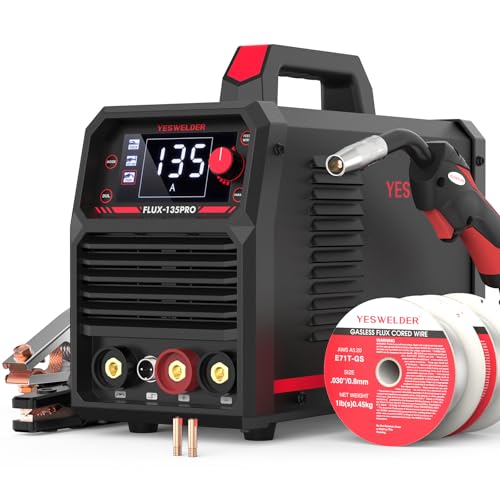
Best for: a pro who wants a light second machine for occasional Lift TIG and stick Skip it if: you need real AC TIG for aluminum
This is the pick I'd hand a working pro who already owns a big TIG rig and wants something light for the truck. It weighs 11.4 lb with a carry handle and measures 14.57×6.10×8.86 in. That's the smallest body in this set by a wide margin, and it's the cheapest of the seven.
The model is the FLUX-135PRO. It handles Gasless Flux Core MIG, stick, and Lift TIG, though YESWELDER says the Lift TIG torch is an extra purchase. Output is a stated 135A on 110V, which the listing claims tackles mild steel up to 3/32". YESWELDER also describes a synergic control that matches voltage to wire speed, plus an oversized LED display for outdoor visibility.
Where it loses ground: this is the sole 110V-only machine among the top picks, and its TIG is Lift only. It won't touch aluminum, and 135A caps thicker work. It trades capability for portability, and for a second machine that's the right trade.
Pros:
- Lightest in the set at 11.4 lb
- Cheapest of the seven picks
- Three processes plus carry handle
- Synergic control claim eases setup
- Sells faster than the rest of this set
Cons:
- Lift TIG only, no aluminum
- 110V only, no dual voltage
- TIG torch sold separately
- 135A limits thicker steel
2. ARCCAPTAIN MIG205MP MIG Welder with Plasma Cutter — Best for pros
The only pick here that pairs high-frequency DC TIG with a built-in plasma cutter in one 46.3 lb body.

Best for: a fabricator who wants HF TIG and MIG in one 46.3 lb unit Skip it if: you carry your welder up ladders
This is the machine for a fabricator who lives at a bench and wants to strike a clean arc without touching the tungsten down. It's the only pick that lists DC HF TIG alongside DC Lift TIG, and HF start is what a pro reaches for on stainless and steel. ARCCAPTAIN counts nine modes, including cut, MMA stick, spot, and spool-gun aluminum with an extra gun.
The current range is broad: MIG 30-205A and DC TIG/MMA 20-205A, at a stated 60% duty cycle. ARCCAPTAIN also claims app control within a 10-meter range and advanced parameter tuning for inductance and burn-back. That's a lot of function for one panel.
The cost is weight and price. At 46.3 lb it's the heaviest here, and it's the most expensive pick in this set. Only two sellers stock it. Against the Sunstac, it gives up AC TIG entirely, so aluminum TIG is off the table unless you buy the spool gun for MIG. For a steel-and-stainless pro, though, HF start justifies the bench footprint.
Pros:
- Only pick with DC HF TIG
- Nine modes including plasma cut
- Broad 20-205A TIG range
- 60% duty cycle claim
- App control within 10 meters, per ARCCAPTAIN
Cons:
- Heaviest in the set at 46.3 lb
- Most expensive pick here
- No AC TIG for aluminum
- Only two sellers list it
3. Everlast THUNDER 255 — Best premium
A 275A shop machine with pulsed TIG and a 5-year warranty, aimed at all-day 240V duty.

Best for: a shop that runs pulsed TIG and MIG all day on 240V Skip it if: you want published dimensions and weight before buying
If you're outfitting a fixed shop station, this is the heaviest-duty pick on the list. The THUNDER 255 lists a 275A output on 240V DC and a Pulsed TIG mode, which the two YESWELDER units and the AmicoPower can't match. Everlast describes it as a digital CC/CV multi-process inverter with a 4.3-inch HD color LCD.
The mode list is deep: Short Circuit, Spray Arc, Synergic Single Pulse MIG, Flux-Cored, Pulsed TIG, and E6010 root pass. It also lists adjustable MIG waveform, arc force, burn-back, and TIG up/downslope. The model is PowerMTS251Si, and it supports 8" and 12" wire spools with a stated 5-year warranty, the longest here.
Two things hold it back. The listing shows dimensions as 0 x 0 x 0 in and gives no weight, so you're buying without knowing the footprint. And its position in its category is the lowest of the seven. Against the ARCCAPTAIN, it adds pulsed control and a longer warranty but drops HF start and plasma cutting. For a pro who values pulse and warranty over data transparency, it earns the premium.
Pros:
- Highest output at 275A
- Pulsed TIG mode, rare here
- Longest warranty at 5 years
- 4.3-inch color LCD, per Everlast
- Supports 8" and 12" spools
Cons:
- No published dimensions or weight
- Slowest seller of the seven
- 240V only, no 110V option
- Only one seller lists it
4. Sunstac 250A Aluminum TIG Welder — Best for beginners
The only true AC/DC TIG machine here, and the natural place to learn aluminum with a foot pedal.

Best for: someone learning true AC/DC TIG on aluminum with a foot pedal Skip it if: you mostly weld steel and want the cheapest way in
Here's the pick if aluminum is why you're shopping at all. The Sunstac TIG-250 is the only true AC/DC TIG machine in this group, and AC is what separates a real aluminum welder from a Lift TIG side mode. The model is the TIG-250 TP ACDC, rated at 250A.
Sunstac lists a full menu: High-Frequency AC, HF DC, Pulsed AC, Pulsed DC, AC Spot, DC Spot, and Stick. It ships with a foot pedal for amperage control, which is how you learn heat management on thin metal. There's an LCD screen for reading current and voltage, and Sunstac claims it welds aluminum, stainless, copper, carbon steel, and iron. Roughly mid-range in price for this set.
The trade-off is focus. This is a TIG-first machine, so it doesn't do MIG. If your daily work is steel fabrication, a MIG-based pick here does more per outlet. And it lists no weight or dimensions, so plan your bench blind. For a beginner set on doing TIG right, especially aluminum, no other pick competes on the process itself.
Pros:
- Only true AC/DC TIG here
- Foot pedal included for amperage
- Seven modes including pulse and spot
- LCD screen for parameters
- Welds aluminum, per Sunstac
Cons:
- No MIG capability
- No published weight or dimensions
- Mid price for a single-process unit
- One seller lists it
5. YESWELDER 160A MIG Welder — Best for heavy use
Dual-voltage 160A output with manual control, for a pro who wants more headroom than the 135A but the same portability.

Best for: a pro who wants dual-voltage 160A output and manual control Skip it if: TIG is your main process, not an occasional one
Step up from the FLUX-135PRO and this is the machine you land on. The YWM-160 lists a 160A output on 110V/220V dual voltage, giving you 25A more and the option to run off either outlet. That flexibility matters on a job site where you can't count on the plug.
It's a 4-in-1: Flux Core MIG, Gas MIG, stick, and Lift TIG, though YESWELDER notes the Lift TIG torch is an extra buy. There's a synergic control that auto-sets voltage and wire speed by thickness, plus a manual mode YESWELDER pitches at seasoned professionals who want to override the presets. The LED display carries the same outdoor-clarity claim as its smaller sibling.
The catch is the same one that runs through this whole group: TIG here is Lift only, so aluminum is out. It's also the third-cheapest of the seven, which keeps it honest against the pricier picks. Against the 135A, it adds output and dual voltage but gains no TIG capability. For a pro whose TIG is occasional and whose MIG is daily, that's the right balance.
Pros:
- Dual voltage 110V/220V
- 160A output, more than the 135A
- Manual control for pros
- Four processes in one body
- Third-cheapest of the seven
Cons:
- Lift TIG only, no aluminum
- TIG torch sold separately
- No stated weight in listing
- Two sellers stock it
6. ARCCAPTAIN MIG250DP Double Pulse MIG Welder — Best for families
Double-pulse MIG at 250A with a stated 2-year warranty, for a home shop where MIG does the real work.

Best for: a home shop wanting double-pulse MIG plus a 2-year warranty Skip it if: TIG is the reason you're buying
This one earns a place for the home shop that mixes projects and wants clean beads without babysitting the puddle. The MIG250DP lists single and double-pulse MIG, which ARCCAPTAIN says improves thermal control and cuts spatter on aluminum and steel. It's a 250A machine, 110V/220V dual voltage.
The spec sheet is fuller than most here. It weighs 39.5 lb, measures 24 x 12.8 x 18.9 in, and carries a stated 2-year manufacturer warranty, one of only two picks with a published warranty. ARCCAPTAIN counts eight modes, including Gas MIG, Gasless Flux Core, MMA stick, spot, and Lift TIG with an extra torch. The dual-color LED display is built for dim workshops and bright sites alike.
The problem for a TIG buyer is plain: TIG here is Lift only and needs a torch you buy separately. This is a double-pulse MIG machine first, and it's priced in the upper tier of this set. Against the Everlast, it trades pulsed TIG and the 5-year warranty for double-pulse MIG and full published dimensions. If MIG is your main process and TIG is a backup, it fits a family shop well.
Pros:
- Double-pulse MIG for aluminum
- Stated 2-year warranty
- Full published weight and size
- Dual voltage 110V/220V
- Eight modes on one panel
Cons:
- Lift TIG only, torch extra
- Upper-tier price here
- 39.5 lb, not a grab-and-go
- Two sellers list it
7. AmicoPower ARC-160 — Runner-up
A stick-first machine with Lift TIG and 100-250V auto-input, for a pro who rods more than he TIGs.

Best for: a stick welder who wants Lift TIG and 100-250V input flexibility Skip it if: you weld aluminum
The ARC-160 rounds out the list as a stick machine that happens to do Lift TIG. The model is the ARC-160D, and AmicoPower pitches it at professionals who run a lot of rod. It lists compatibility with E6010, E6011, E6013, E7014, and E7018 electrodes, which covers most stick work.
The standout figure is voltage range: it auto-detects and runs on 100-250V, the widest input window in this set, so it adapts to almost any outlet or generator. It's rated at 160A with an 80% duty cycle claim, and it weighs 16 lb, second-lightest here. AmicoPower lists hot start, anti-stick, and thrust adjustment, all standard stick-machine helpers, built on an IGBT inverter.
The limits are real. TIG is Lift only, so aluminum is out, and there's no MIG at all. Its position in its category is near the bottom of the seven, and the listing gives no released date. It's the second-cheapest pick, which fits its stick-first focus. Against the ARCCAPTAIN MIG205MP, it drops HF TIG, plasma, and MIG for a lighter, wider-voltage stick box. For a rod-heavy pro, it's a sensible runner-up.
Pros:
- Widest input range at 100-250V
- Light at 16 lb
- 80% duty cycle claim
- Broad electrode compatibility
- Second-cheapest pick here
Cons:
- Lift TIG only, no aluminum
- No MIG capability
- Low category position
- One seller lists it
AC output: the spec that decides aluminum work
Most guides compare amperage. Amperage isn't what decides a professional TIG purchase. AC output is.
Here's why. TIG on steel and stainless runs on direct current, and every machine here handles DC in some form. Aluminum is different. Its surface grows an oxide layer that melts far hotter than the metal underneath, and only alternating current cleans that oxide as you weld. No AC, no aluminum. It's that binary.
So the real filter is one question: does the machine list AC TIG? Across these seven, exactly one does. The Sunstac TIG-250 lists High-Frequency AC and Pulsed AC. Every other pick tops out at DC, whether that's HF DC on the ARCCAPTAIN MIG205MP, Pulsed DC on the Everlast, or plain Lift TIG on the rest.
That's why a 275A machine can be the wrong TIG buy for an aluminum shop while a 250A machine is right. Output tells you how thick you can go. AC tells you what metal you can touch. Check the AC line first, then worry about amps.
Which pick wins for your bench?
Different benches, different answers. Match your situation to the flip:
- You already own a big TIG rig and want a light backup. Take the YESWELDER FLUX-135PRO at 11.4 lb.
- You weld aluminum with TIG. Only the Sunstac TIG-250 runs AC, so it's the pick.
- You want HF start on steel and stainless in a shop. The ARCCAPTAIN MIG205MP lists DC HF TIG plus a plasma cutter.
- You run TIG all day and want pulse plus a long warranty. The Everlast THUNDER 255 lists Pulsed TIG and a 5-year warranty.
- MIG is your daily process, TIG the occasional one. The YESWELDER 160A adds dual voltage; the ARCCAPTAIN MIG250DP adds double-pulse MIG.
- You mostly run stick and want outlet flexibility. The AmicoPower ARC-160 auto-detects 100-250V.
The cutoff that flips most decisions is the AC line. Below it, any DC-capable pick works for steel. Above it, aluminum, and the Sunstac stands alone.
What the listings leave out
Even a full spec sheet hides things a pro needs. Read past the headline numbers.
- TIG torches are often extra. Both YESWELDERs and the ARCCAPTAIN MIG250DP note the Lift TIG torch is a separate purchase. Budget for it.
- Duty cycle context is missing. The ARCCAPTAIN MIG205MP lists 60% and the AmicoPower 80%, but neither states the amperage that rating applies to. Duty cycle drops as current climbs, so the number alone tells you little.
- Weight is blank on three picks. The Sunstac, AmicoPower's TIG figure, and the Everlast all leave gaps. The Everlast lists dimensions as 0 x 0 x 0 in, which is no dimension at all.
- Shielding gas isn't included. Gas MIG and HF TIG both need a bottle you supply separately.
- Consumables run out. Tungsten, collets, cups, and nozzles are ongoing costs no listing spells out.
None of these kill a pick. They just mean the price on screen isn't the price on the bench. Plan for the torch, the gas, and the consumables before you commit.
The verdict
If your work is steel and stainless, the YESWELDER FLUX-135PRO is the default. It's the lightest here at 11.4 lb, the cheapest of the seven, and it keeps Lift TIG, stick, and MIG within reach on a truck or a crowded bench. That combination of low weight and low cost is why it wins overall.
If your work is aluminum, the answer flips completely. The Sunstac TIG-250 is the only true AC/DC TIG machine in this group, and AC output is the one spec that separates a real aluminum welder from a Lift TIG side mode. No other pick can do the job, so price and portability don't enter into it.
The cutoff is the AC line. Below it, for DC steel work, the YESWELDER wins on portability and value, with the ARCCAPTAIN MIG205MP the upgrade for HF start and the Everlast THUNDER 255 for pulsed TIG and a 5-year warranty. Above it, for aluminum, the Sunstac is the only door. Decide which metal you weld most, and the rest of the choice makes itself.
FAQ
Is the best TIG welding machine for professionals worth buying over a MIG unit?
The best TIG welding machine earns its place when weld appearance and thin-metal control matter more than speed. TIG lays cleaner beads with tight heat control, which MIG can't match on stainless or aluminum trim. If you fabricate visible joints or thin material daily, a TIG-capable pick like the Sunstac TIG-250 pays off. For fast production welds, MIG still wins.
What decides whether a TIG welding machine can weld aluminum?
What decides aluminum capability is AC output, not amperage. Aluminum grows an oxide layer that only alternating current can clean during the weld, so a DC-only machine physically can't do it well. Among these seven picks, only the Sunstac TIG-250 lists High-Frequency AC and Pulsed AC. Every other machine tops out at DC TIG or Lift TIG, which handles steel but not aluminum.
Is the Everlast THUNDER 255 worth the premium over the ARCCAPTAIN MIG205MP?
The Everlast THUNDER 255 is worth the premium if you value pulsed TIG and its stated 5-year warranty, the longest here. It lists 275A on 240V and a 4.3-inch color LCD. The ARCCAPTAIN MIG205MP counters with DC HF TIG, a plasma cutter, and full published weight at 46.3 lb. If HF start and cutting matter more than pulse, the ARCCAPTAIN is the better spend.
How heavy is the lightest TIG welding machine here?
The lightest machine here is the YESWELDER FLUX-135PRO at 11.4 lb, with a carry handle and a body measuring 14.57×6.10×8.86 in. The AmicoPower ARC-160 follows at 16 lb. Both suit a truck or a job site where you move the welder often. The ARCCAPTAIN MIG205MP sits at the other end at 46.3 lb, a fixed-bench machine you won't want to carry far.
What's the most common mistake buyers make with TIG welding machines?
The most common mistake is assuming a "3-in-1" or "9-in-1" listing means full TIG capability. Most of these do TIG as Lift TIG, a secondary mode that welds steel but not aluminum, and several need a torch sold separately. Check the exact TIG type and whether the torch is included before buying. A MIG machine with Lift TIG is not a dedicated TIG welder.
Your next move is simple: decide which metal you weld most before you compare a single amp. If it's steel or stainless, start with the YESWELDER FLUX-135PRO for its 11.4 lb weight and low price, or step up to the ARCCAPTAIN MIG205MP for HF start. If aluminum is on the bench, the Sunstac TIG-250 is your only real option here, because it's the one machine that runs AC. Match the metal to the process, budget for the torch and gas, and the FLUX-135PRO makes a smart, portable default for the working steel welder.
Last updated: September 7, 2026. Product availability re-checked.
This page contains affiliate links. As an Amazon Associate we earn from qualifying purchases, at no extra cost to you.