Best Professional MIG Welding Machine for Duty Cycle
Six MIG welders compared on published amp output, duty cycle, dual-voltage capability and weight, with a named winner and the exact conditions that flip the pick to something bigger.
The best professional MIG welding machine here is the YESWELDER 135A FLUX-135PRO, because 135A of output in an 11.4 lb body covers mild steel up to 3/32 in without tying you to a bench. If you need 220V input and a stated 60% duty cycle, the ARCCAPTAIN MIG165 is the better buy at 10 lb with a 2-year warranty. Pick wrong and the cost shows up fast: a machine that overheats mid-bead leaves you standing in a shop with cooling metal and a stop-start weld you'll have to grind out.
That failure mode is worth naming precisely. Thermal cutout doesn't announce itself. You lay a bead, the fan spins up, the arc dies, and you wait. Two of these six publish a duty cycle figure. The other four don't.
Best professional MIG welding machine at a glance
| Pick | Max output | Input voltage | Price |
|---|---|---|---|
| Best overall YESWELDER 135A MIG Welder |
135A claim | 110V | Check Price |
| Best upgrade ARCCAPTAIN 165A MIG Welder |
165A claim 60% duty claim |
110V / 220V | Check Price |
| Best premium ARCCAPTAIN MIG205MP with Plasma Cutter |
205A claim 60% duty claim |
Not listed | Check Price |
| Best for pros YESWELDER 160A MIG Welder |
160A claim | 110V / 220V | Check Price |
| Best minimal setup BESTMIG 135A MIG Welder |
135A claim | 110V | Check Price |
| Best budget pick Futelo 145A MIG Welder |
145A claim 30–145A range |
110V | Check Price |
How I screened these six listings
I worked only from what the six listings publish, then lined the figures up in a single column so the gaps became obvious. That's a more useful exercise than it sounds, because these machines describe themselves in wildly different vocabularies.
The screen ran on four things:
- Published maximum amperage. Every one of the six states it: 135A, 165A, 205A, 160A, 135A and 145A.
- Stated input voltage. Two are dual-voltage. Three are 110V only. One doesn't say.
- Stated duty cycle. Only the two ARCCAPTAIN machines publish one, both at 60%.
- Weight and footprint. Five of six give a weight. The spread runs from 7.5 lb to 46.3 lb, which is the widest gap in this whole comparison.
What got cut from the shortlist logic: any machine whose only differentiator was mode count. Five of these six advertise three or four processes and one advertises nine. Mode count is the easiest number to inflate and the hardest to use. A lift TIG mode that requires a torch you don't own is a line on a box, not a capability.
I also treated bracketed marketing headers as what they are. Three of these listings write their features inside decorative brackets with words like cutting-edge and revolutionizes. That language tells you nothing about the transformer inside.
What actually decides a professional MIG welding machine?
Most guides to the best professional MIG welding machine rank on amperage. Amperage is the wrong lead. Every machine here reaches at least 135A, and mild steel work in a home shop or a mobile repair kit rarely asks for more.
Duty cycle is what decides it. Duty cycle is the fraction of a ten-minute window a machine can weld before it needs to cool. A 60% figure means six minutes on, four minutes off. Run past it and thermal protection cuts the arc, which is exactly the interruption that ruins a long structural bead.
Here's the trick with this set: only two of the six publish a duty cycle number. Both ARCCAPTAIN machines claim 60%. The YESWELDER, BESTMIG and Futelo listings all describe over-current and overheating protection without saying at what point it engages. That's a meaningful information gap, and it's the single biggest reason I'd steer someone doing sustained work toward the machines that put the figure in writing.
The second deciding factor is manual override. The YESWELDER 160A listing explicitly states you can adjust wire feed speed and voltage by hand, and calls that mode suited to seasoned professionals. Synergic control is genuinely good at stopping burn-through on thin sheet. It's less good when you're chasing a specific bead profile on a repair joint and the machine keeps pulling your settings back to its recommendation.
Third: input voltage. That one gets its own section below, because it changes what you can plug into.
1. YESWELDER 135A MIG Welder — Best overall
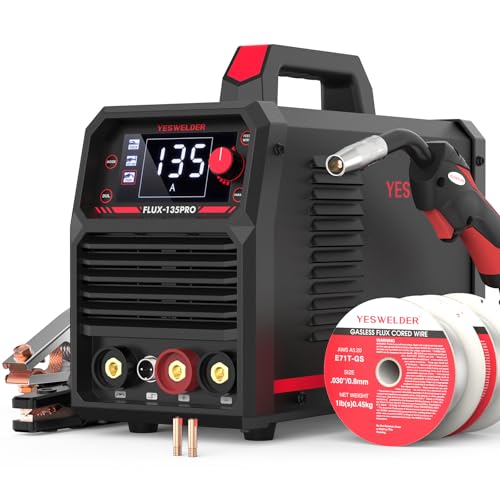
A 135A three-process machine at 11.4 lb, and the one buyers here choose most often by a wide margin.
Best for: mobile repair work on mild steel up to 3/32 in Skip it if: you need 220V input or a published warranty
The FLUX-135PRO wins on the combination nothing else here matches. YESWELDER states 135A output on 110V, a stated capacity of mild steel up to 3/32 in, and a carrying weight of 11.4 lb with a handle. It's the second-lightest machine in this set and it sells substantially faster than the other five, which is a signal worth something when five of six listings are backed by a single seller or two.
The listed model is FLUX-135PRO, the enclosure runs 14.57 x 6.10 x 8.86 in, and the shipping dimensions come in at 7.56 x 17.4 x 13.7 in. Three processes are on board: gasless flux core MIG, stick, and lift TIG. YESWELDER is clear that the lift TIG torch is a separate purchase, which is more honest than some listings here manage.
The synergic control claim matters most to newer welders. YESWELDER says the machine matches recommended voltage to wire feed speed automatically to prevent burn-through. Treat that as the manufacturer's description of the control scheme, not a guarantee on 22-gauge sheet.
The trade-off against the rest of the set is real. This is a 110V-only machine, so the 220V circuit in your shop does nothing for it. No warranty term appears on the listing, and both ARCCAPTAIN picks beat it on published amperage.
Pros:
- 135A output stated on 110V input
- 11.4 lb with an integrated carrying handle
- Three processes including stick and lift TIG
- Sells faster than the other five here
- Flux core wire included per the listing
Cons:
- 110V only, no 220V input
- No warranty term published
- No duty cycle figure stated
- Only one seller lists it
- Lift TIG torch costs extra
2. ARCCAPTAIN 165A MIG Welder — Best upgrade
Four processes, dual voltage, a stated 60% duty cycle and a 2-year warranty, all at 10 lb.

Best for: dual-voltage work with a stated 60% duty cycle Skip it if: you only ever run flux core on 110V
This is the machine I'd point most shop owners toward, and it's a close call for the top slot. ARCCAPTAIN lists 165A maximum output, 110V and 220V input, and a 60% rated duty cycle. It weighs 10 lb, the lightest figure of any machine here that also states a duty cycle, in a 9.7 x 14.9 x 5.3 in case.
Four modes are listed: gas MIG, flux core MIG, lift TIG and MMA stick. The WP-17V TIG torch is a separate purchase, stated plainly. The gas MIG capability is the part worth paying for, because shielding gas gives you cleaner beads with far less spatter than flux core on thin material.
Two more details separate it. ARCCAPTAIN publishes a 2-year manufacturer warranty, and it's the only pick in this set that does. The listing also claims upgraded MCU and IGBT hardware with an improved cooling fan, described as 30% better heat dissipation. That's a manufacturer figure without a stated baseline, so read it as a design intent rather than a measurement.
It is the second-most expensive pick here. If your work is 110V flux core only, that premium buys you capability you'll never switch on.
Pros:
- 165A output with 110V and 220V input
- 60% rated duty cycle claimed
- Only pick here with a published warranty, 2 years
- Lightest in the set at 10 lb
- Four modes including gas MIG
Cons:
- Second-highest price position in this set
- TIG torch sold separately
- Cooling claim given without a baseline
- Sells more slowly than the winner
3. ARCCAPTAIN MIG205MP MIG Welder with Plasma Cutter — Best premium
205A, nine modes and a built-in plasma cutter, in a 46.3 lb body you'll leave on the bench.

Best for: a fixed bench that also needs plasma cutting Skip it if: you carry the machine to jobs
The MIG205MP is the only pick here that cuts as well as welds, and that changes what it replaces. ARCCAPTAIN lists nine modes: gas MIG, gasless MIG, cut, DC HF TIG, DC lift TIG, MMA stick, clean, spot welding and spool gun aluminium. The spool gun is a separate purchase.
The published current ranges are the most detailed in this set. MIG runs 30–205A, DC TIG and MMA run 20–205A, clean runs 20–40A and cut runs 20–50A. Cutting thickness is given as 10 mm quality and 18 mm maximum. Rated duty cycle is 60%, matching the MIG165.
Two features aim squarely at people who already know what they're doing. The listing describes app control with parameter adjustment and real-time monitoring inside a 10-metre range, plus a memory function. It also lists granular MIG parameters: inductance, burn-back and welding speed. Inductance control is the sort of adjustment a beginner never touches and a fabricator uses constantly to tune arc stiffness.
Then the weight. At 46.3 lb it is more than four times the mass of the MIG165, in a 12.7 x 17.3 x 7.88 in case. It's also the most expensive pick here and the slowest seller of the six. No input voltage appears on the listing, which is a strange omission on a machine this capable.
Pros:
- 205A MIG output, the highest here
- Plasma cutting to 10 mm quality, 18 mm maximum
- Inductance and burn-back adjustment listed
- 60% rated duty cycle claimed
- App monitoring within a 10-metre range
Cons:
- 46.3 lb, over four times the MIG165
- Most expensive pick in this set
- Input voltage not stated on the listing
- Spool gun needed for aluminium
- Slowest seller of the six
4. YESWELDER 160A MIG Welder — Best for pros
160A dual voltage with explicit manual control over wire speed and voltage.

Best for: manual voltage and wire speed control at 160A Skip it if: you want a stated machine weight before you buy
The YWM-160 earns its label on one specific line in the listing. YESWELDER states you can adjust wire feed speed and voltage manually to your own preference, and names that mode as suited to seasoned professionals. That's the override the automatic-only machines here don't advertise as clearly.
Output is listed at 160A with 110V and 220V dual input, which puts it second on amperage among the sub-40 lb machines and gives you the 220V option the winner lacks. Four processes are listed: flux core MIG, gas MIG, stick and lift TIG, with the lift TIG torch again a separate purchase. Model is YWM-160. The listed size is 20.79 x 15.43 x 12.01 in, the largest footprint of any machine here apart from the plasma-cutting MIG205MP.
Synergic control is also on board. YESWELDER describes it as switching recommended voltage and wire feed speed when you change thickness or amperage. Having both automatic and manual paths on one dial is the useful part.
The gaps are in the specification sheet rather than the machine. No weight is published, which is awkward for a machine with a footprint this size. No duty cycle appears either, and no warranty term. It sits mid-range on price and sells slowly compared with the two cheapest picks.
Pros:
- 160A with 110V and 220V dual input
- Manual wire feed and voltage adjustment stated
- Four processes including gas MIG
- Synergic mode also available
Cons:
- No published weight figure
- Largest footprint outside the plasma machine
- No duty cycle or warranty stated
- Lift TIG torch sold separately
5. BESTMIG 135A MIG Welder — Best minimal setup
135A and 1/8 in capacity, shipped with a helmet and gloves so nothing else is needed to start.

Best for: a first machine that arrives with a helmet and gloves Skip it if: you weld anything past 1/8 in
BESTMIG's argument is the box, not the machine. The listing includes welding helmets and gloves alongside the ground clamp, electrode holder and torch, and states directly that many competitors leave those out. Nothing else in this set bundles eye protection. For anyone buying a first machine, that removes a purchase you can't safely skip.
The specifications are solid for the second-cheapest pick here. Output is stated as a true current of 135A with capacity up to 1/8 in, which is a slightly thicker figure than the winner's stated 3/32 in. It weighs 10.7 lb in a 6.6 x 14.8 x 9.8 in case. Model is FLUX 135 WELDER. Three processes are listed: flux core MIG, lift TIG and stick. Wire compatibility runs from 0.030 in upward per the listing.
The digital control is described as adjusting parameters automatically from your current setting, which puts it in the same synergic camp as the YESWELDER and Futelo picks.
Where it loses is headroom and information. There's no gas MIG mode, so shielding gas is off the table. Input is 110V only. No duty cycle, no warranty, and 135A is the joint-lowest output here. The listing's own bracketed feature headers lean heavily on marketing language, which makes the genuinely useful bundled-accessory point harder to spot.
Pros:
- Helmet and gloves included, unique in this set
- 135A true current, 1/8 in stated capacity
- 10.7 lb in a compact 6.6 in deep case
- Second-cheapest pick here
Cons:
- No gas MIG mode, flux core only
- 110V input only
- Joint-lowest output at 135A
- No duty cycle or warranty published
6. Futelo 145A MIG Welder — Best budget pick
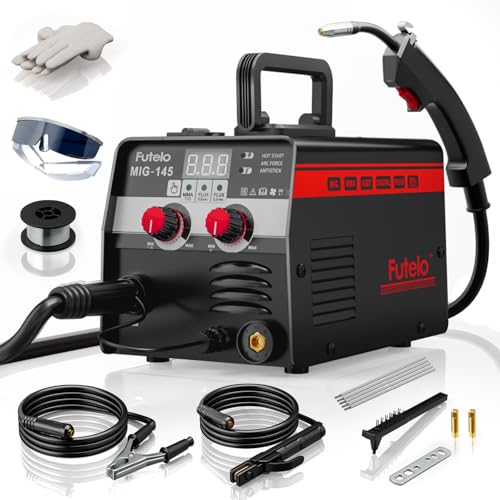
7.5 lb and 30–145A, the lightest machine here and the cheapest of the six.
Best for: occasional garage repairs with one-hand portability Skip it if: you weld for hours at a stretch
The MIG-145 is the smallest and cheapest machine in this comparison, and it doesn't give up much output for it. Futelo lists 145A maximum with a full 30–145A range, which is 10A more than either 135A pick. It weighs 7.5 lb in a 6.3 x 11.2 x 5.9 in case, the smallest footprint of the six by a clear margin. Model is MIG-145.
Three processes are listed: flux core MIG, stick and lift TIG. Synergic control works from wire diameter, either 0.030 in or 0.035 in, or from amperage, with the machine setting voltage and wire speed. The listing also details what's in the box: the welder, a 14AK MIG torch, ground clamp, electrode holder and five 2.5 in welding rods.
That stated 30A floor is worth more than it looks. A low minimum is what lets you tack thin sheet without blowing a hole through it, and it's the only machine here that publishes the bottom of its range.
The compromises follow from the size. It's 110V only, there's no gas MIG mode, no duty cycle figure and no warranty term. A 7.5 lb chassis has very little thermal mass to absorb heat, which makes the absent duty cycle number more of a concern here than on the heavier picks. It's also the slowest-selling of the sub-40 lb machines and only one seller lists it.
Pros:
- 7.5 lb, lightest of the six
- Full 30–145A range published
- Cheapest pick in this set
- Torch, clamp, holder and rods included
Cons:
- 110V only, no gas MIG mode
- No duty cycle stated on a very light chassis
- No warranty term published
- Only one seller lists it
Does 110V or 220V matter more than amps?
Input voltage is the constraint people discover after the box is open. Three of these six are 110V only. Two accept both 110V and 220V. One doesn't publish an input figure at all.
Why it matters more than the headline amp number: a 110V circuit limits what a machine can draw regardless of what the front panel says. A dual-voltage machine plugged into 220V has far more headroom for sustained work at the top of its range. So the practical hierarchy looks like this:
- 110V only, 135–145A: the YESWELDER 135A, BESTMIG 135A and Futelo 145A. Short beads, sheet metal, repairs.
- 110V and 220V, 160–165A: the ARCCAPTAIN MIG165 and YESWELDER 160A. Same portability, better ceiling when a 220V outlet is available.
- 205A, input not stated: the MIG205MP. Highest output and the only cutter, but confirm the plug before you commit shop space to it.
If you rent, or you work out of a truck, the dual-voltage machines still run on 110V. You lose nothing by having the option. The reverse isn't true, and a 110V-only machine is a permanent ceiling.
What the listings don't tell you about duty cycle
Four of these six listings describe protection circuits without publishing the threshold that triggers them. Every one of them mentions over-current, overload and overheating protection. None of the four says how long you can weld first.
That's not necessarily a bad machine. It is a missing number, and for anyone evaluating a professional MIG welding machine it's the number that predicts whether a workday goes smoothly. Physical clues help fill the gap. Mass and enclosure volume correlate with heat capacity, and the 46.3 lb MIG205MP has far more of both than the 7.5 lb Futelo. That's not a measurement, just an observation about where heat has to go.
Two other things the listings leave out across this set:
- Wire spool capacity. No pick states the maximum spool diameter it accepts, which decides whether you can fit a large economical spool or only small ones.
- Torch consumable sizing. Only the Futelo names its torch, a 14AK. Consumable availability matters a lot two years in.
Ask about the spool size before you buy. It's the question that gets skipped most often.
When a different pick wins
Three conditions flip the recommendation away from the winner. Each one is checkable before you spend anything.
- You have a 220V outlet and use it. The ARCCAPTAIN MIG165 takes over. 165A, dual voltage, a 60% duty cycle claim and a 2-year warranty at 10 lb.
- You also cut metal. The MIG205MP replaces two tools. Cutting to 10 mm quality thickness and 205A of MIG output justify the 46.3 lb if the machine never leaves the bench.
- You want to dial in a bead by hand. The YESWELDER 160A states manual wire feed and voltage adjustment for experienced users, alongside dual voltage.
Two more thresholds worth knowing. If your material regularly exceeds 1/8 in, none of the three 110V-only picks is stated to reach it, and the 205A machine becomes the honest answer. And if the machine is a gift or a first purchase for someone with no gear at all, the BESTMIG bundle including a helmet and gloves solves a problem the others don't address.
The verdict
Sort this field by price position and the choice gets clear at each tier.
At the entry end, the Futelo MIG-145 and the BESTMIG FLUX 135 do the same job differently. The Futelo is lighter at 7.5 lb with a wider published 30–145A range. The BESTMIG adds a helmet and gloves and a stated 1/8 in capacity. Neither publishes a duty cycle and both are 110V only, so treat both as short-burst machines for repairs rather than production.
The middle tier is where the winner sits. The YESWELDER FLUX-135PRO takes the best professional MIG welding machine slot on the strength of 135A in an 11.4 lb package that buyers here choose more often than anything else, with three processes and stated capacity to 3/32 in. Its stablemate, the YESWELDER 160A, trades weight information for 160A and dual voltage plus explicit manual control.
At the premium end the split is between portability and capability. The ARCCAPTAIN MIG165 is the smarter buy for most people: 165A, dual voltage, a 60% duty cycle claim, a 2-year warranty and 10 lb. The MIG205MP is the specialist, with 205A and plasma cutting to 10 mm at 46.3 lb.
The cutoff is your outlet. On 110V only, take the FLUX-135PRO. With 220V available, take the MIG165.
FAQ
Is a professional MIG welding machine worth it over a cheaper hobby unit?
A professional MIG welding machine is worth the step up when you need either sustained arc time or a published duty cycle you can plan around. The two ARCCAPTAIN picks here state 60%, meaning six minutes of welding per ten-minute window. If you weld in short bursts on thin steel, the entry picks at 135A and 145A cover it.
Which of these machines gives the most capability per dollar?
The most capability per dollar sits with the ARCCAPTAIN MIG165. It publishes 165A output, 110V and 220V input, a 60% duty cycle, four welding modes and a 2-year manufacturer warranty at just 10 lb. It's the second-most expensive here, but it's the only pick in the set with a stated warranty term, and warranty coverage is what protects the spend.
YESWELDER 135A or ARCCAPTAIN MIG165: which should I buy?
Between the YESWELDER 135A and ARCCAPTAIN MIG165, the deciding factor is your power supply. The YESWELDER is 110V only at 135A and 11.4 lb, and it sells faster than anything else here. The MIG165 adds 220V input, 30A more output, gas MIG, a 60% duty cycle claim and a warranty, at 10 lb. With 220V access, take the ARCCAPTAIN.
What amperage does a professional MIG welding machine actually need?
The amperage a professional MIG welding machine needs depends on material thickness, not job title. The YESWELDER 135A states mild steel to 3/32 in and the BESTMIG states 1/8 in at the same 135A. Past 1/8 in, the 205A MIG205MP is the only pick here with published range to match. Under that, 135A to 165A is ample.
What mistake do first-time MIG buyers make most often?
The mistake first-time MIG buyers make most often is counting modes instead of checking what each mode requires. Five of these six list lift TIG, and every one of those five states the TIG torch is a separate purchase. The MIG205MP's aluminium mode needs a spool gun you don't get. Buy for the process you'll use weekly.
Pick the machine around the outlet you'll actually plug it into, then check whether the mode you care about needs a torch you don't own. Those two questions eliminate most of the regret in this category. For most people the YESWELDER FLUX-135PRO is the right default, and not because it's the cheapest or the most powerful here. It's the one that puts real 135A output and three processes into 11.4 lb, which is the weight where a welder stops living in one corner of the garage and starts going wherever the broken thing is.
Last updated: September 7, 2026. Product availability re-checked.
This page contains affiliate links. As an Amazon Associate we earn from qualifying purchases, at no extra cost to you.