Best Flashlight for Professionals Who Work After Dark
Two of these six are UV inspection tools, three are white-light workhorses, and one is a two-pack you keep in the van. The published specifications sort them faster than the marketing does.
The best flashlight for professionals in this set is the Goreit 365nm UV flashlight, a 1.06 lb inspection light with a filtered 365nm emitter, an LCD charge display and a 2-year manufacturer warranty behind it. If your work needs white light rather than fluorescence, the MagLite ML300L is the better buy at 0.65 lb with a claimed 487 lumens on full power.
Price tiers in this category split along a clean line. The entry picks buy you a small aluminium body, a zoom head and a single-year warranty. The middle buys a rechargeable cell and a power readout. The premium end buys either a specialist wavelength or American manufacturing and a beam you can adjust with one hand. Nothing here buys all three at once.
Best flashlight for professionals at a glance
| Pick | Key spec | Weight | Price |
|---|---|---|---|
| Best overall Goreit 365nm Black Light UV Flashlight |
365nm UV, LCD display | 1.06 lb | Check Price |
| Most versatile MagLite ML300L 2-Cell D LED Flashlight |
487 lumens claim, adjustable focus | 0.65 lb | Check Price |
| Best for heavy use Lepro LED White Light Flashlight |
140 lumens claim, IPX4 | 3.68 oz | Check Price |
| Best for families Lylting Rechargeable LED Flashlight |
IPX7, USB-C, 5 modes | Not listed usefully | Check Price |
| Best premium uvBeast V3 365nm Black Light UV Flashlight |
365nm UV, 60 ft range claim | 0.83 lb | Check Price |
| Best budget pick Victoper LED Flashlight 2 Pack |
2 count, 656 ft beam claim | 5 oz | Check Price |
One note before the picks. Amazon's results for a "professional" search do not filter for trade certification, duty cycle ratings or anything a purchasing manager would recognise as professional grade. Two of these listings use the word themselves in their marketing copy. That's a claim, not a standard, and you'll have to judge whether the specifications match the work you do.
How I screened this field down to six
I started from the published specification sheets rather than the marketing headlines, because the headlines in this category are close to useless. One listing here advertises a lumen figure with five digits. Another gives a weight of 1 g for a light measured in inches. When the numbers on the page contradict each other, the numbers you can cross-check are the only ones worth using.
So the screen ran on four things I could actually read off the listings:
- Wavelength or output, stated with a unit. A "super bright" claim scores nothing.
- Published weight and dimensions, so you can tell a pocket light from a belt light.
- A stated warranty term. Five of six give one, which made it a usable filter.
- Body material and ingress rating, where the listing names them.
That cut the obvious padding: lights whose only distinguishing claim was a number nobody can verify, and lights that published nothing about how they're sealed. What survived splits into two groups that barely compete. Two are 365nm ultraviolet inspection tools. Four are white-light lamps, ranging from 3.68 oz to 1.06 lb.
The set is small on purpose. Six lights that publish comparable figures teach you more than twenty that publish adjectives.
What separates a UV inspection light from a work light?
This is the fork in the road, and getting it wrong is the expensive mistake in this category. A UV flashlight does not help you see. It makes certain substances fluoresce so you can find them, and the wavelength decides whether that works.
Both UV picks here specify 365nm. That matters. Goreit's listing argues that genuine 365nm produces a purer black light than the common 395nm alternative, with less visible purple glare washing out what you're trying to see on currency, ID documents or gemstones. uvBeast makes the same distinction more bluntly, calling 365nm the gold standard and saying its own device runs at a higher flux density than most 365nm units. Both are manufacturer claims. They agree with each other, which is worth something.
Here's the trick with UV: contrast, not glow. Goreit's own listing is refreshingly direct that 365nm light does not make blood glow. It creates high-contrast shadows against the background. If you were sold on a television version of what a black light does, adjust your expectation before you buy.
The four white-light picks answer a different question entirely: how far, how wide, how long. MagLite publishes 487 lumens on full power with 6.5 hours of runtime, dropping to 260 hours in Eco mode. Lepro publishes 140 lumens and a 492 ft beam distance. Those are numbers you can plan a shift around.
Buy the wavelength for inspection. Buy the lumens and runtime for everything else. Buying one when you needed the other is how a light ends up in a drawer.
1. Goreit 365nm Black Light UV Flashlight — Best overall
A filtered 365nm inspection light with a charge readout, which makes it the pick that tells you where you stand mid-job.

Best for: inspection work where a 365nm wavelength and a visible charge readout matter Skip it if: you need white light to see where you're walking
Two things put the Goreit in front. First, it's one of only two picks here using a filtered 365nm emitter rather than the cheaper 395nm wavelength, and Goreit's listing spells out why that matters when you're examining banknotes, licences or stones. Second, and this is the differentiator inside the whole set, it carries an LCD charge display that Goreit rates at ±1%. No other pick here publishes a percentage readout at all.
The body measures 6.38 x 1.69 x 1.26 in and weighs 1.06 lb, making it the heaviest light in this group. That's a belt or bag light, not a pocket light. Goreit claims a 30W four-core UV output, a 2-hour charge and a 10-hour runtime. The 2-year manufacturer warranty ties it with the Lylting for the longest term stated in this set.
The trade-off is narrowness. This does one job. It won't light a stairwell or a crawlspace the way the MagLite will, and against the uvBeast it gives up the long-range claim while asking a mid-tier price. Only one seller lists it, which is worth knowing.
Pros:
- Filtered 365nm rather than cheaper 395nm
- Only pick with a ±1% charge readout
- 2-year manufacturer warranty, longest here alongside one other
- Claimed 2-hour charge to 10-hour runtime
- Manufacturer is candid about what UV can't do
Cons:
- Heaviest pick at 1.06 lb
- No white-light mode, so it can't be your only flashlight
- No published ingress rating
- Single seller on the listing
2. MagLite ML300L 2-Cell D LED Flashlight — Most versatile
The only pick that publishes a full runtime table, and the one I'd choose if I could keep just one light.

Best for: anyone who wants one light that spots, floods and runs on cells from any shop Skip it if: you need something pocketable
MagLite publishes what nobody else here does: a full runtime breakdown across every mode. 487 lumens and 6.5 hours on Full Power, 101 hours on Low, 260 hours on Eco. That's a light you can plan around, whether the job is a two-hour inspection or a three-day outage.
It measures 3 x 8 x 3 in and weighs 0.65 lb, which makes it long but lighter than the Goreit. The head twists to move between spot and flood, so one hand changes the beam while the other stays on the work. The listing names anodized aluminium construction and water resistance, and states the light is designed and made in the USA.
Two caveats. Water resistance is claimed but no ingress figure is published, unlike the Lylting's stated IPX7. And the warranty entry reads simply "manufacturer warranty" with no term attached, which is the vaguest warranty statement in this set.
It sits at the premium end alongside the uvBeast, and against the cheaper Lepro it's bulkier and needs two D cells you supply yourself. What you're buying is beam control and runtime you can actually verify on the page.
Pros:
- Full published runtime table across three modes
- Twist-focus from spot to flood, one-handed
- 487 lumens claimed on full power
- Anodized aluminium body, no charging cable needed
- Lighter than the Goreit at 0.65 lb
Cons:
- 8 in long, so not a pocket light
- Warranty term not specified
- No published ingress rating
- Runs on D cells you have to buy separately
3. Lepro LED White Light Flashlight — Best for heavy use
At 3.68 oz it's the lightest pick here, which is exactly why it gets used instead of left behind.

Best for: a pocket light you'll grab a dozen times a shift Skip it if: you need serious throw or full waterproofing
Weight decides whether a flashlight gets carried, and this one is the lightest in the group by a wide margin. 3.68 oz, 4.29 in long, 1.34 in across. Lepro's listing gives 128 g and a 1.2 in diameter, and calls out that it drops into a pocket without pulling the fabric. It also sells faster than anything else in this set, which tells you something about how many people want a small light rather than a bright one.
The published output is 140 lumens with a 492 ft beam distance, and the head pulls out to zoom between spot and flood. The casing is aluminium, rated IPX4 for water resistance, which means splashes and rain rather than submersion.
Two honest limits. 140 lumens is the lowest published figure in this set, well under the MagLite's 487. And IPX4 is the weakest sealing claim here, against the Lylting's IPX7. The warranty runs one year.
Against the two-pack Victoper it's a single light for a higher price position, and against the MagLite it gives up beam control and runtime. What it wins is the thing spec sheets don't capture: it's small enough that you actually have it on you.
Pros:
- Lightest pick at 3.68 oz
- 4.29 in body fits a shirt pocket
- Pull-head zoom from spot to flood
- Aluminium casing, stated rust and corrosion resistance
- Sells faster than the rest of this set
Cons:
- 140 lumens is the lowest published output here
- IPX4 only, so splash resistant rather than waterproof
- One-year warranty
- No rechargeable cell or charge readout
4. Lylting Rechargeable LED Flashlight — Best for families
The only pick with a published IPX7 rating and USB-C charging, which is the right combination for a light that lives in a drawer.

Best for: a household emergency light with USB-C charging and IPX7 sealing Skip it if: you want consistent published dimensions before you buy
Two specifications make this the emergency-drawer pick. The listing states IPX7 waterproofing, the highest ingress rating anyone here publishes, and a built-in USB-C input port. That combination means it survives a downpour and charges off the same cable as your phone. For a light that has to work on the one night the power fails, both matter more than raw output.
There are five modes: low, medium, high, strobe and SOS. Lylting also states a power display so you can see remaining charge, and describes a long, wide body designed for a full-hand grip. The 2-year warranty matches the Goreit for the longest term here.
Now the honest part. This listing's published measurements contradict themselves, giving a size of 9.64 x 2.36 x 2.36 in alongside dimensions of 0.98 x 3.15 x 0.98 in, and a weight of 1 g that cannot be right for either. The advertised lumen figure is a five-digit number I won't repeat as fact. Treat the numbers on this page with real caution.
It's the slowest seller in this set, and against the MagLite you get no published runtime table.
Pros:
- IPX7, the strongest sealing claim here
- USB-C input, charges off a phone cable
- 2-year warranty
- Five modes including strobe and SOS
- Stated power display
Cons:
- Published dimensions contradict each other
- Stated weight of 1 g is not credible
- Advertised lumen claim is implausible
- Slowest seller of the six
5. uvBeast V3 365nm Black Light UV Flashlight — Best premium
A 365nm inspection light built for range, and the pick to take when you're scanning a wall rather than a document.
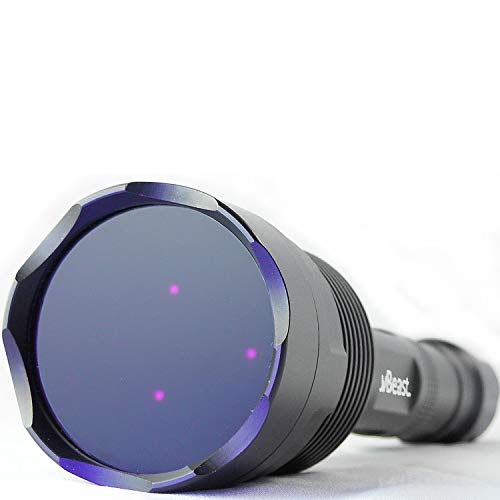
Best for: long-range 365nm UV inspection at distance Skip it if: you want a charge readout or a longer warranty
uvBeast sells one idea and sells it hard: distance. The listing claims a 365nm beam that reaches past 60 feet, and argues that high-intensity 365nm units with that kind of throw are hard to find. It also states a higher UV flux density than most 365nm devices currently sold, and that the company supplies professional users directly. All of that is uvBeast's own account of its product, and it's the most specific range claim any UV listing here makes.
The body is metallic black, 8.66 in long, 0.91 in at its narrowest and 2.17 in wide, at 0.83 lb. That's lighter than the Goreit's 1.06 lb despite being longer. The listing says it's ready to use out of the box.
It's the most expensive pick here, and the specification sheet is thinner than the price position suggests. No LCD readout, no published charge time, no ingress rating, and a one-year warranty against the Goreit's two. If you're inspecting documents at arm's length, that extra range buys you nothing and the Goreit's charge display buys you something real.
Range is the whole argument. Judge whether you need it.
Pros:
- Claimed 365nm beam past 60 feet
- Stated flux density above most 365nm devices
- Lighter than the other UV pick at 0.83 lb
- Filtered 365nm rather than 395nm
- Listed as ready to use out of the box
Cons:
- Most expensive pick here
- One-year warranty, half the Goreit's term
- No charge readout or published charge time
- No published ingress rating
- 8.66 in body, awkward in a tool bag
6. Victoper LED Flashlight 2 Pack — Best budget pick
Two lights for the lowest price position in the set, which solves the real problem of never having one where you need it.

Best for: stocking two vehicles or a toolbox and a nightstand at once Skip it if: you want a single serious light rather than two light ones
This is the only multi-pack here: count of 2, and the cheapest of the six. That changes the maths. Every other pick asks you to choose one location for one light. This one covers two, and the second-place sales position suggests plenty of buyers do exactly that.
Each light measures 5.12 x 0.39 x 1.18 in, and the pair weighs 5 oz combined, so each one is roughly half the Lepro's mass. Victoper claims a beam reaching 656 feet, the longest white-light throw stated in this set, and five modes: low, medium, high, SOS and strobe. The body is described as aircraft-grade alloy with a type 3 hard-anodized anti-abrasive coating.
The gaps are what you'd expect at this price. No ingress figure is published, only a general waterproof claim. No published runtime, no charge readout, no rechargeable cell mentioned. The warranty is one year. And the listing's own framing leans on gifting and camping, which tells you where the design priorities sat.
Two lights that cover the basics beat one light in the wrong room. That's the case.
Pros:
- Only two-pack here, count of 2
- Cheapest pick of the six
- Claimed 656 ft beam, longest white-light throw stated
- Five modes including strobe and SOS
- Type 3 hard-anodized coating claimed
Cons:
- No published ingress rating
- No runtime figures published
- One-year warranty
- Very slim 0.39 in profile may feel insubstantial in a glove
What does more money actually buy here?
Move up the price ladder in this set and you don't get a straight brightness increase. You get specialisation. Here's what each tier actually delivers, based on what the listings publish.
- Entry tier. A small aluminium body, a zoom head, five modes on one of the two, and a one-year warranty. The Victoper adds a second light. The Lepro adds a stated IPX4 rating and the lowest weight here at 3.68 oz. Neither publishes runtime.
- Middle tier. A rechargeable cell and a way to see how much charge is left. The Goreit's ±1% LCD and the Lylting's USB-C port both live here, and both carry 2-year warranties, the longest terms in this set.
- Premium tier. Either a specialist 365nm wavelength with a long-range claim, or American manufacturing with a full published runtime table and twist-focus beam control.
The pattern is worth noticing. The two priciest picks publish fewer verifiable numbers than the two mid-tier ones. uvBeast lists no charge time and no ingress rating. MagLite lists no warranty term. Both make strong qualitative claims instead.
Where I'd spend the extra: on the runtime table. Knowing a light gives 6.5 hours high and 260 hours eco is worth more on a job site than a lumen figure with no duration attached. That's the MagLite's real argument, and it's the one specification in this set that changes how you plan work.
Rechargeable or disposable cells: which suits your day?
This split matters more than most buyers expect, and neither answer is wrong.
Rechargeable suits a routine. The Goreit claims a 2-hour charge to 10 hours of runtime, and the Lylting takes USB-C, meaning the cable already in your bag works. If you finish a shift in the same place every day and there's a socket, this is the easier life. You never buy cells again, and both of these publish a charge indicator so you're not guessing.
Disposable suits unpredictability. The MagLite runs on two D cells, and D cells are stocked in every hardware store, petrol station and supermarket on earth. When you're three hours from anywhere and the light dies, that's the difference between a swap and a wasted evening. The published 260-hour Eco runtime means the swap is rare anyway.
Ask yourself one question: when this light runs flat, where will I be? If the honest answer is "at home or in the van", go rechargeable. If it's "no idea", the cells win.
Two picks here, the Lepro and the Victoper, don't state either way clearly enough for me to call it. Check the listing before you commit if this is your deciding factor.
What the listings do not tell you
Three gaps run through this whole set, and knowing them changes what you trust.
Lumen claims are unregulated. One listing here advertises a five-digit lumen figure on a hand-sized light. Compare that to MagLite's 487 lumens with a stated 6.5-hour runtime and Lepro's 140 lumens, and the pattern is obvious: the specific, modest numbers come with duration attached, and the enormous ones don't. When a listing gives output without runtime, the output figure is decoration.
Ingress ratings are inconsistent. Only two picks publish a code. Lylting states IPX7, Lepro states IPX4, and those are genuinely different capabilities. The other four say "waterproof" or "water-resistant" without a number. That's a claim you can't compare, so treat it as no claim at all.
Warranty wording varies more than warranty length. Two picks state 2 years, three state 1 year, and the MagLite entry says only "manufacturer warranty" with no term. When you're choosing between the best flashlight for professionals at the mid tier and the premium tier, that difference is one of the few things you can actually hold the seller to.
None of these lists a duty cycle, a thermal step-down behaviour, or a replacement-parts path. For genuinely heavy trade use, those absences matter, and none of these six listings closes them.
The verdict
The Goreit 365nm UV flashlight is the winner because it does one job well and tells you where it stands while doing it. A filtered 365nm emitter puts it in the serious inspection category, the ±1% LCD readout is unique in this set, and the 2-year warranty matches the longest term published here. At 1.06 lb it's the heaviest pick, and it will never light your way across a car park. Accept that and it's the most informative tool in the group.
Two conditions flip the recommendation. First, if you need white light at all, the Goreit is the wrong purchase and the MagLite ML300L is the right one. Its published runtime table is the single most useful specification in this set: 487 lumens for 6.5 hours, 101 hours on Low, 260 hours on Eco, plus twist-focus between spot and flood and D cells you can buy anywhere. Second, if your UV work happens at distance rather than arm's length, uvBeast's claimed 60-foot-plus 365nm beam is the specific advantage the Goreit doesn't match, and you pay the highest price in the set for it while giving up the charge readout and half the warranty term.
The MagLite's exact edge over the Goreit is planning. It's the only pick here that lets you know, before the shift starts, how long the light lasts.
FAQ
Is a UV flashlight worth it for professional use?
A UV flashlight is worth it only if fluorescence is part of the job: leak tracing, document checks, gemstone examination, pest work, contamination inspection. Both UV picks here specify 365nm rather than 395nm, which their listings argue reduces visible purple glare. If you just need to see in the dark, this is the wrong tool and a white-light pick serves you better.
What is the best flashlight for professionals on a tight budget?
The best flashlight for professionals on a tight budget here is the Victoper two-pack, the cheapest of the six with a count of 2 and a claimed 656 ft beam. Two lights at one price means one in the van and one in the toolbox. The trade-off is thin documentation: no published runtime, no ingress code, and a one-year warranty.
How do the Goreit and the uvBeast compare on UV performance?
Comparing the Goreit and the uvBeast, both use filtered 365nm rather than 395nm. uvBeast claims a beam reaching past 60 feet and higher flux density than most 365nm devices. Goreit counters with a ±1% LCD charge display, a claimed 2-hour charge to 10-hour runtime, and a 2-year warranty against uvBeast's one. Distance versus information.
Does IPX7 matter more than a higher lumen rating?
Whether IPX7 matters more depends on where you work. Only Lylting publishes IPX7 and only Lepro publishes IPX4 in this set, while the other four state waterproofing without a code. A sealing rating is a standardised, testable figure. Unregulated lumen claims are not. If you work outdoors, I'd take the published rating over the bigger unverified number.
What mistake do buyers make most often in this category?
The mistake buyers make most often is treating output as the deciding specification. A lumen figure with no runtime attached tells you nothing about a shift. MagLite publishes 487 lumens with 6.5 hours on high and 260 hours on Eco, and that pairing is what makes the number usable. Buy the runtime, the weight and the sealing rating instead.
Start by deciding which of the two categories you're actually shopping: fluorescence or illumination. That single choice removes four of these six lights immediately, and it's the choice most people skip. If it's fluorescence, the Goreit's charge readout means you'll never be halfway through an inspection wondering how much light you have left, and that's a small thing that turns out to matter every single time. If it's illumination, the MagLite's D cells and 260-hour Eco mode make it the light you'll still be using in ten years.
Last updated: September 7, 2026. Product availability re-checked.
This page contains affiliate links. As an Amazon Associate we earn from qualifying purchases, at no extra cost to you.