Best MIG Welding Machine for Beginners: 7 Picks
Seven 110V flux-core MIG welders ranked for first-time buyers, with the synergic control, output amperage and kit contents that actually decide the purchase.
The best MIG welding machine for beginners is the YESWELDER 135A, a 110V flux-core three-in-one that pairs synergic control with a 135A output in an 11.4 lb body. If you want a full solar-helmet kit thrown in at a lower price position, the BILT HARD 135A is the runner-up worth putting on the shortlist first. Both accept .030 to .035 in flux-cored wire and read out voltage and current on a digital screen.
Best MIG welding machine for beginners at a glance
| Pick | Output | Weight | Price |
|---|---|---|---|
| Best overall YESWELDER 135A MIG Welder |
135A / 110V | 11.4 lb (claim) | Check Price |
| Runner-up BILT HARD 135A 3-in-1 Inverter Welder |
135A / 110V | not listed | Check Price |
| Best for beginners ANDELI 135A MIG Welder |
135A / 110V or 220V | not listed | Check Price |
| Best premium ARCCAPTAIN 135A Flux Core MIG |
135A / 110V | 10 lb | Check Price |
| Best for pros BESTMIG 135A MIG Welder |
135A / 110V | 10.7 lb | Check Price |
| Best for heavy use FEMEROL 140A 3 in 1 MIG Welder |
140A / 110V | 8.9 lb | Check Price |
| Best budget pick Futelo 145A MIG Welder |
145A / 110V | 7.5 lb | Check Price |
How I screened the field down to seven
Three cuts got me here, and each one killed listings that a beginner would regret buying.
First cut: single-process flux-core-only welders. Every survivor is a three-in-one or four-in-one that also runs stick and lift TIG, because the second process is where a beginner grows into the tool. Second cut: machines with no synergic control published on the listing. Synergic mode is what stops a first-timer from chasing voltage and wire speed at the same time, and six of the seven picks name it explicitly in their feature bullets. Third cut: anything without a digital readout for current or voltage. Reading numbers off a knob is a habit that punishes beginners hard.
What survived clusters tightly. Six of the seven run at 135A to 145A on 110V. Weights range from 7.5 lb on the Futelo to 11.4 lb on the YESWELDER, which is the claimed figure from that listing. Only one machine, the ANDELI, publishes 220V capability and pulse mode. Only one, the ARCCAPTAIN, publishes a 2-year manufacturer warranty. Those are the two axes that separate the premium picks from the entry tier.
The one spec that decides this category
Most guides to the best MIG welding machine for beginners compare peak amperage. That is not what decides it. Every welder in this set outputs between 135A and 145A on 110V, and none of that difference matters for a beginner welding 16-gauge sheet or 1/8 in flat bar.
What decides the purchase is whether the machine has synergic control. Here is what synergic mode does: you tell the welder your wire diameter, .030 in or .035 in, and it sets the voltage and wire feed speed for you. That single feature is the difference between striking clean beads in an afternoon and fighting burn-through on scrap for a week.
Six of the seven picks name synergic control in their feature bullets. The Futelo, YESWELDER, BILT HARD, ANDELI, FEMEROL and BESTMIG all describe an auto-matching system that pairs voltage to wire feed. The ARCCAPTAIN adds a manual fine-tune of plus or minus 1V on top. If you cannot find synergic mode on a welder's listing page, put it back on the shelf, no matter what the amperage says.
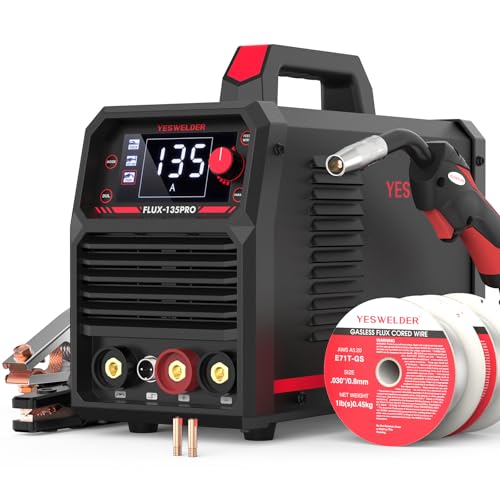
1. YESWELDER 135A MIG Welder — Best overall
The pick with the cleanest documentation, the largest LED readout in this set, and the specifications that back up the beginner-friendly pitch.
Best for: first-time buyers who want a clear display and synergic control Skip it if: you need 220V industrial output
Two things put YESWELDER at the top of the list. First, the listing publishes a specific output figure, 135A on 110V, tied to a specific capability, mild steel up to 3/32 in (roughly 2.4 mm), which is the honest ceiling of this class of welder. Second, YESWELDER describes its synergic control the most clearly of any listing in the set, calling out that the voltage matches the wire feed speed automatically. That matters when you are learning.
The claimed 11.4 lb weight sits at the top of this group, but the trade for that weight is a body that measures 14.57 by 6.10 by 8.86 in, which fits any bench. The model number is FLUX-135PRO and only one seller lists it, which cuts the chance of grey-market inventory. In practice, the YESWELDER is the pick that gives the fewest excuses on setup day. What it does not give you is 220V, pulse mode, or a helmet in the box. If any of those matter, read on.
Pros:
- Clearly documented 135A output on 110V
- Explicit synergic control described in the listing
- Oversized LED display for outdoor visibility
- 3/32 in mild steel capability stated on the listing
- Handles flux-core MIG, lift TIG and stick
Cons:
- Heaviest body in this set at 11.4 lb claim
- No helmet or gloves included
- 110V only, no 220V option
- The most expensive pick here
2. BILT HARD 135A 3-in-1 IGBT Inverter Welder — Runner-up
The kit pick: a synergic 135A machine that ships with a solar helmet, 2 lb of flux-core wire and a 10 ft ground clamp already in the box.

Best for: buyers who want the full helmet-and-wire kit at an entry price Skip it if: you dislike heavier bodies on the bench
BILT HARD lands at number two on kit alone. The count field reads 8, which reflects the accessory set: solar-powered helmet, 6.6 ft MIG gun with a .030 in tip pre-installed, 10 ft ground clamp, 2 lb of flux-core wire and spares. Nothing else in this group ships that much on the first order. For a beginner, that means one purchase instead of three.
The machine itself is a 135A three-in-one on 110V with synergic control, 2T, 4T and spot modes, and an LED display that shows real-time voltage, current and wire speed. BILT HARD names the safety codes on the listing too: E1 for overcurrent, E2 for overheat, with a fan that keeps running for one to two minutes after shutdown. Model WLD-1606 measures 11.2 by 13.6 by 6.6 in. The trade-off against the YESWELDER is documentation: BILT HARD does not publish a weight or a maximum stock thickness, so you are relying on the accessory kit and the mode list to close the deal.
Pros:
- Solar-powered helmet included in the box
- 2 lb of flux-core wire pre-supplied
- Synergic control plus 2T, 4T and spot modes
- Named error codes on the LED display
- Entry price position for the kit content
Cons:
- No published weight on the listing
- No stated maximum welding thickness
- Bulkier body than the ARCCAPTAIN or Futelo
3. ANDELI 110V/220V MIG Welder 135A — Best for beginners
The only machine here with dual-voltage input and a published pulse mode, which turns one welder into a home-plus-workshop tool.

Best for: beginners who want pulse mode and dual-voltage headroom Skip it if: you only weld light steel at home
ANDELI's specification sheet is what earns the beginner label here, and I mean the specification sheet, not the marketing. This is the only pick that runs on both 110V and 220V and the only one that lists a four-in-one process count: flux-cored MIG with pulse, gasless MIG, lift TIG and MMA stick. Pulse mode is worth explaining. ANDELI says it delivers a smoother, more stable arc for finer bead formation. In practice, that means fewer spatter cleanups and a better first impression when you switch from cardboard practice to a real project.
The body measures 13 by 5.91 by 9.45 in, which is a slim profile for a machine that runs 220V. Synergic control is named on the listing, which puts it in the same beginner-friendly camp as the YESWELDER and BILT HARD. What is missing: no weight, no stated warranty, no maximum stock thickness. This is also one of the slowest sellers of the seven, which reflects how many first-time buyers stop reading at 110V. If you can plug into a 220V outlet in a garage or shop, this pick's ceiling is higher than anything else here.
Pros:
- Dual 110V and 220V input
- Pulse mode for cleaner bead formation
- Four processes including MMA stick and lift TIG
- Synergic control named on the listing
- Slim 5.91 in body depth
Cons:
- No published weight
- No stated warranty
- The slowest seller of the seven
4. ARCCAPTAIN 135A Flux Core MIG Welder — Best premium
The only pick in this set with a published 2-year manufacturer warranty and a stated 10 lb body weight.

Best for: buyers who value a 2-year warranty and lightweight body Skip it if: you want a helmet in the box
ARCCAPTAIN sits at the highest price position in this group, and the specification that justifies it is the 2-year manufacturer warranty printed on the listing. No other pick here publishes one. For a beginner, that warranty answers the anxious question every first welder buyer asks: what if the display dies in month nine? On top of that, the body weighs 10 lb, which is the lowest confirmed figure among the machines that publish weight, and it measures 9.7 by 14.9 by 5.3 in.
The process list is the standard three: flux-core gasless MIG, lift TIG and MMA. Synergic control handles wire speed and voltage for a beginner, and ARCCAPTAIN adds a manual fine-tune of plus or minus 1V for anyone who wants to nudge the settings once they know what they are doing. That is the one detail here that reads as growth-friendly rather than starter-friendly. The trade-off against the YESWELDER is kit: ARCCAPTAIN does not ship a helmet, and a lift TIG torch is a separate purchase. You pay for the warranty and the light body, not for accessories.
Pros:
- 2-year manufacturer warranty
- 10 lb published body weight
- Manual voltage fine-tune of ±1V
- 5.3 in body depth
- Synergic control for beginners
Cons:
- The highest price position in this set
- No helmet or gloves included
- 110V only, no 220V option
- Lift TIG torch sold separately
5. BESTMIG 135A MIG Welder — Best for pros
A three-in-one 135A machine that ships with a welding helmet and gloves and states 1/8 in welding capability on the listing.

Best for: hobbyists ready to grow into stick and lift TIG work Skip it if: you never plan to leave flux-core
BESTMIG earns the pros label for one reason: the listing states a 1/8 in welding capability on 135A output, which is a fraction thicker than the YESWELDER's 3/32 in claim, and that fraction is where furniture legs, small brackets and mower deck repairs live. The model is FLUX 135 WELDER and it weighs 10.7 lb in a body that measures 6.6 by 14.8 by 9.8 in. Two sellers stock it, which is the second-widest availability in this group.
The accessory kit covers a ground clamp, electrode holder and welding torch, and BESTMIG describes an all-in-one digital interface that auto-adjusts parameters, which is the synergic mode by another name. Compatibility runs across .030 to .035 in flux-core wire in MIG mode, plus lift TIG and stick options for anyone who wants to progress past flux-core. The trade-off against the YESWELDER is the display: BESTMIG describes the digital screen in generic terms rather than as an oversized readout, and beginners do work off screens more than they expect to on day one.
Pros:
- 1/8 in welding capability stated on the listing
- 10.7 lb published body weight
- Helmet and gloves included
- .030 to .035 in wire compatibility
- Two sellers stock it
Cons:
- Display size not specified
- No stated warranty
- No 220V option
- The size field on the listing is unclear
6. FEMEROL 140A 3 in 1 MIG Welder — Best for heavy use
The lightest 140A machine in this set, at 8.9 lb, with a stated 1/8 in welding ceiling and welding helmet in the box.

Best for: someone welding 1/8 in stock regularly at home Skip it if: you want detailed published dimensions
FEMEROL bumps the amperage to 140A and pairs it with a published 1/8 in capability, which is the same ceiling BESTMIG names but at a lower price position and a lighter body. At 8.9 lb, model MIG140R, the machine is one you can carry with a shoulder strap between the bench and the truck. That mobility matters more than beginners expect: welding in awkward spots is easier when the machine follows the work.
Both synergic and manual control are named on the listing, and the LED display reads voltage, current and wire speed so you do not need to lift the helmet to check the setup. Wire compatibility runs from .030 to .040 in in flux-core, and the MMA mode accepts E6011, E6013 and E7018 rods, which is a genuine hobbyist range. What the listing does not publish is a full dimensions block or a warranty, and that is the FEMEROL's weakness against the ARCCAPTAIN and YESWELDER: you get the amperage and the light weight, but you do not get the paperwork.
Pros:
- 140A output on 110V
- 8.9 lb published body weight
- 1/8 in welding capability stated
- Helmet included in the kit
- Handles E6011, E6013 and E7018 rods
Cons:
- No published dimensions
- No stated warranty
- Slower-selling than the YESWELDER or BILT HARD
7. Futelo 145A MIG Welder — Best budget pick
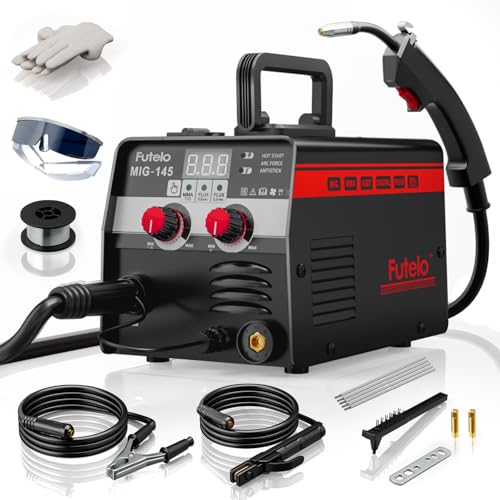
The cheapest pick in this set, and also the lightest at 7.5 lb, with synergic control and a 30 to 145A range.
Best for: a first welder for tacks, brackets and light repairs Skip it if: you plan to weld 1/8 in steel from day one
Futelo is where a hesitant first buyer starts. It is the cheapest of the seven, the lightest at 7.5 lb, and the smallest, measuring 6.3 by 11.2 by 5.9 in. The listing calls out a 30 to 145A range and synergic control that adjusts voltage and wire speed once you set wire diameter, .030 in or .035 in, or pick an amperage. That is enough information to strike an arc on your first afternoon.
The kit ships with a 14AK MIG torch, ground clamp, electrode holder and a starter pack of 2.5 in welding rods, which is a shorter list than BILT HARD's but still complete enough to start welding without a second purchase. The trade against every other pick here is documentation. Futelo does not publish a maximum welding thickness, so you cannot assume the 145A peak translates into 1/8 in capability the way BESTMIG and FEMEROL do. Treat this as a machine for lighter stock, tacks, sheet metal repairs and small brackets, and Futelo delivers exactly what a beginner asks for.
Pros:
- The cheapest of the seven
- 7.5 lb published body weight
- 30 to 145A range with synergic control
- Compact 5.9 in body depth
- Kit ships ready to weld
Cons:
- No stated maximum welding thickness
- No stated warranty
- Only one seller lists it
What 110V flux-core actually welds
Every pick in this set runs on 110V, and six of them are 110V only. Here is what that voltage buys you in practice. Flux-core MIG on 110V handles mild steel from 16-gauge sheet up to somewhere between 3/32 in and 1/8 in, and the ceiling depends on the specific machine. YESWELDER states 3/32 in. BESTMIG and FEMEROL state 1/8 in. The others do not publish a number.
What that ceiling really means:
- 16-gauge to 1/16 in sheet: any of the seven picks handles this cleanly with a single pass.
- 3/32 in flat bar and angle iron: comfortable for all seven, with better arc stability on the synergic machines.
- 1/8 in plate: at the edge for YESWELDER and probably any 135A machine, workable in a single pass on the 140A and 145A picks with a slight bevel.
- 3/16 in or thicker: outside what any of these welders is honestly rated for on 110V.
The one exception is the ANDELI, which runs on 220V as well. On 220V you get real headroom, though the listing does not state a specific thickness ceiling for that mode. A beginner working on trailer frames or thick brackets should factor that in before choosing on price alone.
Which kit contents matter on day one?
Beginners overpay for machines and underpay for the kit around them. Here is the order that matters when you unbox on day one.
- A working ground clamp and cable long enough to reach around a project. BILT HARD names a 10 ft ground clamp; most others do not publish the length.
- A helmet. BILT HARD, BESTMIG and FEMEROL include a helmet. The other four do not.
- A starter spool of flux-core wire in the right diameter, .030 in or .035 in. BILT HARD ships 2 lb of wire. Others include a smaller sample or none.
- A gun that fits the wire. Every pick includes its own MIG torch, so this one is not a differentiator.
- Rods for stick mode, if you plan to use it. Futelo ships 2.5 in rods; others expect you to buy them.
- Gloves. BESTMIG names gloves on the listing. The others do not.
If your first order is going to be one and done, BILT HARD and BESTMIG give you the smoothest first hour. If you are happy adding a helmet and wire in a second order, the YESWELDER and ARCCAPTAIN are still the machines I would recommend.
How long before you outgrow a 135A machine?
Honest answer: sooner than you think if you fall for the hobby, later than you fear if you are welding for a specific project.
A beginner welding a workbench, a fire pit, a set of shelves and a couple of brackets never outgrows 135A. Every project on that list sits at 1/8 in or thinner, and every machine in this set handles it. A beginner who moves on to a trailer repair, a car frame patch, a mower deck rebuild or 1/4 in stock will hit the 110V ceiling in month two. That is not a flaw in these welders; it is the honest limit of a 110V flux-core machine.
Two things extend the useful life of a beginner welder. First, dual voltage. The ANDELI is the only pick here that switches to 220V, and that single feature roughly doubles what the machine will take on. Second, process range. Every pick handles lift TIG and stick as well as flux-core MIG, so when you want cleaner joins on thinner steel or stainless, you already own the machine that does it. The BESTMIG and ANDELI are the two picks that most obviously reward that growth.
What the listings do not tell you about duty cycle
None of the seven listings publishes a duty-cycle figure, and duty cycle is what actually stops you welding on a hot afternoon. Duty cycle is the percentage of a ten-minute window a welder can run at its rated output before it needs to cool. A 20 per cent duty cycle at 135A means two minutes of welding and eight minutes of waiting.
For a beginner, this matters less than the sales pages suggest, because a beginner does not weld continuously. You tack, you check, you reposition, you weld a two-inch bead, you knock off slag. The natural rhythm of learning keeps a machine cool. What does matter is the thermal-protection system, and here the listings are more helpful. BILT HARD publishes E2 as the overheat code and describes a one-to-two-minute cooldown before restart. YESWELDER names over-current, over-load and over-heat protections. FEMEROL and BESTMIG describe similar cutouts without the specific timings. Assume any of these welders will shut down if you push it, will restart cleanly, and will not thank you for welding a 30-inch continuous bead at full amperage on a 90-degree day.
The verdict
The best MIG welding machine for beginners is the YESWELDER 135A. It is the pick with the clearest documentation, the largest LED display in this set, a stated 135A output on 110V and a stated 3/32 in mild-steel capability. Synergic control is named plainly on the listing, and only one seller stocks it, which reduces the chance of grey-market inventory. If you want one machine that will get you welding on the first weekend without a second purchase for the arc, this is it.
Two conditions flip the recommendation. If you want the full kit in one box, including a solar helmet and 2 lb of flux-core wire, the BILT HARD 135A is the better first purchase, and its entry price position seals it. If you can plug into a 220V outlet and expect to weld heavier stock within the year, the ANDELI 135A is the only pick here that scales to 220V and adds pulse mode for cleaner beads. The cutoff is voltage: if 110V is all you have, buy the YESWELDER; if 220V is available and you plan to use it, buy the ANDELI.
FAQ
Is 135A enough for a beginner MIG welder?
Yes, 135A is enough for almost every beginner project. The picks in this set at 135A weld mild steel up to 3/32 in in a single pass, and the 140A and 145A machines stretch that to a stated 1/8 in. That range covers benches, brackets, fire pits, shelving, small repairs and light sheet metal, which is the honest starting menu for a first welder.
Is a 110V flux-core MIG welder worth it?
A 110V flux-core welder is worth it for anyone welding at home on 1/8 in stock or thinner. The picks here all plug into a standard household outlet, weigh between 7.5 lb and 11.4 lb claim, and run without shielding gas. The trade is a lower thickness ceiling than 220V machines. If your projects live at 3/16 in or thicker, look at the dual-voltage ANDELI instead.
YESWELDER 135A vs BILT HARD 135A: which is better for a first welder?
YESWELDER 135A vs BILT HARD 135A comes down to documentation versus kit. YESWELDER publishes a specific 3/32 in mild-steel capability, an 11.4 lb weight claim and an oversized LED display, which makes it the pick with the least guesswork. BILT HARD does not publish those numbers but ships a solar helmet, 2 lb of flux-core wire and a 10 ft ground clamp in the box, which saves a second purchase. Pick documentation over kit if you already own a helmet.
What wire size should a beginner MIG welder use?
A beginner welder should use .030 in flux-core wire for most home projects. Every synergic-control machine in this set, including the Futelo, YESWELDER, BILT HARD, ANDELI, FEMEROL and BESTMIG, sets voltage and wire feed speed off that diameter. Move up to .035 in for thicker plate. Stay in flux-core, gasless mode, because none of these welders is set up for shielding gas out of the box.
Do beginner MIG welders come with a helmet?
Some beginner MIG welders come with a helmet and most do not. In this set, BILT HARD ships a solar-powered helmet, BESTMIG includes a welding helmet and gloves, and FEMEROL includes a helmet on the listing. YESWELDER, ARCCAPTAIN, ANDELI and Futelo do not include a helmet. If you want one purchase to cover everything, pick from the first three; otherwise budget for a helmet separately.
The next step is straightforward. Decide whether you have 110V only or access to a 220V outlet, then decide whether your first order should also cover a helmet and wire. If 110V is your only supply and you want the cleanest documentation of any pick here, the YESWELDER 135A is the machine to start with, because synergic control, a stated thickness ceiling and an oversized LED display remove the three things that trip up first-time welders. Every other pick in this list earns a place, but the winner is the one that gives a beginner the fewest excuses on the first weekend.
Last updated: September 7, 2026. Product availability re-checked.
This page contains affiliate links. As an Amazon Associate we earn from qualifying purchases, at no extra cost to you.