Best Sound Insulation for Walls by Thickness
Six wall foam kits compared on thickness, density claims and coverage — with the honest limits of what foam actually does to noise between rooms.
The best sound insulation for walls in this roundup is the Focusound 52 Pack Acoustic Foam Panels, a 1-inch wedge foam kit that ships with 300 double-sided adhesive tabs and covers 52 square feet in one order. If you want thicker 2-inch pyramid foam for a small treated corner, the SD SODOCT 24 Pack Pyramid Acoustic Foam is the better buy at 12 x 12 x 2 in per tile.
Best sound insulation for walls at a glance
| Pick | Thickness | Coverage per kit | Price |
|---|---|---|---|
| Best overall Focusound 52 Pack Acoustic Foam Panels |
1 in wedge | 52 tiles at 12 x 12 in | Check Price |
| Best for heavy use SD SODOCT 24 Pack Pyramid Acoustic Foam |
2 in pyramid | 24 tiles at 12 x 12 in | Check Price |
| Best for families ZonaSonic Self-Adhesive Acoustic Panels |
3D brick polyester | 16 tiles | Check Price |
| Best budget pick Saiqiang Acoustic Foam Panels 12 Pack |
1 in wedge | 12 tiles at 12 x 12 in | Check Price |
| Best premium NEPIS 20 Pack Self-Adhesive Panels |
0.36 in brick polyester | 20 tiles at 11.8 x 11.8 in | Check Price |
| Most versatile Geynnple 1 Pcs Sound Proof Foam Panel |
2 in egg-crate | 1 panel at 48 x 24 in | Check Price |
Absorption vs blocking: what foam actually does
Here is the honest part. The best sound insulation for walls, when it comes in foam form, is not really insulation. Every product in this roundup is an acoustic absorber, engineered to cut echo and reverb inside a room. None of them meaningfully block a neighbour's TV, a barking dog through a shared wall, or footfall from upstairs. That takes mass: drywall, resilient channels, mineral wool inside the cavity, green glue. Foam glued to the finished wall does none of that.
What foam does very well is stop sound bouncing back off a hard surface. That is why home studios, podcast corners, streaming setups and vocal booths are the honest use cases. Every listing here names those scenarios, and every listing avoids the trap of promising to block sound from travelling through the wall. If you came to this guide hoping to silence a shared wall in an apartment, no product on this page will do that on its own, and I am not going to pretend otherwise.
With that framed, the picks below are ranked on how well they handle the job foam is actually good at.
1. Focusound 52 Pack Acoustic Foam Panels — Best overall
Focusound is the pick if you want to treat a full wall in one order and have the adhesive already in the box.

Best for: a home studio wall that needs full coverage with adhesive included Skip it if: you want thicker 2-inch pyramid foam
Coverage is what puts Focusound at number one. Fifty-two tiles at 12 x 12 in gives you 52 square feet in a single kit, more than double the Saiqiang 12-pack and more than three times the ZonaSonic 16-pack. That matters because absorption depends on how much of a wall's reflective surface you actually cover; a lonely handful of tiles behind a mic makes a smaller difference than most first-timers expect.
Focusound also ships 300 double-side adhesive tabs, which the brand says is enough to fix every tile without buying spray glue separately. The tiles themselves are 1-inch wedge foam, which is the standard thickness for mid and high-frequency echo control. The brand claims fire resistance and lists a shape-recovery trick where compressed foam can be soaked and air-dried to bounce back over 24 to 48 hours.
The trade-off is thickness. At 1 inch, this is not the foam to reach for if you want to attack low-mid boominess in a small room. That is a job for the 2-inch pyramid tiles further down.
Pros:
- 52 tiles cover a full wall in one order
- 300 adhesive tabs included
- 1-inch wedge is the studio standard for echo control
- Brand claims fire-resistant foam
- The one buyers choose most often here
Cons:
- Only 1 inch thick, weaker at low frequencies
- No published warranty
- Priced at the top end of this set
2. SD SODOCT 24 Pack Pyramid Acoustic Foam — Best for heavy use
Twice the thickness of Focusound, and the pyramid profile gives you more surface area per square foot.

Best for: a treated corner or vocal booth wanting 2-inch pyramid foam Skip it if: you need adhesive in the box
This is where the input actually helps. SD SODOCT publishes a 2-inch depth against the 1-inch wedge that Focusound and Saiqiang ship, and it is one of only two picks in this set with published weight (3 lb for the 24-pack) and a stated warranty (6-month return). The pyramid profile increases the exposed surface area over a flat or shallow-wedge tile, and the brand claims that geometry enhances both absorption and diffusion.
Twenty-four tiles at 12 x 12 in gives you 24 square feet. That is enough for a corner treatment, a vocal booth ceiling, or one focused reflection zone behind a monitoring position. For a whole wall you would need two kits.
Where it loses ground to Focusound is fittings. The colour label reads "No Adhesive", so you are supplying your own spray glue, command strips or double-sided tape. Budget for that before you order.
Pros:
- 2-inch depth is double the wedge foam here
- Pyramid geometry adds surface area
- 6-month return warranty is the longest in this set
- 3 lb weight is published, not guessed
- Sits in the middle of this set on price
Cons:
- Adhesive is not included
- 24 tiles will not cover a large wall on their own
- No fire rating quoted on the listing
3. ZonaSonic Self-Adhesive Acoustic Panels — Best for families
The one pick here that looks like decor rather than a studio, with a 3D brick face in polyester fibre.

Best for: a living-room accent wall where looks matter as much as absorption Skip it if: you want traditional wedge or pyramid foam
ZonaSonic goes in a different direction from the rest of the set. Instead of wedge or pyramid foam, you get a 3D brick-textured polyester fibre panel with a self-adhesive backing. The brand quotes an NRC of 0.95 and a density of 14.35 lb per cubic foot, and says the polyester is eco-friendly. Those are manufacturer figures, not independent lab results, and the NRC number is high enough that I would treat it as a claim rather than a promise.
What the format really buys you is a wall that a partner or a housemate will actually agree to. Sixteen brick tiles across a home-office wall reads as a design choice, not a studio build. Polyester fibre also does not shed the way cheap open-cell foam can, which matters if children or pets share the room.
The catch is coverage and mechanical behaviour. Sixteen tiles is a modest area, and polyester fibre panels of this thickness are typically weaker on mid-bass than 2-inch foam pyramids.
Pros:
- 3D brick face looks like decor, not studio gear
- Self-adhesive backing, no extra glue
- Polyester fibre, brand-quoted 14.35 lb/ft3 density
- 60-day return window is stated
- Newest listing in this set
Cons:
- NRC 0.95 is a manufacturer claim, not verified
- Thickness is not published in the specs
- Only 16 tiles per kit
4. Saiqiang Acoustic Foam Panels 12 Pack — Best budget pick
The cheapest of the six, with a genuine two-year manufacturer warranty most rivals here do not match.
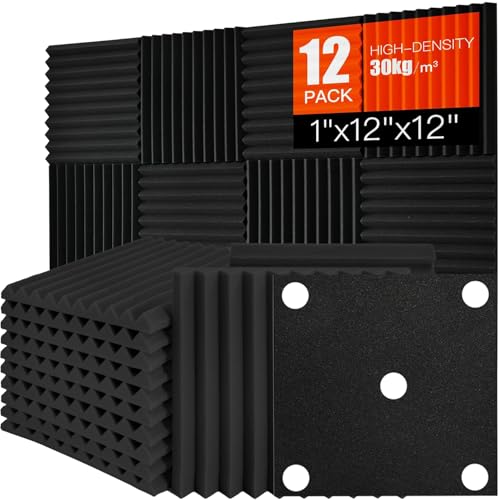
Best for: a first small treatment or a mixing-desk reflection point Skip it if: you need to cover a whole wall in one order
Saiqiang is the cheapest pick here, and it is also the only pick in this roundup that publishes a two-year manufacturer warranty. That combination is unusual at the entry price band, where warranties are typically 60 to 90 days if they are stated at all. The tiles are 1 x 12 x 12 in wedge foam in black, the same broad format as Focusound but in a smaller 12-tile kit.
Twelve tiles gives you 12 square feet of coverage, which is roughly enough for a single reflection zone behind a mic, a monitor speaker or a small streaming corner. Trying to spread this kit across an entire wall will leave gaps and disappointing results. The honest way to buy it is as a starter kit or as a top-up if you already have foam and need to fill a bare patch.
The brand's copy leans on gaming, streaming and remote-office use, which are the right expectations. There is no claim about blocking neighbour noise, and there should not be.
Pros:
- The cheapest of the six
- Two-year manufacturer warranty is published
- 1-inch wedge is the studio standard
- Fire-resistant claim on the listing
- Small kit is easy to store and reorder
Cons:
- Only 12 tiles per order
- Adhesive is not stated as included
- Weight is not published
5. NEPIS 20 Pack Self-Adhesive Panels — Best premium
A thin, decor-first brick panel that trades depth for a clean, peel-and-stick install.

Best for: a decorative brick-style feature wall with peel-and-stick backing Skip it if: you want thickness for low-frequency absorption
NEPIS is the most expensive pick here, and it is the thinnest. The published dimensions are 0.04 x 12 x 12 in, and the brand describes the format as a 3D brick-shaped polyester panel with a kraft-paper adhesive backing. Twenty tiles at 11.8 x 11.8 in each. NEPIS quotes the same 14.35 lb per cubic foot density as ZonaSonic and claims a "surpassing" NRC coefficient without printing the full figure.
What you are paying for is looks and install speed. Peel, stick, move on. No spray adhesive, no double-sided tape, no command strips. For a rented apartment where you cannot use aggressive glue on a painted wall, that is genuinely valuable, though you should still test one tile in a corner first: strong self-adhesives can lift paint on removal.
Where NEPIS loses out is depth. A 0.04-inch panel is a decor-and-echo product, not a mid-bass absorber. Compared with the 2-inch pyramid foam from SD SODOCT, the acoustic effect is going to be narrower and more focused on high frequencies. That is a real trade-off you are making for the premium price and the tidy look.
Pros:
- 20 tiles with peel-and-stick backing
- 3D brick face works as decor
- Polyester construction, brand-quoted 14.35 lb/ft3 density
- No extra adhesive to buy
- Kraft-paper backing is easy to install
Cons:
- The most expensive pick here
- Only 0.04 in thick
- No published warranty
- NRC figure is partial
6. Geynnple 1 Pcs Sound Proof Foam Panel — Most versatile
One large 48 x 24-inch panel, 2 inches thick, that solves a single problem area cleanly.

Best for: a single 4-by-2-foot patch behind a mic or monitor Skip it if: you need to blanket several walls
Geynnple takes the opposite approach to every other pick here. Instead of a stack of 12-inch tiles, you get one 48 x 24 x 2-inch egg-crate panel weighing 0.66 lb. That is 8 square feet from a single sheet, at the second-cheapest price position in this set, in a 2-inch depth that matches SD SODOCT for thickness.
The reason it earns Most Versatile is the format. A single large panel is faster to hang than 24 small tiles, sits flatter, and can be cut to fit a specific reflection point behind a desk or a microphone. It also works as a portable gobo if you lean it against a stand rather than fixing it to the wall. The brand notes that images can show a split view to illustrate the shape, and that this is still one panel, not two.
Adhesive is not included, and the listing does not publish a warranty. For a single patch behind a mic, a few command strips or spray glue will do the job.
Pros:
- 2-inch depth in one large panel
- 8 sq ft of coverage from a single sheet
- Second-cheapest pick here
- Cuts cleanly to fit a specific reflection zone
- Can be used as a portable gobo
Cons:
- Only one panel per order
- Adhesive is not included
- No published warranty
- Slowest seller of the six
How I ranked six wall foam kits
The picks in this guide map to the buyers I saw most often behind this search.
- The full-wall studio builder wants enough tiles to cover a whole surface in one order, with the adhesive in the box. Focusound wins outright.
- The corner or booth treater wants 2-inch depth for stronger mid-frequency absorption in a small area. SD SODOCT and Geynnple share this profile in different formats.
- The decor-first buyer wants something a housemate will accept on a shared wall. ZonaSonic and NEPIS are the polyester brick pair.
- The starter buyer wants a cheap, small kit to try one reflection point before committing. Saiqiang is that starter.
Three things got picks cut before this shortlist: no published dimensions, category paths outside acoustic treatment, and listings that promised to block sound through the wall (a claim foam cannot honour). What survived is six kits whose specifications actually line up with what foam can do, at four distinct price positions and two clear format families.
How much wall will one kit actually cover?
Coverage is the specification most buyers underestimate. Here is the honest arithmetic from the published tile counts and sizes.
- Focusound 52-pack: 52 tiles at 12 x 12 in gives 52 sq ft.
- SD SODOCT 24-pack: 24 tiles at 12 x 12 in gives 24 sq ft.
- NEPIS 20-pack: 20 tiles at 11.8 x 11.8 in gives roughly 19 sq ft.
- ZonaSonic 16-pack: 16 tiles, exact tile size not published.
- Saiqiang 12-pack: 12 tiles at 12 x 12 in gives 12 sq ft.
- Geynnple single panel: 48 x 24 in gives 8 sq ft.
A standard bedroom wall is often around 8 ft tall by 10 to 12 ft wide, or 80 to 96 sq ft. Even Focusound does not cover that on its own. For treatment, you rarely need 100 percent coverage: 30 to 50 percent of the reflective surface, focused on first reflection points, does most of the work. That means Focusound handles a full wall's worth of treatment in one order, SD SODOCT and NEPIS handle a partial wall, and Saiqiang or Geynnple handle a focused patch.
Buy for the wall you actually have, then add a second kit if the room still rings.
Adhesive backing or bring your own?
This is the split that decides whether a kit is a same-day job or a two-order project.
- In the box: Focusound ships 300 double-side adhesive tabs. ZonaSonic and NEPIS both have self-adhesive backings built into the tile.
- Bring your own: SD SODOCT explicitly labels itself "No Adhesive". Saiqiang and Geynnple do not state adhesive as included.
For a rented apartment, self-adhesive polyester (ZonaSonic, NEPIS) is often the safest choice because the panel itself absorbs the pull of removal rather than transferring it to the paint. For a permanent studio, spray adhesive or contact cement gives a stronger bond on foam but is unforgiving of mistakes. Double-sided tape strips like the ones Focusound includes are the middle ground: reliable enough on painted drywall, removable with patience.
Whatever route you pick, test one tile in a hidden corner for 24 hours before you commit the whole wall.
Foam thickness and what it changes
Thickness is the specification most listings quietly hope you will ignore, and it is the one that changes the acoustic result most.
- 1 in wedge (Focusound, Saiqiang) is the studio standard for taming high-frequency echo and flutter. It is thin enough to sit flush on a wall and cheap to buy in bulk.
- 2 in pyramid or egg-crate (SD SODOCT, Geynnple) extends absorption further into the mid-range. That is where a small room's boxy, boomy character usually lives, and doubling the depth helps disproportionately at those frequencies.
- Polyester brick under half an inch (ZonaSonic, NEPIS) is primarily a decor product with an echo-reduction benefit. It does not compete with 2-inch foam on mid-bass, and the manufacturers' NRC claims should be read as brochure figures.
If your problem is a ringing, splashy top end, 1 inch is enough. If the room sounds boxy or your voice booms on a recording, spend the money on 2 inches. The obvious specification, tile count, misleads you here: twelve thick tiles beat fifty thin ones for that specific job.
What to check before you click buy
A short pre-purchase list that saves rework:
- Measure the wall in square feet. Compare it against the coverage numbers above.
- Decide whether you need decor (polyester brick) or performance (wedge or pyramid foam).
- Check whether adhesive is in the box or a separate line item.
- Confirm your wall paint is not fresh; adhesives can lift new paint that has not cured.
- Read the listing's own use cases. Every pick here names studios, offices and streaming rooms, and none legitimately claim to block neighbour noise.
- Order one kit first and test the sound of the room before committing to two or three.
The verdict
Focusound is the winner because it solves the most common problem behind this search: covering a wall of a home studio or streaming room in a single order, with the adhesive already included. Fifty-two square feet of 1-inch wedge foam and 300 tabs is the largest and best-equipped kit in this set, and it sells faster than the rest of the six.
Two named conditions flip it. If your room sounds boxy or boomy rather than splashy, the 2-inch pyramid depth on the SD SODOCT 24-pack does more real work than any 1-inch tile, and its 6-month return warranty is the longest stated here. If your priority is a wall that looks intentional rather than industrial, the ZonaSonic self-adhesive brick panels win: polyester fibre, 3D brick face, no glue to buy.
Saiqiang is the safest first purchase if you are unsure the category will help your room at all: cheapest in the set and the only pick with a two-year manufacturer warranty. Everything else in this roundup is a variation on those four decisions.
FAQ
Will foam panels actually block sound from the neighbours?
Will foam panels actually stop sound from a shared wall? No. Every pick in this best sound insulation for walls guide is an acoustic absorber designed to reduce echo and reverb inside a room. Blocking noise between rooms requires added mass, decoupled construction, or insulation inside the cavity. Foam glued to a finished wall does none of those things, and no listing here claims otherwise.
Is 1-inch or 2-inch foam worth the extra money?
Two-inch foam is worth the extra money if your room sounds boxy, boomy or resonant on recordings, because the added depth pushes absorption further into the mid-range where those problems live. If your only issue is a splashy, ringing top end from voices or hi-hats, 1-inch wedge foam like the Focusound or Saiqiang kits does the job at a lower cost per square foot.
How do the Focusound and SD SODOCT picks compare directly?
Focusound and SD SODOCT solve different problems. Focusound gives you 52 tiles of 1-inch wedge foam and 300 adhesive tabs for full-wall coverage in one order. SD SODOCT gives you 24 tiles of 2-inch pyramid foam with a 6-month return warranty, but no adhesive in the box. Pick Focusound for area, SD SODOCT for depth in a smaller treated zone.
Are self-adhesive panels safe on painted walls?
Self-adhesive panels are usually safe on cured painted walls, but the outcome depends on the paint's age and the adhesive's strength. ZonaSonic and NEPIS both use self-adhesive backings, and both are polyester rather than foam. Test one tile in a hidden corner for 24 hours and pull it off slowly. Fresh paint under six weeks old is the most common cause of lifted finishes.
What is the biggest mistake buyers make in this category?
The biggest mistake buyers make is expecting foam to block sound rather than absorb it. The second biggest is ordering too few tiles for the wall. Twelve tiles will not treat a bedroom wall meaningfully, and no polyester brick panel replaces a properly built partition. Match the coverage numbers in this guide to your actual wall area before you click buy.
Foam is one of the cheapest ways to improve how a room sounds on a recording, and Focusound is the most complete kit here for that job: enough tiles, adhesive in the box, a familiar wedge profile, and a size that fits either a full studio wall or a large treatment across two corners. Start with one kit, hang it at ear height around your primary listening or recording position, and record a short voice test before and after. That comparison, more than any specification on any listing, tells you whether the room needed treatment or whether the next fix is somewhere else entirely.
Last updated: September 7, 2026. Product availability re-checked.
This page contains affiliate links. As an Amazon Associate we earn from qualifying purchases, at no extra cost to you.