Best Solar Panel Charger for Biking: Pack Light
Seven solar chargers ranked for cyclists who care about weight, USB output and whether the panel actually straps to a pannier without a bracket.
The best solar panel charger for biking is the TangoSun 25W, because at 0.66 lb and 0.98 x 17.3 x 8.3 in folded, it is the only pick in this set light enough to strap to a pannier without a bracket. The BigBlue 28W takes over if you charge a phone, a GPS and a power bank on the same day, since its three USB ports push 5V/4.8A collectively.
How I cut the field down to seven
I started with weight and output type, because those are the only two facts that matter to a cyclist. A 3 lb rigid panel with alligator clips is a garage tool. A 0.66 lb folding panel with USB-C is trail gear. Both call themselves a solar panel charger, and both show up under the same searches.
The criteria I weighted, in order:
- Weight and folded size. Anything over 2 lb is off the bike.
- Output type. USB for on-bike charging, 12V DC for battery maintenance at home.
- Weather rating. IP67 beats IP44 beats no rating, and cyclists get rained on.
- Conversion efficiency. Claimed figures, not measured, but comparable across the set.
- Mounting hardware. Carabiners strap to a pack; alligator clips do not.
Three of the seven picks are 12V trickle kits, not USB chargers. I kept them in the roundup because the best solar panel charger for biking, for many riders, is the one that lives on the garage window sill and keeps the e-bike battery healthy through winter. The other four are true portable USB panels that ride with you.
Nothing was cut for popularity. Two of the picks are the ones buyers choose most often in this set, and one is the slowest seller of the seven. Rank did not decide the labels.
Best solar panel charger for biking at a glance
| Pick | Weight | Output | Price |
|---|---|---|---|
| Best overall TangoSun 25W Solar Panel Charger |
0.66 lb | USB-C + USB-A, 5V/3A each | Check Price |
| Best for heavy use BigBlue 28W High-Efficiency Solar Panel Charger |
1.48 lb | Dual USB-C + USB-A, 5V/4.8A total | Check Price |
| Best compact FlexSolar 40W Foldable Solar Panel Charger |
not listed | QC3.0 USB-A + PD2.0 USB-C, 18W each claim | Check Price |
| Best for beginners Voltset 20W 12V Solar Panel Battery Charger |
4 lb | 12V DC for battery kit | Check Price |
| Best premium SOLPERK 20W 12V Solar Battery Charger Kit |
3 lb | 12V DC with 8A controller | Check Price |
| Best for families SUNER POWER 12W 12V Solar Battery Charger Pro |
not listed | 12V DC with MPPT | Check Price |
| Best budget pick SUNAPEX 12V Solar Battery Charger Kit |
1.2 lb | 12V DC, 1.8W | Check Price |
The weight problem no listing spells out
Every listing here quotes wattage. Only some quote weight, and none quote the number that actually matters to a cyclist: watts per pound. That gap is where buyers overpay.
Here is the math this set supports. TangoSun's 25W panel weighs 0.66 lb, so you carry roughly 38W for every pound in the pack. BigBlue's 28W weighs 1.48 lb, roughly 19W per pound. SOLPERK's 20W kit weighs 3 lb, roughly 7W per pound. Voltset's 20W kit is 4 lb, or 5W per pound. Two of the three lightest picks are the ones that make sense on a bike, and the heaviest two are the ones that make sense in a garage.
If a listing tells you the wattage but not the weight, treat that as a red flag on any panel you would carry. Wattage is what the marketing team knows; weight is what your shoulders know.
USB output or 12V kit: which one do you actually need?
Four of these picks charge USB devices directly. Three are 12V trickle kits that connect to a battery, not to a phone. The distinction is not obvious from the product titles, and getting it wrong is the single most expensive mistake in this category.
- Choose USB output if you want to charge a phone, GPS head unit, action camera, headlamp or power bank while you ride or at camp. That is TangoSun, BigBlue, FlexSolar.
- Choose a 12V kit if you want to maintain an e-bike battery, motorcycle battery, RV house battery or car battery through the winter. That is SOLPERK, Voltset, SUNER POWER, SUNAPEX.
A 12V trickle kit will not charge a phone through its alligator clips. A USB panel will not maintain a 12V battery through a bare cable. This is not a case where the more expensive pick does both. The best solar panel charger for biking, for most cyclists, is the USB one; the 12V kits earn their place for e-bike owners who want their battery ready in April.
1. TangoSun 25W Solar Panel Charger — Best overall
The lightest pick here by a wide margin, and the only one that folds to under an inch thick without needing a rigid frame.

Best for: cyclists who strap a panel to a pannier or handlebar bag Skip it if: you need a 12V trickle charger for a vehicle battery
At 0.66 lb, the TangoSun is less than half the weight of the next-lightest USB panel in this set, and roughly one-sixth the weight of the Voltset 20W kit. The folded dimensions of 0.98 x 17.3 x 8.3 in mean it slides flat against the back panel of a pannier or into the map pocket of a bar bag. TangoSun claims a 25% conversion rate from HPBC cells and lists USB-C and USB-A outputs at 5V/3A each, so it will charge a phone and a head unit at the same time. The listing rates it IP67 and includes two carabiners, which is what you actually clip to a bike, unlike the mounting bracket that ships with the rigid kits. TangoSun publishes a 12-month warranty, which is more than BigBlue's listing offers. Against the rest of the set it trades peak wattage for pack weight, and that is the right trade for a cyclist.
Pros:
- Lightest pick in the set at 0.66 lb
- Folds under an inch thick
- USB-C and USB-A at 5V/3A each
- IP67 rating and ETFE coating
- 12-month warranty published
Cons:
- Slowest seller of the seven here
- Lower output than the 28W and 40W panels
- Carabiners only, no adjustable stand
2. BigBlue 28W High-Efficiency Solar Panel Charger — Best for heavy use
Three USB ports and 5V/4.8A total output, which is more current than any other USB pick here.

Best for: riders charging a phone, GPS and power bank on the same day Skip it if: you count every ounce on a road bike
The BigBlue's advantage over the TangoSun is the third port and the higher combined current. Dual USB-C and one USB-A, each rated 5V/3A, add up to a claimed 5V/4.8A collectively. That matters if you finish a day with three flat devices and one hour of usable sun. BigBlue lists a 28W panel, 25.4% conversion efficiency, and IP44 weather resistance, which is a step below the IP67 rating on the TangoSun and FlexSolar. It weighs 1.48 lb and folds to 1.34 x 11.1 x 6.3 in, so the folded footprint is smaller than the TangoSun even though the panel is heavier. This is the pick for a bikepacker with a full electronics kit rather than a commuter with a phone. Its trade against the TangoSun is weight; against the FlexSolar, it is watts. No warranty is published on the listing, which is the one column where it lags the rest.
Pros:
- Three USB ports, most in this set
- 5V/4.8A total collective output claim
- 25.4% conversion efficiency claim
- Compact folded footprint at 11.1 x 6.3 in
- Shadow-free surface design
Cons:
- IP44 rating below the IP67 picks
- More than twice the weight of the TangoSun
- No warranty published on the listing
3. FlexSolar 40W Foldable Solar Panel Charger — Best compact
The highest wattage in this set, in a strip that unfolds to 48.8 in and stows to a tenth of an inch thick.

Best for: bikepackers who want the most watts in a folded strip Skip it if: you have no room for a 48.8 in unfolded panel
FlexSolar quotes 40W, which is the highest peak output of any pick here. The listing describes QC3.0 USB-A and PD2.0 USB-C ports rated 18W each and a DC output for compatible power stations. Unfolded, the panel is 0.1 x 48.8 x 11 in, so it is the length of two panniers laid end to end. Folded, it stows to a strip that fits against a frame bag or a rack pad. FlexSolar claims 24% conversion and an IP67 rating, and includes two carabiners. Weight is not listed, which is the missing figure a bike buyer wants most, so treat this as the pick to compare in person against the TangoSun if you can. Against the BigBlue, its DC output opens up power-station charging that USB-only panels cannot match; against the TangoSun, it trades folded portability for peak wattage.
Pros:
- 40W peak, highest in this set
- USB-C PD, USB-A QC3.0 and DC outputs
- IP67 rating and 24% conversion claim
- Folds to 0.1 in thick
- Two carabiners included
Cons:
- Weight not listed
- 48.8 in unfolded length is awkward on a small bike
- No warranty published on the listing
4. Voltset 20W 12V Solar Panel Battery Charger — Best for beginners
A published 1-year warranty and IP67 construction on a 20W kit designed to keep a 12V battery healthy year-round.
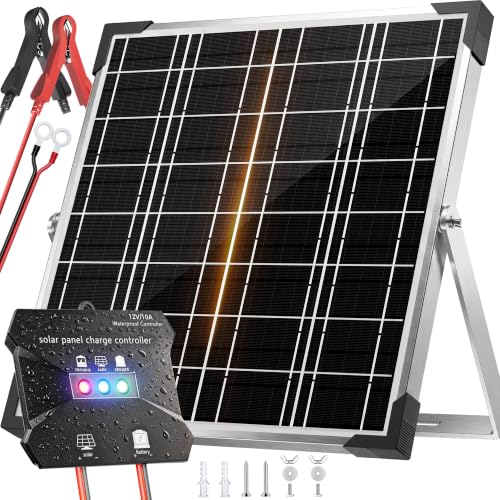
Best for: e-bike owners maintaining a 12V accessory battery at home Skip it if: you want to charge USB devices directly on the trail
The Voltset is the friendliest of the 12V kits for someone who has not wired a solar charger before. The listing describes pre-drilled mounting holes for a 30-second setup, an MPPT controller with overcharge, over-discharge, short-circuit and reverse-polarity protection, and compatibility with LiFePO4, AGM, Gel, Flooded and Lithium Ion chemistries. Voltset rates it IP67 and quotes an operating range from -40°F to 185°F, which is broader than the other 12V picks specify. The kit weighs 4 lb and measures 1.69 x 15 x 13.6 in, so it lives on a garage window or a shed roof, not a pannier. What it gives up against the SOLPERK is a lower price position and a smaller controller amperage, but the published 1-year warranty is the only one in the 12V group. If you are storing an e-bike over winter, that peace of mind matters more than a few dollars.
Pros:
- 1-year warranty, only 12V pick that publishes one
- IP67 rating with -40°F to 185°F range claim
- Compatible with five battery chemistries
- Overcharge, reverse-polarity and short-circuit protection
- Pre-drilled mounting holes
Cons:
- 4 lb, too heavy for the bike itself
- 12V only, no USB output
- The one seller here that lists it
5. SOLPERK Solar Panel Kit 20W 12V Solar Battery Charger — Best premium
An 8A MPPT controller and a 360-degree adjustable mounting bracket, in a kit that ships with six matching pieces.

Best for: riders with a fixed base camp and a 12V battery bank Skip it if: weight or portability matters at all
SOLPERK's kit is the one buyers choose most often in this set, and the specifications explain why for its intended use. The 8A controller is larger than the controllers described on the Voltset and SUNAPEX kits, which SOLPERK claims delivers 20-30% higher charging efficiency. The mounting bracket is 360-degree adjustable, which matters if the panel sits on an RV roof or a shed that faces the wrong compass point. SOLPERK claims 21-30% cell efficiency, low-iron tempered glass, and a 25-year design life on the panel itself. It weighs 3 lb and measures 0.7 x 15 x 13.2 in, so it is lighter than the Voltset but still not something you strap to a bike. Six pieces ship in the box, which is the highest count in this set. Its weakness against Voltset is that no warranty is published on this listing, so the 25-year life claim is a design figure, not a guarantee.
Pros:
- 8A controller, larger than other 12V kits here
- 360-degree adjustable bracket included
- 21-30% cell efficiency claim
- Low-iron tempered glass panel
- Six-piece kit with alligator clips and hardware
Cons:
- No warranty published on the listing
- 3 lb, still too heavy for on-bike carry
- 12V only, no USB output
6. SUNER POWER Waterproof 12W 12V Solar Battery Charger Pro — Best for families
Ultra-Smart MPPT with a three-stage charging algorithm and eight named protection modes.

Best for: households running an e-bike battery tender in the garage Skip it if: you want a charger to carry on the bike itself
The SUNER POWER is the most expensive pick here, and the listing puts that price into its controller. SUNER POWER describes an Ultra-Smart MPPT circuit and a three-stage charging algorithm covering bulk, absorption and float phases, which is the kind of profile a lead-acid or LiFePO4 battery wants for long service life. The listed protections cover over-charge, over-discharge, over-voltage, over-current, over-load, short circuit, reverse polarity and over-temperature. That is eight named protections, more than any other pick here. The panel measures 0.6 x 16.5 x 9.4 in and comes in navy blue. Weight is not published, which is the one field a bike buyer wants; treat that as the reason to check the listing before assuming it will pack. Its trade against the SOLPERK is a smaller wattage rating for a more sophisticated controller, and against the Voltset it charges less quickly for a stronger safety profile.
Pros:
- Eight named protection modes
- Three-stage charging algorithm
- Ultra-Smart MPPT technology claim
- Compact 0.6 in thickness
- Works with sealed lead-acid, marine and RV batteries
Cons:
- Highest price position in this set
- Weight not listed
- No warranty published on the listing
7. SUNAPEX 12V Solar Battery Charger Trickle Maintainer Kit — Best budget pick
The cheapest pick here, and the lightest 12V kit at 1.2 lb.

Best for: keeping an idle e-bike or scooter battery topped up between rides Skip it if: you need USB output for a phone or head unit
The SUNAPEX kit is a 1.8W trickle charger, which is a fraction of the wattage on the SOLPERK and Voltset kits. That is the point. A trickle charger is not a fast charger; it is a maintainer that replaces self-discharge in a battery that sits for weeks between rides. At 1.2 lb it is the lightest of the four 12V picks, and at 14 x 21.1 x 4.92 in packaged it is roughly the size of a rolled-up cycling map. The controller has two indicator lights, red for sunlight exposure and green for charging, so you can glance at it from across the garage. SUNAPEX claims a high-strength PV glass surface with an ABS frame and a 10-year lifespan on the panel. Its weakness against the rest of the 12V kits is raw output: 1.8W will not recover a deeply discharged battery, only hold a healthy one steady. If your e-bike battery is dead by January, this is the wrong kit.
Pros:
- Cheapest of the seven here
- Lightest 12V pick at 1.2 lb
- Built-in overcharge protection
- Two-light status display
- ABS frame with PV glass surface
Cons:
- 1.8W is too small to recover a flat battery
- No USB output
- No warranty published on the listing
What the biking modifier really means here
None of these products carries a specification that says "for biking". Amazon returned this set for the search, but the modifier is really a description of how you plan to use whichever panel you buy, not a feature the manufacturer stamps on the box.
For a cyclist, "biking-friendly" is a stack of practical facts:
- Under 1.5 lb, so it does not throw off the balance of a loaded rack.
- Folds to a thickness under 1.5 in, so it slides into a pannier flat.
- USB output at 5V, so it charges a phone directly without an inverter.
- IP-rated for water, because you will get caught in rain.
- Carabiners or grommets, not a rigid mounting bracket.
Only three of the seven picks meet all five: TangoSun, BigBlue and FlexSolar. The 12V kits meet none of them. If you are buying to carry a panel on a ride, choose from the first three. If you are buying to look after your e-bike battery in the shed, the 12V kits are the right tools for a job that has nothing to do with the ride itself.
How much sun does a pannier-mounted panel see?
A panel strapped to the back of a pannier spends most of the day at a poor angle to the sun. The specifications a listing quotes are peak figures taken with the panel square to direct sunlight, and a moving bike delivers neither square nor direct.
Three things stretch real-world output on the road:
- Charge a power bank, not a phone. A bank tolerates the interrupted current a moving panel produces. A phone will stop and start charging on every shadow.
- Face the panel up, not sideways. A pannier top or a rear rack pad captures more light than a side pocket.
- Deploy at rest stops. Twenty minutes on a picnic table beats two hours of shaded riding.
The TangoSun, BigBlue and FlexSolar all include carabiners for exactly this: unclip, drape over a rock, come back after lunch. The listings do not say so, but that is the workflow the hardware assumes.
The verdict
The TangoSun 25W is the best solar panel charger for biking for most cyclists, because at 0.66 lb it is the only pick you will actually carry without resenting it after twenty miles. Its USB-C and USB-A outputs cover the two ports your phone, head unit and power bank use, and IP67 keeps it working through the kind of weather that ends a ride early.
If you charge a phone, a GPS and a power bank on the same day, the BigBlue 28W is the better buy. Three ports and 5V/4.8A total mean you finish the evening with three full batteries instead of one full and two empty; the trade is 1.48 lb in the pack instead of 0.66 lb.
If you are not carrying a panel at all, and the real job is keeping a 12V battery healthy between rides, the Voltset 20W kit is the right pick. It is the only 12V option in this set that publishes a warranty, and its IP67 rating with a -40°F to 185°F operating claim covers unheated storage.
The cutoff is simple: under 1.5 lb, USB, ride with it. Over 2 lb, 12V, leave it on the shed roof.
FAQ
Can you actually charge a phone from a solar panel while riding?
Charge a phone from a moving bike and you will watch it stop and start every time the panel enters a shadow. The workable route is a power bank in the middle: the panel charges the bank continuously, tolerating interruptions, and the bank charges the phone at rest. The TangoSun, BigBlue and FlexSolar all support this workflow through their USB ports.
Is a solar panel charger worth it for a weekend bike tour?
A solar panel charger is worth it on a weekend tour only if you camp away from outlets and use enough electronics to flatten a power bank. If you carry a phone, a GPS head unit and a headlamp for two nights out, a 0.66 lb panel like the TangoSun pays for itself in one trip. For a single overnight, a fully charged 10,000 mAh bank is lighter and simpler.
What size solar panel do I need for a bike GPS and phone?
Size solar panel is really a question about wattage and weight together. For a phone and a GPS head unit charging in daylight, 25W to 28W is the sweet spot in this set: the TangoSun 25W or the BigBlue 28W. The FlexSolar 40W is more than most cyclists need, and its 48.8 in unfolded length is harder to place at a picnic table.
TangoSun 25W or BigBlue 28W, which one for bikepacking?
TangoSun 25W or BigBlue 28W depends on how many devices you carry. The TangoSun is 0.66 lb with two USB ports at 5V/3A each, so it suits a phone-plus-GPS rider. The BigBlue is 1.48 lb with three ports at 5V/4.8A collectively, so it suits a rider with a power bank in the mix. Weight favours TangoSun; throughput favours BigBlue.
What is the biggest mistake buyers make in this category?
The biggest mistake is buying a 12V trickle kit and expecting it to charge a phone. Three of the seven picks in this set are trickle kits with alligator clips: SOLPERK, Voltset, SUNER POWER and SUNAPEX. They connect to 12V batteries, not to USB devices. Read the output type before you read the wattage; it is the one specification that decides whether the panel does the job at all.
Start with the TangoSun 25W and a small power bank if you are not sure. That combination weighs under a pound and a half together, packs into a jersey pocket if you have to, and covers a phone, a GPS and a headlamp on a two-night trip. The reason the TangoSun wins here is not that it beats every panel on wattage, because it does not. It wins because a cyclist actually takes it along. A 40W panel that stays home because it is too awkward to pack is 0W in the field, and the numbers on the listing stop mattering the moment you leave the driveway.
Last updated: September 7, 2026. Product availability re-checked.
This page contains affiliate links. As an Amazon Associate we earn from qualifying purchases, at no extra cost to you.