Best Satin Varnish for Acrylic Paintings: Liquitex Wins
Six satin varnishes lined up by bottle size, removability and what the labels actually promise. Liquitex Professional takes the top spot, but two of these picks were never made for canvas at all.
The best satin varnish for acrylic paintings is Liquitex Professional Satin Varnish, because its 237ml bottle carries an archival, non-yellowing claim and the most complete published spec sheet in this group. If you'd rather keep the option to strip the layer off later, Winsor & Newton Galeria Acrylic Satin Varnish is the pick, since its listing calls it removable outright.
Most shoppers compare sheen names. Satin against matte, satin against gloss. That comparison won't help you here, because every bottle on this page says satin. What actually splits this field is whether the finish comes off again, and how much of the bottle you'll waste on a canvas it wasn't designed for.
Best satin varnish for acrylic paintings at a glance
| Pick | Bottle size | Removable? | Price |
|---|---|---|---|
| Best overall Liquitex Professional Satin Varnish |
237ml (8 fl oz) | No, listed non-removable | Check Price |
| Best for beginners Winsor & Newton Galeria Acrylic Satin Varnish |
250ml (8.4 fl oz) | Yes, removable claim | Check Price |
| Best for pros Gamblin Gamvar Pict Varnish Satin |
125ml (4.2 oz) | Not stated | Check Price |
| Runner-up The Army Painter Aegis-Suit Satin Varnish |
400ml (13.5 fl oz) | Not stated | Check Price |
| Best minimal setup MCTRHG Clear Acrylic Paint Sealer |
Not published | Not stated | Check Price |
| Best budget pick Vallejo Model Color Satin Liquid Varnish |
60ml (2 fl oz) | No, listed permanent | Check Price |
How I cut this list down to six satin varnishes
Three things knocked candidates out before I started comparing figures.
The first was sheen drift. Plenty of bottles market themselves as "low sheen" or "eggshell" without ever printing the word satin. Those are out, because you cannot compare a finish nobody named. Every product here lists satin as its colour or finish value.
The second was the missing bottle. A varnish listing with no published size tells you nothing about coverage, and coverage is most of the decision. One pick survived that screen anyway, and I've flagged it plainly below, but several others didn't.
The third was the spray-only trap. A rattle can that never states a volume, a finish, or a compatible surface is a gamble on a finished painting. Not worth it.
What survived splits into two clear groups:
- Canvas-first varnishes. Liquitex, Winsor & Newton and Gamblin all name paintings, canvases or picture varnishing directly.
- Model and craft varnishes. Vallejo and The Army Painter come from the miniature aisle. Vallejo does name canvases among its surfaces. MCTRHG sits between the two, aimed at rocks, pours and diamond art as much as stretched canvas.
That split matters more than brand prestige, and it's why the ranking below isn't simply cheapest-to-priciest. The keyword here is acrylic paintings, and only some of these bottles were built with a stretched canvas in mind.
Removable or permanent: which do you actually want?
This is the real deciding criterion for the best satin varnish for acrylic paintings, and almost nobody leads with it.
A removable varnish is a sacrificial layer. Dust, grease and smoke settle into it, and a conservator can lift the whole film off years later and replace it, leaving the paint untouched. Winsor & Newton says its Galeria satin is "uniquely removable" and that it protects finished acrylic paintings from dirt and grease build-up. That is a specific, useful promise.
A permanent varnish becomes part of the painting. Liquitex is direct about it: archival, permanent, non-removable. Vallejo calls its varnishes permanent too. Once it's on, it's on.
Neither choice is wrong. Here's the split I'd use:
- Selling or gifting the work, or unsure of its future? Choose removable. You're leaving a door open for whoever owns it in thirty years.
- Sealing your own work for your own walls? Permanent is fine, and often tougher.
- Painting on rocks, boards or objects that get handled? Permanent, every time. Handling wear beats archival theory.
- Working on a commission for a collector? Removable, and say so on the certificate.
Two picks here state their removability plainly. Three don't state it at all. That silence is not a promise of either behaviour, so treat an unstated film as permanent until the manufacturer tells you otherwise.
1. Liquitex Professional Satin Varnish — Best overall
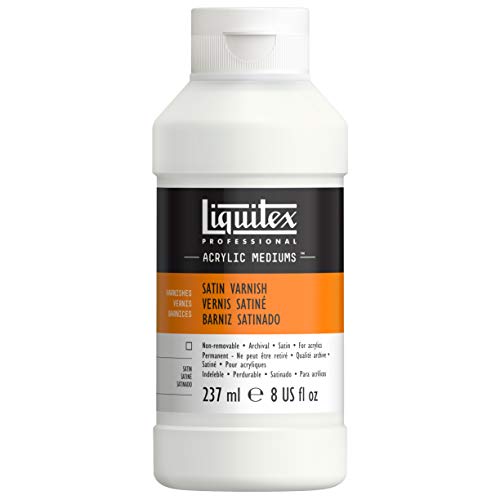
The most complete spec sheet in this group, in the largest brush-on bottle from a paint house that also makes the acrylics underneath it.
Best for: painters who varnish regularly and want a large archival bottle Skip it if: you might ever want to remove the layer
Liquitex publishes more about this bottle than any other brand here: 237ml of volume, 0.6 lb of shipping weight, a 5.69 x 2.25 x 2.25 in bottle, model 8208. That's the full set. It's also the only pick here that names a safety standard, ASTM D4236, and says it's safe for educational use.
The claims worth weighing are the archival ones. Liquitex describes the film as permanent, non-removable, non-yellowing and water-resistant once dry, drying to a hard, flexible surface that isn't tacky. It also says the varnish is intermixable with its own professional acrylic colours and mediums, which is the practical advantage of buying a varnish from the company that made your paint. You can tune sheen by mixing rather than guessing between bottles.
It's the most expensive pick here, and three sellers list it, which is more competition than most of this set gets. The trade-off is that permanence. Galeria gives you a layer you can strip; this one you can't. And at 237ml, it's a commitment if you only varnish a canvas twice a year.
Pros:
- Largest published brush-on volume in this set at 237ml
- Most complete spec sheet of the six
- Archival, non-yellowing and water-resistant claims stated
- Intermixable with Liquitex professional acrylics and mediums
- Conforms to ASTM D4236
Cons:
- Permanent and non-removable, with no reversibility
- The highest price position in this set
- Bottle size is more than an occasional varnisher needs
2. Winsor & Newton Galeria Acrylic Satin Varnish — Best for beginners
The only pick here that promises you can undo it, in the largest jar of the six.

Best for: first-time varnishers who want a safety net Skip it if: you need a small trial bottle
Galeria's listing is short and it says the one thing a nervous first-timer needs to hear. Winsor & Newton calls it "a uniquely removable satin varnish" for protecting finished acrylic paintings from the build-up of dirt and grease. That's the whole pitch, and for someone varnishing a canvas for the first time, it's the right pitch.
At 250ml this is the biggest jar in the group by published volume, in a 2.64 x 4.8 x 2.64 in container, model 3040803. Winsor & Newton also notes the varnish comes in 75ml as well as 250ml, so a smaller trial size exists in the range even though this listing is the larger one. Two sellers stock it, and it sits at roughly mid-range for this set.
What you don't get is the detail Liquitex publishes. There's no non-yellowing claim, no drying description, no standards reference. The listing weight reads 0.28 g, which is clearly a data entry slip rather than a real figure, so ignore it. And a removable film is by definition a softer, less abrasion-resistant one, which matters if the piece will be handled rather than hung.
Pros:
- Explicitly removable, unique among these six
- Largest published jar volume at 250ml
- Names finished acrylic paintings as the intended surface
- Also offered in a smaller 75ml size
Cons:
- Sparse spec sheet: no yellowing or dry-time claims
- Listed weight of 0.28 g is obviously wrong
- Removable films trade durability for reversibility
- Only the 250ml jar on this listing, no small trial size
3. Gamblin Gamvar Pict Varnish Satin — Best for pros
A named picture varnish in a mid-size 125ml bottle, with almost nothing published to argue about.

Best for: studio painters who want a named picture varnish Skip it if: you want detail from the listing before you buy
Gamvar is the only bottle in this group whose product name contains the words "picture varnish". That phrase is the language of finishing a painting rather than sealing an object, and it's the reason this one sits above the model-shop picks despite the thinnest listing here.
The published figures: 125ml, given as 4.2 oz, weighing 4.16 oz, in a 4.6 x 1.8 x 1.8 in bottle, model 10604. It's clear in colour. That's genuinely everything the listing states, because the single feature line just repeats the product name.
So this pick is a judgment call on the name and the format rather than on evidence. The 125ml size is the sensible middle of this field: enough for several canvases, small enough that it won't sit half-used for years. It's a mid-range price position, and one seller lists it.
The trade-off is real. If you want to compare a non-yellowing claim, a removability statement, or a drying description against another bottle before you commit, Liquitex and Galeria hand you those and this one doesn't. It's also the slowest-moving pick of the six in its category, so it isn't the one buyers reach for by default.
Pros:
- Only pick named as a picture varnish
- Sensible mid-size 125ml bottle for canvas work
- Clear colour and satin finish both stated
- Mid-range price position, not the priciest here
Cons:
- Almost no published detail beyond size and model
- No removability, yellowing or dry-time claim at all
- Slowest seller of the six in its category
- Single seller listing
4. The Army Painter Aegis-Suit Satin Varnish — Runner-up
The biggest container here by a wide margin, at 400ml, aimed at miniatures rather than canvas.

Best for: sealing textured or three-dimensional painted work in volume Skip it if: your painting is a finished canvas on a wall
At 400ml, or 13.5 fl oz, this is far and away the largest container in the group. The 2.56 x 7.87 x 2.56 in shape tells you it's a can rather than a jar, and the colour value reads "Satin Varnish", model CP3027.
Read the feature text carefully, though, and it's mostly about The Army Painter's Colour Primer range: an undercoat primer with fine pigment, designed for metal, plastic and resin miniatures, acrylic-based and fast-drying. The brand describes it as part of its "Spray, Paint, Dip, Done" workflow, and says the primers are matte. That's primer copy sitting on a satin varnish listing, and it means the listing tells you less about the satin film than the name suggests.
Where it earns its place: volume and reach. If you're sealing acrylic-painted figures, terrain or textured relief work in quantity, 400ml goes a long way and an aerosol reaches into recesses a brush can't. That's a genuine capability nothing else here offers.
It's also a premium price position, one seller lists it, and none of the archival language a canvas painter wants appears anywhere. On a flat stretched canvas, a brush-on from the top three picks gives you more control and more information.
Pros:
- Largest volume in the set at 400ml
- Aerosol reaches recesses and texture a brush misses
- Acrylic-based and described as fast-drying
- Stated as suitable for metal, plastic and resin surfaces
Cons:
- Feature text mostly describes primers, not the satin varnish
- No archival, yellowing or removability claim
- Premium price position with the least canvas-specific detail
- Aerosol overspray is awkward for framed flat work
5. MCTRHG Clear Acrylic Paint Sealer — Best minimal setup
A small brush-on sealer pitched squarely at craft acrylics, with no published volume to plan around.

Best for: craft painters sealing rocks, pours and small boards Skip it if: you want a published volume before ordering
This is the one pick that names the widest spread of surfaces. MCTRHG lists canvas, painted rocks, acrylic pouring, bottle art, diamond art and wood, and calls the sealer a non-tacky brush-on top coat that goes on without surface damage. If your acrylic work isn't all on stretched canvas, that breadth is useful.
The claims are the usual protective set, and they're the manufacturer's: MCTRHG says the film helps protect against dust, UV exposure, yellowing and everyday wear, that it forms a clear less-permeable layer, and that it dries to a smooth even coat that deepens colour without glare or cloudiness. Treat all of that as marketing copy, not measurement. There's also a satisfaction promise, with the brand offering compensation if you're unhappy.
The problem is the spec sheet. Colour is satin, count is 1, dimensions are 2.6 x 1.77 x 1.97 in, model AAVHL-04. No volume, no weight. Those dimensions describe a small bottle, and by price position it's the second-cheapest here, but you're ordering without knowing how much varnish arrives.
Its compensating strength is sales: this is the one buyers choose most often in this group. Only one seller lists it.
Pros:
- Names the widest range of surfaces of any pick here
- Second-cheapest position in the set
- The one buyers choose most often here
- Brush-on and described as non-tacky
- Brand-backed satisfaction promise
Cons:
- No published volume or weight at all
- Small footprint suggests limited coverage
- All protective claims are unattributed marketing copy
- Single seller listing
6. Vallejo Model Color Satin Liquid Varnish — Best budget pick
The cheapest way to see what satin does to your colours, in a 60ml bottle that names canvas among its surfaces.

Best for: testing satin sheen on small panels and figures Skip it if: you paint anything larger than a small board
Vallejo is the cheapest of the six and the smallest at 60ml, given as 2 fl oz, weighing 2.82 oz in a 2.36 x 5.91 x 3.94 in package, model 26519, released in 2015. For a first look at how a satin film changes your darks, that size is exactly right and the low cost makes a test panel painless.
It's also more canvas-relevant than its miniature-aisle origins suggest. Vallejo says the water-based satin acrylic varnish is formulated to protect canvases, primed wood, metal, resin, some plastics and generally varnishable surfaces, and that it intensifies colour while adding protection against scratches, wear and dust. The brand offers gloss, matte and satin in 18ml, 60ml and 500ml, so you can scale up once you've decided. It describes its varnishes as permanent.
Two caveats. Vallejo notes it's mid-rebrand, so packaging may arrive in either the old or new design. And 60ml disappears fast across a large canvas: this is a sampler and a small-work varnish, not a bottle you'd start a big piece with. Only one seller lists it, and the colour field reads "Multicolor", which tells you nothing.
Pros:
- Cheapest of the six
- Water-based and names canvases among its surfaces
- Available in 18ml, 500ml and other finishes in the range
- Small 60ml size ideal for test panels
Cons:
- Smallest volume here at 60ml, poor value on large work
- Permanent, so no reversibility
- Packaging varies during the brand's rebrand
- Written for figures and dioramas, not framed paintings
Which of these were made for canvas, and which weren't?
The keyword says acrylic paintings, but Amazon's results don't respect that qualifier. Two of these bottles come from the miniature and wargaming aisle, and none of the six publishes a canvas-specific test result. So judge the fit yourself, using the listing language.
Here's what each one actually names:
- Liquitex: intermixable with professional acrylic paint and mediums. Paint-house language, canvas-first.
- Winsor & Newton: "finished acrylic paintings", stated outright.
- Gamblin: "Pict Varnish", the trade term for picture varnish.
- Vallejo: canvases, primed wood, metal, resin, some plastics.
- MCTRHG: canvas, rocks, pours, bottles, diamond art, wood.
- The Army Painter: metal, plastic and resin miniatures.
Only three of the six use the word painting or picture. If your work is a stretched canvas destined for a wall, stay in that group. If it's painted objects, textured relief or figures, the others become competitive, and The Army Painter's 400ml aerosol becomes genuinely the best tool for the shape of the job.
How far does a bottle go on a stretched canvas?
Nobody here publishes a coverage figure, so plan by volume and by the number of coats you intend.
The published sizes run from 60ml to 400ml, which is a nearly seven-fold spread. Ranked smallest to largest: Vallejo at 60ml, Gamblin at 125ml, Liquitex at 237ml, Winsor & Newton at 250ml, The Army Painter at 400ml. MCTRHG publishes no volume, and its 2.6 x 1.77 x 1.97 in bottle is the smallest footprint of the brush-on picks.
Some practical planning:
- Budget two thin coats, not one thick one. Thin coats level better and cloud less. That doubles whatever you thought you needed.
- Add a test panel to every job. Varnish a scrap of the same primed surface first. That's a real cost in millilitres.
- Match bottle to habit. Varnishing once a season? 60ml or 125ml. Varnishing every finished piece? 237ml or 250ml.
- Don't buy 400ml of aerosol for one canvas. Aerosols lose material to overspray, and a can that sits half-used can clog at the nozzle.
The two 8-ounce-class bottles, Liquitex at 237ml and Galeria at 250ml, are the sweet spot for anyone finishing work regularly. That's the practical reason they hold the top two spots.
What the labels don't tell you about satin sheen
Satin is not a standardised number. There's no gloss-unit figure on any of these six listings, which means "satin" from one brand can sit visibly glossier or flatter than "satin" from another. Two bottles on this page even describe their finish differently: Liquitex calls its finish "Satin Gloss", while Vallejo's colour field reads simply "Multicolor". Neither tells you where on the scale you'll land.
Three things the listings leave out entirely:
- Number of coats recommended. Not stated on any of the six.
- Drying and recoat times. Only Liquitex describes the dry film, as hard, flexible and non-tacky. The Army Painter says its primers dry quickly, which is a different product.
- Application method. Brush, spray or both is implied by format, never specified as guidance.
The workaround is boring and it works: varnish a test card before the painting. Paint a card with the same colours, let it cure, varnish half. Compare the varnished and bare halves under the light the painting will hang in. Satin flattens deep darks less than matte and reflects less than gloss, but exactly how much is something you can only see, not read.
The verdict
Three price positions, three answers.
At the entry end, Vallejo Model Color Satin Liquid Varnish is the cheapest way in. Sixty millilitres won't finish a large canvas, but it's water-based, it names canvases among its surfaces, and it costs the least of anything here to find out whether you like satin at all. Buy it to test, then scale into the 500ml size Vallejo also sells.
In the middle sit the two picks worth most people's money. Winsor & Newton Galeria Acrylic Satin Varnish is the best satin varnish for acrylic paintings if reversibility matters to you, because it's the only bottle in this set that says removable, and 250ml is the largest published jar here. Gamblin Gamvar is the mid-range choice if you want the picture-varnish pedigree and can accept a listing that publishes size and nothing else.
At the top, Liquitex Professional Satin Varnish is the default. It publishes the most, claims archival permanence and non-yellowing performance, conforms to ASTM D4236, and mixes with the acrylics you probably already own. The cutoff is simple: if the painting may ever need re-varnishing by someone other than you, choose Galeria. Otherwise, choose Liquitex.
FAQ
Is a satin varnish for acrylic paintings worth buying at all?
A satin varnish for acrylic paintings is worth it if the work will hang in a lived-in room. Acrylic films stay slightly soft and attract dust and grease, and Winsor & Newton names exactly that build-up as what its varnish blocks. Satin also evens out patchy sheen between matte and glossy passages, which is a purely visual gain a bare canvas won't give you.
Which satin varnish gives the best value across these six?
The best value across these six depends on how often you varnish. Vallejo is the cheapest at 60ml, so it wins on entry cost. Liquitex at 237ml and Winsor & Newton at 250ml carry far more varnish for a higher price position, which makes them the better per-canvas choice for anyone finishing work regularly rather than once a year.
Can I use a model varnish on a stretched canvas painting?
Using a model varnish on canvas is sometimes fine, sometimes not. Vallejo explicitly names canvases, primed wood, metal, resin and some plastics among its surfaces, so it's a reasonable choice. The Army Painter's Aegis-Suit describes metal, plastic and resin miniatures and its feature text talks about primers, so it's built for figures rather than framed flat work.
Liquitex or Winsor & Newton: which satin varnish should I choose?
Choose Liquitex or Winsor & Newton on one question: reversibility. Liquitex states archival, permanent and non-removable, plus non-yellowing and water-resistant when dry, and conforms to ASTM D4236. Galeria states the opposite, calling itself uniquely removable. Liquitex publishes far more about its film; Galeria gives you the option to strip and replace it later. Volumes are close, 237ml against 250ml.
What's the most common mistake when varnishing an acrylic painting?
The most common mistake is one thick coat instead of two thin ones. Thick films pool, cloud in the recesses of brushwork, and dry unevenly. Not one of these six listings states a recommended coat count or recoat time, so test on a scrap panel painted with the same colours first, and let each coat dry fully before adding the next.
Order a test panel's worth before you commit a finished piece to anything. Varnish a scrap of the same primed surface, live with it under the light the painting will actually hang in, then buy the full bottle. If you'd rather skip that step, Liquitex Professional Satin Varnish is the safest default here for one reason the other five can't match: it comes from the company that likely made your paint, it mixes with those same acrylics, and it publishes an archival, non-yellowing, ASTM-referenced claim you can hold it to. That's the closest thing to a known quantity on this page.
Last updated: September 7, 2026. Product availability re-checked.
This page contains affiliate links. As an Amazon Associate we earn from qualifying purchases, at no extra cost to you.