Best Residential Siding for Repairs and Panels
Five residential siding products compared for real homeowner jobs: full cedar shake panels, patch kits, flashing sheets, aluminum coil, and hidden fasteners.
The best residential siding on this shortlist is the Polaris Homeside Select Double 7in. Cedar Shake Vinyl, because one box covers 50 sq. ft. of wall with a textured cedar-shake face and only 37 lbs. to carry up the ladder. If your job is a patch rather than a re-side, the Loose Siding Fasteners take over: a 10-pack relocks up to 6 ft of horizontal vinyl with no tools.
How I narrowed this shortlist to five
Three picks were cut before this list came together, and naming the reasons matters more than naming the picks. Anything without a stated size in inches or square feet went first: you cannot plan a wall from a listing that will not tell you what one box covers. Anything sold without a clear application (interior trim strips, generic PVC sheet with no siding claim) went next. Finally, anything whose category path pointed away from siding entirely was dropped, even when the photo looked close.
What survived splits cleanly:
- One full panel product, the Polaris cedar shake vinyl, sold by the half-square box.
- Three repair products aimed at cracks, loose courses and joint waterproofing.
- One trim metal, an aluminum coil for fascia and flashing that lives next to siding on every real job.
That mix is deliberate. Most residential siding queries are not "which brand should I re-clad my house in" but "what do I buy to fix the wall I already have". The best residential siding pick for a full re-clad is not the best residential siding pick for a 4-inch crack under a downspout, and this shortlist covers both without pretending one product does everything.
Best residential siding at a glance
| Pick | What it does | Coverage or count | Price |
|---|---|---|---|
| Best overall Polaris Homeside Select Double 7in. Cedar Shake Vinyl |
Full cedar-shake vinyl panels | 10 panels, 50 sq. ft. per box | Check Price |
| Best for pros Loose Siding Fasteners 10 pcs |
Relocks loose horizontal vinyl | 10 fasteners, up to 6 ft of course | Check Price |
| Best minimal setup ElaraBerry PVC Siding Repair Flashing Sheets |
Paintable joint waterproofing | 50 sheets, 10 x 6 in each | Check Price |
| Best budget pick FAILUN Vinyl Siding Repair Kit |
Self-adhesive crack patches | 12 patches, 6.3 x 4.75 in each | Check Price |
| Best premium Eagle 1 Aluminum/Vinyl Siding Coil |
Fascia, drip edge, flashing | 24 in x 50 ft roll | Check Price |
Full panels or a repair kit: which job are you doing?
The single decision that runs this category is the one nobody makes out loud. You are either residing a wall or you are fixing an existing wall, and those two jobs share almost nothing.
If you are residing, coverage per box is the number you plan around. The Polaris panels give you 50 sq. ft. per box at 37 lbs. and 480 linear ft. across ten pieces. Work out your square footage, add the listing's 20% waste allowance, and you have a box count. That is a shopping list.
If you are fixing, the number is different. Length of loose course, count of visible cracks, feet of joint that leak. The repair picks are sized to those measurements: 6 ft of relock per 10-pack, 12 patches for scattered holes, 50 sheets for a run of joints. Buying full panels to fix a crack is expensive and slow. Buying a patch kit when a whole gable is failing is a waste of a Saturday.
Only the Polaris pick is best residential siding in the "clad the wall" sense. The other four are best residential siding in the "keep the wall you have" sense, and both readings of the phrase are legitimate.
1. Polaris Homeside Select Double 7in. Cedar Shake Vinyl — Best overall
The only full-panel product in the set, sold by the half-square with a textured cedar-shake face.
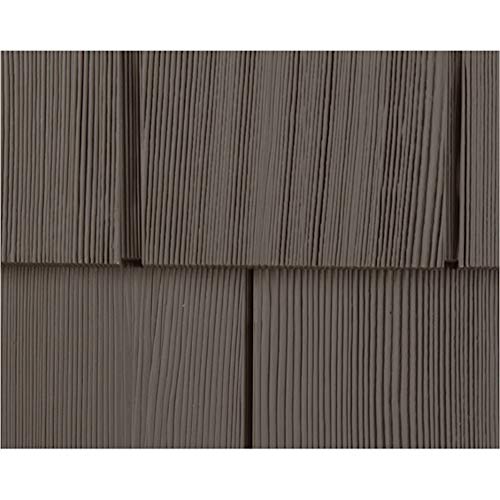
Best for: a homeowner residing a wall or gable in cedar shake vinyl Skip it if: you only need to patch a few cracks
This is the only pick here that is actually residential siding in the sense a builder means. One box holds 10 panels, covers 50 sq. ft., runs 480 linear ft. and weighs 37 lbs. Each panel measures 17 x 50.9 x 0.38 in with a 1/8 in thickness on the profile, and the face is textured from real cedar shakes according to Polaris. The colour on this listing is Slate, and Polaris notes colour may vary slightly from the photograph, which is standard for vinyl and worth a same-lot order.
Two things separate it from the rest of the shortlist. It is the only product with a stated square-foot coverage per box, which is the number a re-clad job runs on. And it is the only product whose feature notes include a specific matching accessory: a CertainTeed 3/4 in. Slate J channel recommendation for the trim run. That kind of listing detail is what stops a two-truck trip to the yard.
The trade-off is scale. This is the priciest way to fix a small crack because it is not aimed at small cracks at all, and among the five it sits in the premium tier for the box, not the wall foot.
Pros:
- Ten panels per box, 50 sq. ft. of coverage
- Textured face from real cedar shakes per Polaris
- 37 lbs. per box, workable one-person carry
- Named J-channel recommendation in the listing
- The only full-panel product in this shortlist
Cons:
- Overkill for a single crack or hole
- Colour may vary from the photo, per Polaris
- Only Slate shown on this listing
- Premium price position within the set
2. LOOSE SIDING FASTENERS — Best for pros
Metal clips that relock unbuttoned horizontal vinyl courses with no tools, ten to a pack.

Best for: a contractor relocking loose horizontal vinyl courses Skip it if: your siding is cedar shake or gapped over 1/8 in
Storm winds unbutton vinyl courses, and the standard fix is to pull nails, rezip and hope. These pliable aluminum clips slide into place and fold over the top of the panel instead. The listing gives you the maths straight: a 10-pack secures up to 6 ft of loose siding, a 20-pack does 12 ft, a 30-pack 18 ft, a 40-pack 24 ft, at one fastener every 7 in. That is a rare piece of usable spec on a repair product.
Two constraints matter. The listing states the fasteners are designed for horizontal vinyl siding, not vinyl cedar shake, so pairing them with the Polaris pick above will not work. And they are not designed to hold panels that have separated by more than 1/8 in or to prevent siding from falling off the wall entirely: this is a relock, not structural rescue.
Made in the USA, rust-resistant aluminum, hidden from view once folded. Among the repair picks this is the most job-specific, and it costs less than the patch kits per fastener while doing a job the patches cannot do at all.
Pros:
- 6 ft of course relocked per 10-pack, one every 7 in
- No tools needed, per the listing
- Rust-resistant aluminum, hidden after install
- Made in the USA
- Cheaper than four of the five picks here
Cons:
- Horizontal vinyl only, not cedar shake
- Not for gaps over 1/8 in
- Ten pieces will not cover a long wall
- Metallic finish will not colour-match on its own
3. ElaraBerry 50 Pack PVC Siding Repair Flashing Sheets — Best minimal setup
Bulk paintable PVC sheets for waterproofing splice joints and lap joints across a run.

Best for: sealing splice joints across a shed, garage or outbuilding run Skip it if: you need a colour-matched cosmetic patch out of the box
Fifty sheets, 10 x 6 x 0.02 in each, 3.09 lb for the whole pack. ElaraBerry positions this as waterproofing for splice joints, lap joints and connection points on exterior wall panels, garages, sheds, warehouses and outbuildings. It is a bulk joint pack, not a face-repair pack, and that distinction is the whole point of it being on the list.
The material is PVC, described as flexible enough to cut or bend on site, and the white surface is paintable so a coat of matched exterior paint can hide the sheet under a facing course. If you are working around several joints on a large outbuilding, buying 50 pre-sized sheets is faster than cutting scraps.
The trade-off is where these sheets belong. They are not designed to be the visible face of a wall, and there is no colour beyond white in the listing. Behind trim, at a joint, under a lap, painted to match: yes. As a cosmetic patch on a front elevation: no. It is also the only repair pick here without a self-adhesive backing, so plan for a compatible sealant.
Pros:
- 50 sheets, enough for a full outbuilding run
- Paintable to match exterior colour per ElaraBerry
- Standard 10 x 6 in size, cuts on site
- Flexible PVC, per the manufacturer
- Only 3.09 lb for the whole pack
Cons:
- White only, no colour options listed
- Not self-adhesive, unlike the FAILUN patches
- Designed for joints, not face repair
- Needs paint to blend on a visible run
4. FAILUN Vinyl Siding Repair Kit — Best budget pick
A dozen self-adhesive white PVC patches for cracks, holes and blemishes.

Best for: quick self-adhesive cover-ups on cracks and small holes Skip it if: the damaged panel flexes in the wind
Twelve patches at 6.3 x 4.75 in each, thin white PVC with self-adhesive backing. FAILUN rates the patches for a temperature range of 5°F to 140°F and claims indoor and outdoor use. It is the cheapest pick on the shortlist and the only one that pairs a wide-format patch with a peel-and-stick application, which is why it earns the budget slot rather than the pro slot.
The right job for it is small and cosmetic. A hairline crack under a hose bib, a hole where a bracket used to sit, a scratch that shows from the driveway. Twelve patches at that size handle a lot of these across a house. The wrong job is a loose panel: adhesive on a flexing surface fails, and FAILUN is not claiming to hold a course down. That is what the Loose Siding Fasteners are for.
The listing is thin on some points a shopper wants. There is a stated dimension per patch but no coverage in square feet across the pack, and colour is white only. If your siding is beige or clay, plan on exterior paint to blend the patch after install.
Pros:
- Self-adhesive, no separate sealant
- 12 patches at 6.3 x 4.75 in each
- Rated 5°F to 140°F per FAILUN
- The cheapest pick in this set
- Wider format than most patch tapes
Cons:
- White only, expect to paint to match
- Not for flexing or unbuttoned panels
- Thin PVC, per the manufacturer
- No coverage total stated for the pack
5. Eagle 1 Aluminum/Vinyl Siding Coil — Best premium
A 24-in wide, 50-ft aluminum roll for fascia covers, drip edge and flashing.

Best for: fascia covers, drip edge and flashing alongside a siding job Skip it if: you want a wall-face siding panel, not trim metal
Eagle 1 lists this as .019 aluminum with a smooth finish paint in black, 24 in wide and 50 ft long, made in the USA, with 1.25 in matching stainless steel trim nails included in the box. That last detail is the reason it earns a slot: the coil and its fasteners ship together, so the trim run does not stall over a nail order.
The listing calls out fascia covers, drip edge and concrete barrier as intended uses. On a real residential siding project, the panel work usually stops at the frieze and the aluminum coil takes over on fascia, soffit edges and rakes. Buying the coil at the same time as the panels stops the ladder from going up twice.
The trade-off is straightforward. This is the priciest pick here, and it is trim metal rather than a wall-face material. If your entire question is "how do I clad my gable", the Polaris panels do that and this coil does not. If your question is "how do I finish the eaves of the wall I just clad", this is the answer and the Polaris box is not.
Pros:
- 24 in x 50 ft coverage per roll
- Free 1.25 in stainless steel trim nails included
- .019 aluminum, smooth finish paint
- Many colours and sizes available per Eagle 1
- Made in the USA
Cons:
- The most expensive pick here
- Trim metal, not a wall panel
- Black on this listing, other colours are separate SKUs
- No square-foot coverage stated, only linear feet
What each product covers, in square feet
Coverage is where these five products stop being comparable in the abstract and start being comparable on a wall.
- Polaris cedar shake vinyl: 50 sq. ft. per box, 480 linear ft. across 10 panels.
- Eagle 1 aluminum coil: 24 in x 50 ft, so 100 sq. ft. of unbent sheet, though most of it will fold into 6-in fascia faces.
- ElaraBerry PVC flashing sheets: 50 sheets at 10 x 6 in each, roughly 20.8 sq. ft. of joint cover.
- FAILUN vinyl patches: 12 patches at 6.3 x 4.75 in each, roughly 2.5 sq. ft. of patch across the pack.
- Loose Siding Fasteners: not measured in square feet at all, 6 ft of course relocked per 10-pack.
Notice how far apart those numbers are. The Polaris box does more wall than the other four picks combined, and the Loose Siding Fasteners cannot be measured on the same axis at all. This is why "best residential siding" is a category question, not a product question: you cannot rank a panel against a fastener on the same yardstick, and the honest answer is to pick the row that matches your job.
How do you match a patch to existing siding?
How do you match a patch to existing siding when the repair products in this set arrive in white, metallic or black? Three moves, in order:
- Buy exterior-grade paint in a colour matched to your existing siding. The ElaraBerry sheets are explicitly paintable, and the FAILUN patches are white PVC that will accept a coat once cleaned. Paint after install, not before, so the adhesive bonds to bare backing.
- Hide the repair where it can be hidden. Fasteners and joint sheets belong under laps, behind trim, or at the top of a course where the shadow line falls on them. The listings for the ElaraBerry sheets and the Loose Siding Fasteners both position them as hidden-once-installed.
- For a large or highly visible failure, replace rather than patch. That is when the Polaris box becomes the answer, and the Slate colour has to be confirmed against a same-lot chip because Polaris flags on the listing that colour may vary slightly from the images.
Paint alone will not rescue a patch on a panel that is loose, buckled or gapped over 1/8 in. Fix the mechanical problem first, then the cosmetic one.
What the listings do not spell out
Amazon listings are stingy about the details a real siding job hinges on. A few things worth knowing before you hit buy:
- Only one seller lists each of these products. Availability of a specific colour or size is a real risk, and same-lot ordering matters most on the Polaris panels, where colour may vary between production runs.
- Sales popularity in this category is uneven. The Loose Siding Fasteners and the FAILUN patches move the fastest of the five, which reads as most homeowners here are shopping for repair rather than re-clad. The Polaris cedar shake box moves the slowest of the group, which is normal for a bulky building material rather than a signal about the product.
- Waste allowance is real. Polaris asks you to plan for about 20% waste on the panel run. On a 500 sq. ft. gable that is 12 boxes, not 10, and forgetting the allowance is how weekend jobs stall on a Sunday.
- Trim and fasteners are separate line items. Polaris names a CertainTeed 3/4 in. Slate J channel in the listing, and Eagle 1 ships trim nails with the coil. The other three picks have no matching accessories stated, so plan for a compatible caulk or sealant separately.
The verdict
If your job is to reside a wall or gable in cedar shake, the Polaris Homeside Select Double 7in. Cedar Shake Vinyl is the best residential siding pick here, and it is the only one that qualifies for that reading of the phrase. One box is 50 sq. ft., 10 panels and 37 lbs., with a named J-channel recommendation and a 20% waste allowance to plan against.
Two conditions flip the recommendation. First, if the wall is basically sound and you are chasing a handful of visible cracks, the FAILUN Vinyl Siding Repair Kit at 12 self-adhesive patches is the better spend and the cheapest pick here. Second, if wind has unbuttoned a horizontal course, the Loose Siding Fasteners at 10 fasteners per 6 ft of relock do a job the patches cannot.
The ElaraBerry PVC sheets are the answer when you have 30 or 40 joints to seal on outbuildings and one bulk pack is faster than cutting scraps. The Eagle 1 aluminum coil joins the shopping list the moment fascia and drip edge enter the plan, and its included 1.25 in stainless nails keep the trim run moving.
FAQ
What is the best residential siding for a full re-clad on this list?
What is the best residential siding for a full re-clad on this list is the Polaris Homeside Select Double 7in. Cedar Shake Vinyl, because it is the only full-panel product in the shortlist. One box covers 50 sq. ft. across 10 panels at 37 lbs., with a 20% waste allowance and a CertainTeed 3/4 in. Slate J channel recommendation to plan the trim run.
Is a vinyl siding repair kit worth it versus replacing a panel?
Is a vinyl siding repair kit worth it depends on the failure. For hairline cracks, small holes and cosmetic blemishes on an otherwise sound panel, the FAILUN kit at 12 self-adhesive patches is the fastest fix and the cheapest here. For loose or buckled panels, or gaps over 1/8 in, a patch will not hold and you should relock with fasteners or replace the panel.
How much wall does one box of Polaris cedar shake vinyl cover?
How much wall does one box cover is 50 sq. ft. across 10 panels, at 480 linear ft. per box and 37 lbs. total weight. Each panel is 17 x 50.9 x 0.38 in with a 1/8 in profile thickness and a double 7 in exposure. Polaris asks you to plan for about 20% waste, so budget boxes against your net wall area accordingly.
Loose Siding Fasteners or FAILUN patches for storm-loosened panels?
Loose Siding Fasteners or FAILUN patches is not a close call for a storm-loosened panel. Use the fasteners. They slide in and fold over the top of the course to relock it, one every 7 in, at 6 ft of coverage per 10-pack. FAILUN patches are self-adhesive cosmetic covers for cracks and holes, and the listing does not claim they hold loose panels down.
Can I use ElaraBerry PVC sheets as visible siding face repair?
Can I use ElaraBerry PVC sheets as visible face repair is not really what they are designed for. The listing positions the 50-pack as joint waterproofing for splice joints, lap joints and connection points, and the sheets ship in white only. The surface is paintable, so behind a trim line or under a lap, painted to match, they work. On a visible front elevation, plan differently.
The next step is a five-minute wall audit. Walk the elevations, count the failure modes, and match each one to a row on the table above. A gable that is 40% failing goes on the Polaris list, and you should measure it and add 20%. A single unbuttoned course goes on the Loose Siding Fasteners list, and you count 7-in spacings. Cracks and holes go on the FAILUN list. Joints on outbuildings go on the ElaraBerry list. Fascia and drip edge go on the Eagle 1 list. That is not five separate carts, it is one job with the right five items in it, and the reason Polaris earns the top slot is that every other pick here supports the wall it clads.
Last updated: September 7, 2026. Product availability re-checked.
This page contains affiliate links. As an Amazon Associate we earn from qualifying purchases, at no extra cost to you.