Best Plywood for Furniture Making: Falken Wins
A honest look at the best plywood for furniture making, plus the edge banding and basswood sheets that finish the job cleanly.
The best plywood for furniture making in this set is the Falken Design Birch Plywood Project Panel Grade B3, a 36 x 60 in sheet at 1/2 in thick that gives you a full cabinet side or bookcase back from a single 22.5 lb panel. For smaller work and drawer bottoms, the KOHAND 6 Pack of 1/4 in basswood boards is the better buy. Two rolls of pre-glued edge banding and one melamine option round out the shortlist.
Best plywood for furniture making at a glance
| Pick | Size | Format | Price |
|---|---|---|---|
| Best overall Falken Design Birch Plywood Project Panel |
36 x 60 x 1/2 in | Full sheet, 22.5 lb | Check Price |
| Best premium Edge Supply White Oak Veneer Tape |
3/4 in x 50 ft | Iron-on veneer roll | Check Price |
| Most versatile BOWIJANYZ Birch Edge Banding |
3/4 in x 100 ft | Iron-on birch roll, 0.8 mm | Check Price |
| Best budget pick KOHAND 6 Pack Basswood Boards |
11.8 x 17 x 0.24 in | 6-pack, 5.22 lb | Check Price |
| Best upgrade GSCIT Club Melamine Edge Banding |
3/4 in x 25 ft | White melamine, 0.6 mm | Check Price |
Two things to notice before we go further. First, this set is a mix: one full sheet, one small pack of thin boards, and three rolls of edging tape. That reflects what "furniture making" actually asks of your material list. Second, only one product here is a true plywood sheet you can build a carcass from, so the ranking below is honest about that.
How I screened the shortlist
I lined up every listing by what it actually contributes to a piece of furniture: a sheet you can cut into panels, or a finished edge you can put on the sheet you already have. Anything that could not answer one of those two questions was cut.
The Falken Design birch panel is the only listing here that gives you a full-size sheet in a thickness suitable for cabinet sides, at 1/2 in and 36 x 60 in. The KOHAND basswood pack is a 6-pack of 1/4 in boards, which is drawer-bottom and back-panel territory, not structural carcass stock. The three remaining picks are edge banding, and edge banding is what turns a plywood build into a piece of furniture rather than a shop fixture. Skip it and you see raw plies on every visible edge.
I dropped anything without a published thickness or size, because for furniture that is the number that decides whether a part works. Every pick here states its dimensions on the listing, in inches or feet, and every pick has a single seller carrying it.
Why edge banding belongs in a plywood roundup
If you are new to building with sheet goods, the surprise is how much of the finish quality lives on the edge. Plywood shows its plies. Melamine shows a grey particle core. Neither reads as furniture until you cover the edge.
That is why three of the five picks are pre-glued veneer or melamine tapes. You cut your plywood panel, you iron the tape on, and the edge disappears into the face. The Edge Supply white oak tape and the BOWIJANYZ birch tape are real wood veneer with hot-melt adhesive already applied. The GSCIT Club roll is melamine in white, aimed at cabinet interiors and painted work. Different jobs, same problem solved.
1. Falken Design Birch Plywood Project Panel — Best overall
A single 36 x 60 in sheet of 1/2 in birch plywood, sized for real cabinet parts and shipped as one 22.5 lb panel.

Best for: cabinet carcasses and bookcase sides at 1/2 in thickness Skip it if: you need 3/4 in stock for a heavy tabletop
This is the only pick in the set that behaves like plywood for furniture in the traditional sense. The sheet is 36 in by 60 in by 1/2 in thick, with a stated weight of 22.5 lb, which is consistent with a birch-faced panel at that thickness. From one sheet you can get both sides of a base cabinet, or the sides and top of a small bookcase, without seaming.
Falken Design describes it as Baltic birch and mentions laser cutting as one use, which tells you the face is smooth enough for detail work. The listing calls the grade B3(D/E), meaning the two faces are graded differently: a cleaner show face on one side, a utility face on the other. For furniture that is fine, because you orient the good face outward.
The trade-off against the rest of the set is straightforward: at 1/2 in, this sheet is a cabinet-side thickness, not a shelf thickness for long spans, and it is the most expensive pick here. It also arrives as a single large panel that needs handling space.
Pros:
- Only full-size plywood sheet in the shortlist
- 1/2 in thickness suits cabinet sides and backs
- Stated 22.5 lb weight consistent with birch faces
- Listing notes laser-cut compatibility for detail work
- Two-face grading gives you a show side
Cons:
- Most expensive pick in this set
- 1/2 in is thin for a long unsupported shelf
- 36 x 60 in needs a station wagon or a cut list before pickup
- No published warranty
2. Edge Supply White Oak Iron-On Veneer Tape — Best premium
A 50 ft roll of real white oak veneer with hot-melt adhesive already on the back, for matching solid oak trim on a plywood build.

Best for: matching plywood edges to solid white oak trim Skip it if: your build is painted and species does not matter
If you are building in white oak, this is the tape that hides the plies. Edge Supply calls it A-grade white oak veneer, 3/4 in wide, in a 50 ft roll, with German-engineered hot-melt adhesive pre-applied. In practice that means you cut your panel, run a household iron along the tape, and trim the overhang with a flush cutter.
The listing says it bends around both flat and curved surfaces, which is the useful claim for anyone banding a rounded shelf front or a curved cabinet corner. Edge Supply also states the roll works on plywood, particleboard, MDF, hardboard, wood and metal, so the same roll finishes a plywood carcass and a matching MDF drawer front.
Against the BOWIJANYZ birch roll below, this pick is the pricier choice per foot and covers half the length. You buy it when the species matters. Against the melamine tape, it is real wood grain that will stain to match solid oak, and melamine will not.
Pros:
- Real A-grade white oak veneer, not printed
- Pre-glued hot-melt bond, iron-on application
- 50 ft roll covers a mid-size cabinet project
- Listed as flexible around curves
- Compatible with plywood, MDF and particleboard
Cons:
- No published thickness for the tape itself
- Half the length of the BOWIJANYZ birch roll
- Species locks you into an oak build
- No stated warranty
3. BOWIJANYZ Birch Edge Banding — Most versatile
100 ft of 3/4 in birch veneer tape at 0.8 mm thick, priced in the entry band, with the longest continuous run of the set.

Best for: a full kitchen's worth of birch plywood edges in one roll Skip it if: you only have one or two shelves to band
BOWIJANYZ lists this roll at 100 ft long, 3/4 in wide and 0.8 mm thick, with hot-melt adhesive pre-glued to the back. That is twice the length of the Edge Supply oak roll and four times the length of the melamine tape. For a whole kitchen of birch plywood cabinets, one roll is realistic where the others would run out.
The listing highlights continuous veneer lengths between 7.22 ft and 8.53 ft before a seam, which is the number that actually matters for looks: fewer joints across a long cabinet side. BOWIJANYZ says the tape is paintable and stainable, so you can carry a birch plywood build straight through to a stained finish or paint it out.
The trade-off is that at 100 ft you are buying more than most single-piece projects need, and birch is a lighter, less figured wood than the oak roll above. If you are building one bookcase, the 100 ft length is overkill and the shorter oak or melamine rolls make more sense.
Pros:
- 100 ft length, longest roll in the set
- 0.8 mm thickness stated on the listing
- Continuous veneer runs up to 8.53 ft between seams
- Paintable and stainable per the listing
- Entry-band price for a real wood veneer
Cons:
- Too much roll for a one-cabinet project
- Birch grain is subtle if you want figure
- No published warranty
- Single seller listed
4. KOHAND 6 Pack Basswood Boards — Best budget pick
Six 11.8 x 17 in basswood sheets at 1/4 in thick, sold as a pack for drawer bottoms, back panels and prototype parts.
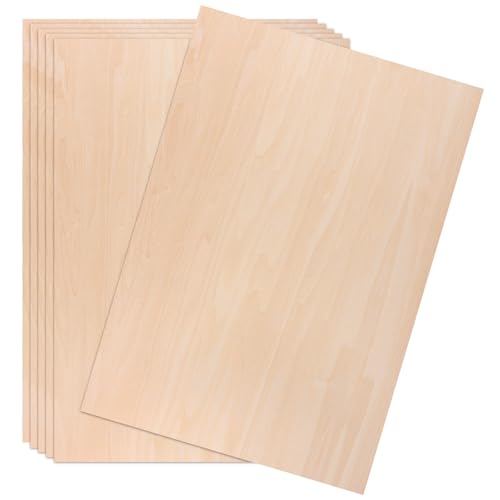
Best for: drawer bottoms, back panels and prototype furniture parts Skip it if: you need structural sides for a loaded bookshelf
Basswood is not plywood, and you should not build a cabinet carcass from these. What the KOHAND pack does give you is six flat, smooth sheets at 11.8 x 17 x 0.24 in, weighing 5.22 lb for the pack, which is exactly the size and thickness for a small drawer bottom, a jewellery box back or a mock-up of a bigger piece before you commit to sheet goods.
KOHAND describes the wood as lightweight with a uniform, dense structure, and says the surface is smooth after processing. The claim that basswood is easy to work with hand tools is well founded for the species generally, and the 20-year warranty on the listing is the only stated warranty in the set. Whether that warranty is meaningful for a consumable is another question.
Against the Falken sheet, these are a supplement, not an alternative. You use them for parts that do not carry load. Against the edge banding, they are unfinished on the edge and will need sanding or their own veneer if you want them furniture-clean.
Pros:
- Six sheets per pack, useful for iterative builds
- 1/4 in thickness suits drawer bottoms and backs
- Only pick in the set with a published warranty
- Smooth surface per the listing, ready for finish
- Light 5.22 lb pack, easy to ship and store
Cons:
- Not structural plywood, do not use for cabinet sides
- 11.8 x 17 in limits project size
- Basswood dents more easily than birch
- Edges need finishing separately
5. GSCIT Club Melamine Edge Banding — Best upgrade
A 25 ft roll of white melamine edge tape at 0.6 mm thick, made for the inside of a plywood cabinet and painted furniture.

Best for: white melamine cabinet interiors and painted shelving Skip it if: you want a real wood grain on the finished edge
Not every plywood edge should be wood. If you are building white cabinet interiors, a painted bookcase or a laundry-room shelf, a melamine tape is faster, cleaner and less fussy than veneer. GSCIT lists this roll at 3/4 in wide, 25 ft long, 0.6 mm thick and white, with the same iron-on melt bond as the veneer rolls.
The listing calls the material melamine, which is a thermally fused surface layer used across kitchen cabinets, and describes it as elastic with a smooth surface. That elasticity matters because melamine tape is more forgiving on slightly uneven edges than a thin wood veneer, and it is easier to keep clean because it is a plastic-faced surface, not open grain.
The trade-off is straightforward. Against the two wood veneer rolls, this pick will never match a solid wood trim, and it cannot be stained. Against the KOHAND basswood and the Falken sheet, it is not a panel at all. It is the entry-band edge that lets a plywood cabinet look finished without paying for oak.
Pros:
- Cheapest pick in this set
- 0.6 mm thickness stated on the listing
- White finish suits painted and mixed-material builds
- Iron-on melt adhesive, same technique as veneer
- Elastic melamine handles slight edge irregularities
Cons:
- Cannot be stained to match wood
- 25 ft roll is short for a full kitchen
- White only, no other colours listed
- No published warranty
What thickness should you actually buy?
Thickness is what decides whether a part works, and the number is not a matter of taste. A quick map, using the stock in this set and general furniture practice:
- 1/4 in: drawer bottoms, cabinet backs, mock-ups. The KOHAND basswood sits here.
- 1/2 in: cabinet sides for base and wall cabinets, short shelves under 30 in, bookcase backs on a frame. The Falken Design panel sits here.
- 3/4 in: long shelves, tabletops, workbench tops, anything that carries real weight over a span.
Notice the shortlist covers the first two tiers and stops. If you need 3/4 in birch for a shelf that spans a full closet, none of these picks give it to you in a single sheet, and you should size that need separately. For anything at 1/2 in and below, the Falken sheet plus a roll of edge banding is a complete answer.
The furniture-making qualifier in the search is only partly supported by this set. Read the picks as materials that go into furniture, not as a complete lumberyard for a whole project.
How much sheet goods does one piece of furniture need?
A working rule of thumb for a small base cabinet, 24 in wide and 34 in tall:
- Two sides. Each roughly 23 x 34 in in 1/2 in plywood.
- One bottom. About 22 x 23 in.
- One back. About 22 x 33 in, often in 1/4 in stock.
- One or two shelves. Same footprint as the bottom.
- A face frame or door. Usually solid wood, not sheet goods.
Add those up and the sides, bottom and shelf fit inside a single 36 x 60 in Falken panel with careful layout. The 1/4 in back comes from a separate small piece, which is where the KOHAND basswood pack earns its place on a prototype. Add banding on every front edge that will show, at roughly 34 in per side and 22 in per shelf front, and one 50 ft or 100 ft roll covers several cabinets.
What the listings do not tell you
A few things a specification sheet cannot show, worth knowing before you buy.
- Grade language varies. Falken calls the sheet Grade B3(D/E). Edge Supply calls its veneer A-grade. These are not the same scale. Read them as "this is the show face" and move on.
- Ply count is not published. Baltic birch is prized for a high ply count and void-free construction, but the Falken listing does not state a ply count. Assume it is fit for cabinet use and check the sheet on receipt before you cut it.
- Adhesive quality on pre-glued tape varies. All three tape picks state hot-melt adhesive, but temperature and iron time matter. Most first-time users hold the iron too briefly. Give it enough heat to melt through, and press with a wood block as it cools.
- A 20-year warranty on basswood is unusual. The KOHAND listing states it. Consumables rarely carry that language, so read it as a return-policy claim rather than a lifetime guarantee.
The verdict
If you want one plywood sheet for furniture, buy the Falken Design Birch Plywood Project Panel. It is the only true sheet in this set, at 36 x 60 x 1/2 in, and one panel yields enough parts for a base cabinet or a small bookcase.
The cutoff is thickness. If your project needs 1/2 in stock for cabinet sides, backs and short shelves, the Falken sheet is the right buy and the BOWIJANYZ birch banding at 100 ft finishes every visible edge in matching veneer. If your project needs only thin sheets for drawer bottoms, back panels or a prototype, the KOHAND basswood 6-pack at 1/4 in is enough and costs a fraction of a full sheet.
Below that split, species decides the tape. Building in oak, buy the Edge Supply white oak roll for a real wood match. Building painted or mixed cabinets, buy the GSCIT Club melamine roll and skip the wood veneer entirely. Nothing here answers a 3/4 in shelf or a solid tabletop, so if that is your build, size it separately.
FAQ
Is Baltic birch the best plywood for furniture making?
Baltic birch plywood is widely used for furniture because it has a high ply count, a smooth face and consistent thickness, which is why the Falken Design panel in this list uses it. It is not the only answer, and thicker cabinet-grade oak or maple plywood also works, but for 1/2 in cabinet sides and shelves, birch is a reliable default.
What thickness of plywood is best for furniture?
The best thickness of plywood depends on the part. 1/4 in is for drawer bottoms and cabinet backs, 1/2 in for cabinet sides and short shelves, and 3/4 in for tabletops, long shelves and anything under load. The Falken Design sheet is 1/2 in, which suits cabinet carcasses. Match the thickness to the span and the weight the part will carry.
Falken Design birch or KOHAND basswood, which should I buy?
Falken Design birch is the pick if you need structural plywood, because it comes as one 36 x 60 x 1/2 in sheet weighing 22.5 lb, enough for cabinet sides. KOHAND basswood is the pick for thin parts and prototypes, with six 11.8 x 17 in boards at 1/4 in thickness. They solve different problems, and a serious build often uses both.
Do I really need edge banding on plywood furniture?
Edge banding on plywood furniture is what separates a finished cabinet from a shop fixture. Plywood shows its plies on every cut edge, and melamine cores show a grey particle line. A pre-glued tape covers that edge in a few minutes with a household iron. Any of the three rolls in this list, chosen by species, does the job.
Can I stain the BOWIJANYZ birch edge banding to match a walnut plywood?
Staining the BOWIJANYZ birch edge banding to a darker tone is possible, and the listing states it is paintable and stainable. Matching walnut exactly is harder because birch takes stain differently than walnut and the grain pattern is not the same. For a true walnut match, use a walnut veneer tape instead. For a close painted or dark-tinted finish, birch works.
Building furniture from plywood is a decision about panels first and edges second, and this shortlist reflects that split. Start with the Falken Design birch sheet for anything that needs a real 1/2 in panel. Add the KOHAND basswood pack when you are prototyping or need thin parts. Then pick the edge tape that matches your build: BOWIJANYZ birch for the longest and most flexible roll, Edge Supply white oak when the species has to match solid trim, GSCIT melamine when the interior is white and painted. Cut once, band the edges before you assemble, and the plywood build will read as furniture.
Last updated: September 7, 2026. Product availability re-checked.
This page contains affiliate links. As an Amazon Associate we earn from qualifying purchases, at no extra cost to you.