Best Machinist Calipers: Starrett EC799A Leads
A ranked look at seven machinist calipers, from a .0005" Starrett electronic slide to a 0-12" dial model with a covered rack. Every pick is tied to a specific job, a resolution figure, and a reason to skip it.
The best machinist calipers are the Starrett Stainless Steel Electronic Slide Caliper, model EC799A-6/150, because it reads to .0005" and 0.01mm across a 0-6" range in a body weighing just 0.7 lb. If you'd rather not think about batteries at all, the Mitutoyo 505-742J dial caliper turns 0.001" per revolution with a lock screw on both the bezel and the jaw. Resolution is what splits this field, and it splits it cleanly. Three of these seven resolve to .0005"; the rest stop at 0.01mm or coarser, which is a different class of work.
Best machinist calipers at a glance
| Pick | Range | Resolution | Price |
|---|---|---|---|
| Best overall Starrett Stainless Steel Electronic Slide Caliper |
0-6" | .0005" / 0.01mm | Check Price |
| Best for pros Mitutoyo 505-742J Dial Caliper |
0-6" | 0.001" per rev | Check Price |
| Best for heavy use Dasqua 6" IP54 Digital Caliper |
6" | 0.0005" claim | Check Price |
| Best for beginners HARDELL Digital Caliper 12 Inch |
12" | 0.0005" claim | Check Price |
| Runner-up Preciva Digital Caliper 12 Inch |
12" | 0.01mm claim | Check Price |
| Best for families Accusize Black Face Red Needle Dial Caliper |
0-12" | 0.001" per rev | Check Price |
| Best budget pick HARDELL Digital Caliper 6 Inch |
0-6" | 0.01mm claim | Check Price |
How I screened these machinist calipers down to seven
I started with the two Amazon subcategories that matter here, digital calipers and dial calipers, and pulled the published specifications for each listing side by side. Range, resolution, accuracy, weight, dimensions, model number. Then I cut anything that didn't state a resolution figure at all.
What survived splits into three groups:
- Four-figure resolvers. Starrett at .0005" and 0.01mm, plus Dasqua and the 12-inch HARDELL, both claiming 0.0005".
- Dial calipers reading 0.001" per revolution. Mitutoyo and Accusize.
- Metric-first units at 0.01mm. Preciva and the 6-inch HARDELL.
That's the whole decision in three lines. Two of the seven are dial instruments with no battery in them. Five are electronic. Only one, the Dasqua, publishes an ingress rating.
A note on the word "machinist" in this search. Amazon's results for machinist calipers pull from general-purpose caliper listings, and none of these products is sold as certified for a specific trade. Nothing in the data tells you a given caliper meets a shop's inspection standard. That's a judgment you make against your own tolerance sheet, not something a listing can settle. What the listings do give you is the resolution and accuracy figures, and those are worth reading carefully.
Resolution or accuracy: which number should you read first?
Most shoppers compare resolution, because it's the bigger-looking number and it's usually first in the title. Resolution is the smallest increment the display shows. Accuracy is how far the reading can sit from truth. They're not the same, and the gap between them is where cheap calipers hide.
Look at the spread in this set:
- Starrett: .0005" resolution, 0.01mm metric increment
- Dasqua: 0.0005" resolution, ±0.001" accuracy claim
- 12-inch HARDELL: 0.0005" resolution, ±0.002" accuracy claim
- 6-inch HARDELL: 0.001" accuracy, 0.01mm resolution
- Preciva: 0.01mm resolution, ±0.03mm accuracy claim
- Mitutoyo: 0.001" accuracy, 0.1" per revolution
- Accusize: 0.001" per revolution graduation
The 12-inch HARDELL displays four decimal places while claiming ±0.002" accuracy. That's a display reading finer than the tool can promise. Not a fault, just a thing to understand before you trust the last digit on a part drawing.
Read accuracy first. Then check that resolution is at least as fine, so you're not rounding away the precision you paid for. On the best machinist calipers, those two numbers sit close together.
1. Starrett Stainless Steel Electronic Slide Caliper — Best overall
The only pick here that publishes both a .0005" inch resolution and a 0.01mm metric increment from a named model, EC799A-6/150.

Best for: close-tolerance benchwork where .0005" resolution matters Skip it if: you need reach beyond 6 inches
At 0.7 lb, this is a light instrument for a full 0-6" range. Starrett gives the overall dimensions as 1.38 x 12.6 x 4.92 in, which is packaging depth rather than the tool itself, but the working range is unambiguous. The measuring surfaces are hardened stainless steel, per the listing, which is the corrosion story most machinist calipers gesture at without specifying.
Two details separate it from the electronic picks below. The unit conversion reads either 0.01mm or .0005", so both scales resolve to the same practical fineness instead of one being an afterthought. And the auto-off runs at 30 minutes of no slide movement, six times longer than the Dasqua's 5-minute shutoff. If you set a caliper down mid-job and come back, that matters more than it sounds.
It's also the most expensive pick here, and only one seller lists it. The trade-off against the 12-inch options is reach: 6 inches is the whole range, so anything longer needs a second tool. Against the Mitutoyo dial, you're accepting a battery in exchange for a digital readout and metric switching.
Pros:
- Finest published resolution in this set at .0005"
- Metric increment matched at 0.01mm
- Only 0.7 lb for a 0-6" instrument
- 30-minute auto-off, longest here
- Hardened stainless measuring surfaces per the listing
Cons:
- Most expensive pick in this group
- Only one seller carries it
- 6" range, half the reach of three picks here
- No ingress rating published, unlike the Dasqua
2. Mitutoyo 505-742J Dial Caliper — Best for pros
A 0-6" dial caliper reading 0.001" per revolution, with a lock screw on the bezel and the jaw.
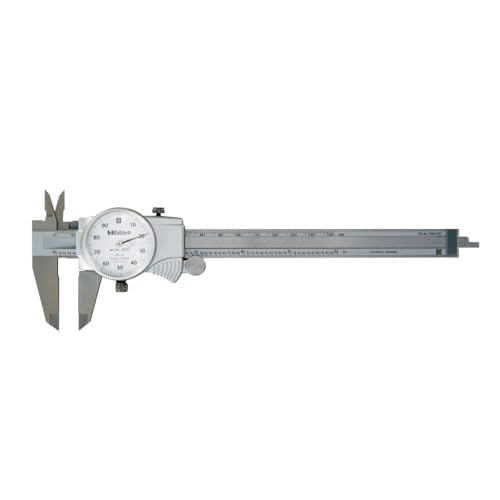
Best for: shop floors where batteries are a nuisance Skip it if: you want a digital readout and unit switching
This is the pick for anyone who has watched a digital caliper blink out halfway through a run of parts. There's no battery. The dial turns 0.1" per revolution against a 0.001" accuracy figure, and Mitutoyo lists the model as 505-742J.
The lock screws are the feature I'd single out. Mitutoyo says both the dial bezel and the jaw lock, which means you can zero the bezel to a reference and stop it drifting, then clamp the jaw to carry a reading off the machine. Dial calipers without a bezel lock lose that. The listing also describes a satin chrome finish chosen to cut glare, and a redesigned dial face for legibility.
Dimensions are 1.4 x 10.6 x 4.5 in. The weight figure on the listing reads 4.54 g, which is clearly a data entry slip for a steel instrument of this size, so treat it as unpublished rather than real.
The trade-off is plain. No metric switch, no depth-to-fraction conversion, no digits. You read a needle, and reading a needle well is a skill. It's also the second-most expensive pick here.
Pros:
- No battery, so nothing to fail or replace
- Lock screws on both bezel and jaw
- 0.001" accuracy with 0.1" per revolution dial
- Satin chrome finish to reduce glare per Mitutoyo
- Handles outside, inside, depth and step
Cons:
- No metric or fractional switching at all
- Published weight figure is clearly erroneous
- Second-highest price position here
- Dial reading takes practice a digital display doesn't
3. Dasqua 6" IP54 Digital Caliper — Best for heavy use
The only caliper in this set with a published ingress rating, IP54 for splash and dust.

Best for: damp, dusty or coolant-splashed workspaces Skip it if: you want a published weight and dimensions before buying
Six of these seven calipers tell you nothing about water or dust. This one publishes IP54, and that single figure is why it's here. Dasqua describes the stainless body as splash-proof and dust-proof, suited to workshops, garages and outdoor use.
The resolution claim is 0.0005" and 0.01mm, with accuracy claimed at ±0.001" and 0.02mm. That's the second-tightest accuracy pairing in this group, behind only the Starrett, and it comes at the second-cheapest price position of the seven. Dasqua credits ABS technology for the measurement, and the display switches between inches, millimetres and fractions in 1/128 increments with one knob.
Two CR2032 batteries ship in the case, so you get a spare from the start. Auto-off fires after 5 minutes of inactivity, which conserves the cell but means more wake-ups than the Starrett's 30 minutes.
What you don't get is a full specification sheet. No weight, no dimensions, no colour. The model designation is simply IP54. For a tool you're picking up a hundred times a day, not knowing its weight before it arrives is a real gap, and the 6" range is the shortest reach on offer here alongside the Starrett and the 6-inch HARDELL.
Pros:
- Only pick with a published IP54 rating
- ±0.001" accuracy claim at a low price position
- Fraction display down to 1/128
- Two CR2032 batteries included per the listing
- Foam-padded storage case
Cons:
- No published weight or dimensions
- 5-minute auto-off, shortest in this set
- Model number is just the ingress rating
- 6" range only
Do you need 6 inches or 12?
Three of these machinist calipers span 0-6". Three reach 12". This is the second decision after resolution, and people get it wrong in both directions.
A 6" caliper covers the overwhelming majority of bench work: bore diameters, stock thickness, fastener lengths, wall sections. It's shorter, lighter and easier to hold square to the work. The Starrett is 0.7 lb.
A 12" caliper buys you span for long stock, frame members, printed parts and cabinet joinery. It costs you handling. The Accusize 0-12" dial weighs 1.98 lb, nearly three times the Starrett, and ships at 16.9 x 5.12 x 1.18 in. Holding two pounds of steel square across a 10-inch span, one-handed, is harder than it looks, and jaw deflection at full extension is a real source of error on any long caliper.
The rule I'd use:
- Most of your work under 5 inches? Buy 6" and buy the better resolution.
- Regularly measuring past 6 inches? Buy 12" and accept a coarser accuracy figure, because none of the 12" picks here matches the Starrett.
- Both? Buy the 6" first. It's the one you'll reach for daily.
Reach is not precision. A 12" caliper claiming ±0.03mm is not more capable than a 6" one holding ±0.001". It's just longer.
4. HARDELL Digital Caliper 12 Inch — Best for beginners
A 12" rechargeable caliper with a backlit screen and fractional inch readings, which is the friendliest combination here for someone new to calipers.

Best for: newcomers who want fractional inch readings and a backlight Skip it if: you're chasing tight tolerances at ±0.002"
The fractional mode is the beginner feature that actually helps. If you're working from plans in sixteenths, a caliper that shows sixteenths saves you a conversion step and a mistake. HARDELL lists three units, inch, millimetre and fractional inch, on a single tap, plus four modes for internal, external, depth and step.
The backlight is the other differentiator. This is the only pick here with one published, and it means a dim garage or a shadowed bore doesn't force you to angle the tool toward a lamp. Charging is built in: HARDELL says 2 minutes gets you working and a 20-minute charge runs 4 months. That's the longest quoted charge interval in this group.
The body is described as all-metal, screen housing included, which HARDELL ties to resistance against magnetic interference near drills and motors. The tool measures 0.04 x 11.8 x 1.57 in and comes in orange, the only non-silver, non-black pick here. Easy to spot on a cluttered bench.
Accuracy is the honest limit. At ±0.04mm and 0.002", it's the loosest published accuracy of the four-decimal displays, and the 0.0005" resolution is finer than the tool promises. Fine for woodwork and general fabrication, not for a tight fit on a shaft.
Pros:
- Only pick with a published backlit display
- Fractional inch mode alongside inch and mm
- 4 months of use from a 20-minute charge per HARDELL
- All-metal body including screen housing
- Orange finish is easy to find on a bench
Cons:
- ±0.002" accuracy, loosest among the four-decimal picks
- Resolution displays finer than accuracy supports
- No published weight
- Charging port is one more thing to keep clean in a shop
5. Preciva Digital Caliper 12 Inch — Runner-up
A 0-300mm rechargeable caliper aimed squarely at 3D printing and woodworking rather than close-tolerance metalwork.

Best for: 3D printing and woodworking over long spans Skip it if: you need better than ±0.03mm
Preciva is specific about the audience, and I respect that. The listing names 3D printing and woodworking, quotes 0-300mm and 0-12", and puts accuracy at ±0.03mm with 0.01mm resolution. Those two numbers sit sensibly together: the display doesn't pretend to more than the tool delivers, which is more than you can say for two of the picks above.
Power comes from a built-in 3.7V 100mAh cell charged over Type-C. That's the only capacity and voltage figure published by any pick here, and Type-C means the cable on your desk already fits. No CR2032 hunt.
The body is hardened stainless, described as rust-proof. Package contents are listed as the caliper, a protective storage box, a Type-C cable and a manual. Dimensions come in at 0.04 x 5.12 x 1.18 in, and it's the third-cheapest of the seven.
Two things hold it back from a higher spot. HARDELL's screen has a backlight; Preciva's listing is careful to say the jumbo LCD reads well "when adequate ambient light is available," which is a polite way of saying there isn't one. And ±0.03mm is the coarsest accuracy figure published in this set. For a printed bracket, fine. For a bearing bore, not close enough.
Pros:
- Resolution and accuracy figures sit consistently together
- Type-C charging with a published 3.7V 100mAh cell
- 0-300mm span at the third-lowest price position
- Hardened stainless, described as rust-proof
- Storage box and cable in the package
Cons:
- ±0.03mm is the loosest accuracy claim here
- No backlight, and the listing hedges on ambient light
- No published weight, colour or model number
- Slowest-moving of the 12" picks in this group
6. Accusize Black Face Red Needle Dial Caliper — Best for families
A 0-12" dial caliper with a covered rack and a high-contrast black face, built for a bench several people share.

Best for: a shared bench where several people grab the same tool Skip it if: 1.98 lb in one hand is too much
Shared tools get treated badly. That's the argument for this one. There's no battery to run flat because someone left it on, no charge port to snap off, and no mode button to leave in the wrong unit for the next person. Accusize graduates the dial at 0.001" per revolution across a full 0-12" range.
The covered rack is the detail that earns it a place. On an open-rack dial caliper, a swarf chip in the gear teeth jams the needle or, worse, throws the reading off silently. Accusize says the rack is covered for longer life and chip-free operation. Combined with a stainless hardened beam and jaws with lapped measuring faces, it's a design built to survive a busy bench.
The black face with a red needle is genuinely easier to read at a glance than a white dial in shop light, and it's the reason this reads well across different users and different eyes.
Weight is the cost: 1.98 lb, the heaviest here by a wide margin, in a package measuring 16.9 x 5.12 x 1.18 in. It's also in the top price group despite being a dial instrument with no electronics. Two sellers list it, one more than most picks in this set, but it's a slow mover.
Pros:
- Covered rack guards the gear train against chips
- 0.001" per revolution across a full 0-12" range
- Black face and red needle read clearly in shop light
- Hardened, ground and lapped measuring faces
- No battery or charge port to fail
Cons:
- 1.98 lb, heaviest pick here by a long way
- Premium price position with no digital readout
- No metric scale at all
- Bulky 16.9" package to store
7. HARDELL Digital Caliper 6 Inch — Best budget pick
The cheapest of the seven, and the only one that ships as a 5-piece kit with a spare battery, screwdriver and steel ruler.

Best for: a second caliper, or a first one that comes with everything Skip it if: 0.01mm resolution isn't fine enough for your work
Count is 5 on this listing, and that's the whole pitch. HARDELL includes the caliper, a case, two batteries with one spare, a mini screwdriver and a stainless steel ruler. Nothing else here comes close to that; most picks give you a case and a battery. The screwdriver matters because it's the tool you need to open the battery door, and it's the one you never have when the display dies.
Specifications are 0-6" and 0-150mm, with accuracy claimed at ±0.02mm and 0.001" and resolution at 0.01mm. Two jaw pairs and a depth probe cover ID, OD, depth and step. The stainless body is described as resisting rust, wear and corrosion, and HARDELL contrasts it directly with plastic-bodied calipers. Package dimensions are 0.1 x 10.4 x 1.18 in.
It's also the one buyers choose most often in this group by a wide margin, which tells you it lands where a lot of people are shopping.
The limit is resolution. At 0.01mm, it shows two decimal places in metric, not the four the Starrett and Dasqua manage. That's plenty for stock thickness and fastener sizing and not enough for a press fit. There's no backlight and no rechargeable cell either, so you're back on CR2032s, which is exactly why the spare is welcome.
Pros:
- Cheapest pick in this set
- 5-piece kit including a spare battery and screwdriver
- Four modes from two jaw pairs plus depth probe
- Stainless body rather than plastic
- One-click metric and imperial switching
Cons:
- 0.01mm resolution, coarser than four picks here
- No backlight and no rechargeable option
- No published weight
- Model designation is simply "6in"
Dial or digital for a machinist caliper?
This set gives you two of each philosophy, and the honest answer is that they fail differently.
Digital wins on: instant metric and imperial switching, fractional readings on the HARDELL 12", zeroing anywhere along the beam, and reading a number rather than interpolating a needle. Four of the five digital picks here publish a resolution of 0.01mm or finer.
Dial wins on: no power source, no auto-off waking up mid-measurement, no charge port to fill with grinding dust, and instant visual feedback on whether a part is drifting as you sweep the jaws. The Mitutoyo and Accusize both graduate at 0.001" per revolution.
Where digital calipers actually annoy people is the auto-off. The Dasqua shuts down after 5 minutes, the Starrett after 30. If you're measuring one part every ten minutes, one of those tools is awake when you pick it up and the other isn't. Zeroing again each time is where drift creeps in.
Where dial calipers annoy people is dirt. That's exactly what Accusize's covered rack addresses, and it's a feature worth looking for on any dial caliper you consider, in this set or outside it.
My default: digital for the bench, dial for the machine.
What the listings don't tell you
Even a detailed caliper listing leaves gaps. Here's what's missing across these seven, so you know what you're taking on faith.
- Jaw depth. How far the jaws reach into a bore or over a flange isn't published for a single pick here. It varies between models, and it decides whether you can measure a recessed diameter at all.
- Repeatability. Accuracy tells you how close one reading is. It doesn't tell you whether ten readings of the same feature agree. That's the specification that separates good machinist calipers from adequate ones, and none of these listings quotes it.
- Calibration paperwork. No pick here states that a certificate ships with the tool. If your work needs traceable calibration, assume you're arranging it separately.
- Warranty. Not one of the seven publishes warranty terms.
- Thumb roller and lock feel. Mitutoyo mentions enhanced sliding surfaces, and Accusize mentions lapped faces. Nobody quantifies the sliding effort, and that's the thing you notice within the first hour.
Two practical habits close some of those gaps regardless of which caliper you buy. Check zero against closed jaws before every session, and check a known gauge block or a fresh drill shank once a week. A caliper that has drifted tells you nothing about the part; it tells you about itself.
The verdict
If you work to close tolerances on a bench, buy the Starrett EC799A-6/150. Its .0005" inch resolution and matched 0.01mm metric increment are the finest published pairing in this group, it weighs 0.7 lb, and the 30-minute auto-off is the longest here by a factor of six. It's the most expensive pick, and that's what you're paying for.
If you work on or beside a machine, buy the Mitutoyo 505-742J. No battery, 0.001" accuracy, 0.1" per revolution, and lock screws on both bezel and jaw. Its exact advantage over the Starrett is that it cannot switch off, cannot lose zero to a dead cell, and cannot be left in the wrong unit.
The cutoff is 6 inches. Below that span, buy on resolution and take the Starrett or, at a much lower price position, the Dasqua with its IP54 rating and ±0.001" claim. Above 6 inches, none of the long picks matches that accuracy, so buy on how you'll read it: fractional and backlit from the 12" HARDELL, metric-consistent from the Preciva, or needle-and-covered-rack from the Accusize at 1.98 lb.
FAQ
Are expensive machinist calipers worth the money?
Expensive machinist calipers are worth it when your tolerance sheet demands it. The gap between the Starrett at .0005" resolution and the Preciva at ±0.03mm is the difference between a press fit and a rough dimension. If your parts fail at a few thousandths, pay. If you're sizing lumber and printed brackets, the cheapest pick here clears the bar comfortably.
Is a dial caliper still worth buying over a digital one?
A dial caliper is still worth buying if power is a nuisance where you work. The Mitutoyo 505-742J and Accusize P920-B212 both graduate at 0.001" per revolution with no cell inside. You give up metric switching entirely and you have to read a needle, but nothing dies mid-job and nothing shuts off after 5 minutes of stillness.
What resolution do I actually need on a caliper?
The resolution you need should match your accuracy requirement. Reading four decimals from a tool claiming ±0.002" gains you nothing real. For general fabrication, 0.01mm covers it, which is where both HARDELL 6-inch and Preciva land. For fits and clearances, look for .0005" backed by a tight accuracy figure, like the Starrett or Dasqua.
Starrett EC799A or Dasqua IP54: which should I pick?
Between the Starrett EC799A and the Dasqua IP54, it comes down to environment. The Starrett publishes .0005" resolution with 0.01mm metric and a 30-minute auto-off, and costs considerably more. The Dasqua is the only pick with an IP54 splash and dust rating, claims ±0.001" accuracy, and sits near the bottom of the price range here. Wet shop, Dasqua.
What's the most common mistake when buying calipers?
The most common mistake when buying calipers is choosing range over resolution. A 0-12" caliper claiming ±0.03mm is not a better instrument than a 0-6" one holding ±0.001", it's just longer, and at 1.98 lb it's harder to hold square. Buy the 6" first unless you genuinely measure past 6 inches most days.
Start with the range you actually use, then buy the tightest accuracy figure you can inside it. That single order of operations rules out most bad caliper purchases. For a bench where parts are measured to a drawing, the Starrett EC799A-6/150 is the sensible default: a 0.7 lb instrument reading .0005" and 0.01mm, with an auto-off long enough that you're rarely re-zeroing. Add the 12" HARDELL later if long stock becomes routine. And whichever you pick, check it against closed jaws before every session, because a caliper you don't verify is a number you can't use.
Last updated: September 7, 2026. Product availability re-checked.
This page contains affiliate links. As an Amazon Associate we earn from qualifying purchases, at no extra cost to you.