Best Lubricant for Sliding Screen Doors, by Type
Six door lubricants compared on formula, applicator and mess, from a 13.5 oz silicone spray to a 1.68 oz wax stick, so you pick the one your screen door track actually needs.
The best lubricant for sliding screen doors is the Rocket TT Slide & Glide Silicone Door Lubricant Spray, a 13.5 oz can whose 100% silicone formula lays down a dry film that won't gum up a screen track. If you'd rather skip aerosol overspray near mesh and glass, the Lemenyaa Door Hinge Lubricant puts 2 oz of silicone oil exactly where you point its needle tip. Here's the 30-second shortlist: Rocket TT for a full track, Lemenyaa for a single squeaky roller, and the 3-IN-ONE can if a heavy patio door shares the job.
Best lubricant for sliding screen doors at a glance
| Pick | Formula | Applicator | Price |
|---|---|---|---|
| Best overall Rocket TT Slide & Glide |
100% silicone, 13.5 oz | Aerosol spray | Check Price |
| Best for quiet operation Lemenyaa Door Hinge Lubricant |
Silicone oil, 2 oz | Needle-tip bottle | Check Price |
| Best for families AGS Door-Ease Stick |
Wax stick, 1.68 oz | Rub-on stick | Check Price |
| Best upgrade 3-IN-ONE Garage Door Lube |
Oil blend, 11 oz | Two-way straw | Check Price |
| Most versatile UniSport Door, Lock & Hinge |
Mineral oil, 8 oz | Bottle | Check Price |
| Best budget pick AGS DE-2 Door Ease Stick |
Wax stick | Rub-on stick | Check Price |
A quick note before the picks. Amazon's search returned these under a screen door query, but most are labelled for doors, locks, hinges and garage hardware in general. None of these listings names screen door mesh as a tested surface. That doesn't make them wrong for the job. It means the deciding factor is formula and mess, not a marketing badge, so I'll flag where each one fits a screen track and where it doesn't.
Silicone spray, wax stick or oil: which one for a screen track?
Most guides compare cans by size and call the biggest one the best. That's not what decides a screen door. The track is a shallow aluminium or vinyl channel with small nylon rollers, and it sits inches from mesh and glass. What matters is the formula and how cleanly you can apply it.
Three formula families show up in this set:
- Silicone (Rocket TT, Lemenyaa): dries to a thin, dry film that doesn't stay tacky, so it grabs less dust in an open track.
- Wax stick (both AGS sticks): a solid you rub on, no liquid to run or overspray.
- Oil blend (3-IN-ONE, UniSport): stays wet longer and clings well, but a wet film in a dusty track can turn to grime.
For an exposed screen track, a dry silicone film or a wax stick is the safer default. Oil is better where the moving parts are sealed away, like a garage door roller. The best lubricant for sliding screen doors is the one that leaves the least residue where dust can reach it, and that thinking runs through every pick below.
1. Rocket TT Slide & Glide Silicone Door Lubricant Spray — Best overall
A 13.5 oz can of 100% silicone that lays a dry, non-sticky film across a full screen track in one pass.
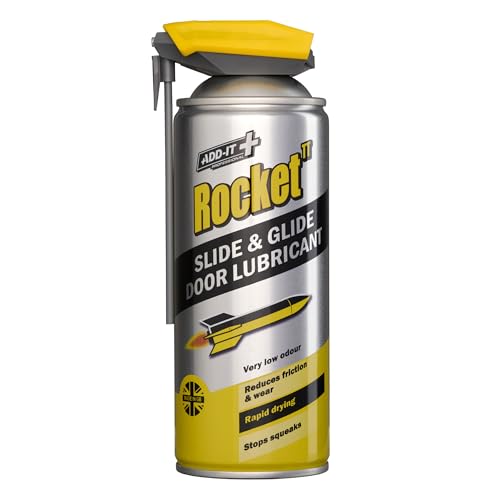
Best for: aluminium screen tracks that need a clean, dry film over their whole length Skip it if: you want zero overspray near glass and screen mesh
This is the pick I'd reach for first on a full patio screen. At 13.5 oz it's the largest can in the group, and Rocket TT says the formula is 100% silicone that dries fast without an oily or sticky residue. That dry finish is the point on a screen track. A tacky film in an open channel collects dust and turns to paste, and silicone is the family that avoids that.
The brand lists it as safe on metal, plastic, rubber, vinyl, wood and glass, which covers the mixed materials in a typical screen door frame. It measures 7.44 x 2.95 x 2.56 in, model RDS400, so it's a standard aerosol can that stores on a shelf easily.
Two trade-offs. It's the most expensive pick here, and only one seller lists it, so choice is thin. And being an aerosol, you'll get overspray near the mesh unless you mask or wipe. Against the no-spray sticks and the needle-tip bottle, that's the cost of covering a long track fast.
Pros:
- Largest capacity in the set at 13.5 oz
- 100% silicone dries to a clean, dry film
- Listed as safe on metal, plastic, vinyl, glass
- Brand claims fast-drying, non-staining finish
Cons:
- Most expensive pick here
- Only one seller lists it
- Aerosol overspray reaches mesh and glass
2. Lemenyaa Door Hinge Lubricant — Best for quiet operation
A 2 oz silicone oil with a needle tip that drops lubricant onto one squeaky roller with no spray and no drift.

Best for: a squeaky roller you want to silence with no spray Skip it if: you have long tracks and a whole patio door to cover
When a single roller starts chirping, you don't want a cloud of aerosol near the screen. The Lemenyaa fixes exactly that. It's a 2 oz bottle of silicone oil, light yellow, with what the brand calls a needle-tip design that places a drop precisely where it's needed. No spray, no spills.
There's a clever touch here: the brand says the bottle has a recessed slot to store the nozzle, so you don't lose the applicator between jobs. Lemenyaa also describes it as odorless, pet-safe and child-safe, made with indoor use in mind. It's the slowest seller of the six to sell out, so availability tends to be steadier than the rarer cans.
The catch is capacity. At 2 oz in a drop-by-drop bottle, this is not how you'd service a long track fast. It's a roller-and-hinge tool. Measuring 5.12 x 1.18 x 1.18 in, model 32#, it's small enough to keep in a drawer. Against the big spray cans, you trade coverage for control, and for quiet operation that's the right trade.
Pros:
- Needle tip places oil on one roller cleanly
- No aerosol overspray near mesh
- Brand claims odorless and pet-safe
- Built-in nozzle storage keeps applicator handy
Cons:
- Only 2 oz, too little for long tracks
- Silicone oil stays wetter than a dry spray
- Drop application is slow over a big door
3. AGS Automotive Solutions Door-Ease Lubricant Stick — Best for families
A 1.68 oz wax stick you rub straight onto the track, with no aerosol, no drips and nothing to overspray.

Best for: homes wanting a no-aerosol stick anyone can use Skip it if: your rollers sit deep in a channel a stick can't reach
If the idea of spraying chemicals near where kids and pets play bothers you, a wax stick sidesteps it. The AGS Door-Ease is a 1.68 oz solid you rub onto the surface, so there's no mist and no liquid to run down the glass. AGS calls it "The Original" no-mess stick lubricant.
One feature stands out for anyone who's over-oiled a track before: the brand says it's impossible to over-apply, because a solid stick meters itself. You leave a thin film where you rub and nothing pools. It's listed as weatherproof and safe on metal, wood, glass, plastic and rubber, so it works on the frame and the track alike. At 1 x 4.25 x 1 in, model DE-3, it fits a toolbox.
The limit is reach. A stick can only touch surfaces you can press it against. Rollers tucked deep in a channel stay dry, which is where a spray or the Lemenyaa needle wins. Two sellers list it, so it's easier to find than the single-seller cans.
Pros:
- No aerosol, safe near kids and pets
- Impossible to over-apply, per the brand
- Weatherproof and safe on five materials
- Compact 1.68 oz stick stores anywhere
Cons:
- Can't reach rollers deep in a channel
- Small 1.68 oz size for big jobs
- Wax film needs firm contact to apply
4. 3-IN-ONE Garage Door Lubricant with SMART STRAW SPRAYS 2 WAYS — Best upgrade
An 11 oz can with a two-way straw that switches between a wide and narrow spray, built for heavy doors that share the job.

Best for: heavy patio doors and garage hardware in one can Skip it if: you only have a light screen door to service
Buy this if your screen door isn't the only thing that sticks. The 3-IN-ONE is an 11 oz can, 0.69 lb, with a Smart Straw the brand says sprays two ways: a wide fan for tracks, a narrow jet for rollers and pulleys. That flexibility is why it earns the upgrade slot.
It's built around garage door hardware. The brand lists hinges, tracks, chains, pulleys and rollers, and calls it a professional-grade formula for heavy commercial doors. If you've got a stiff patio slider and a garage that groans, one can handles both. It's the one buyers reach for most often here by a wide margin, so it's a proven workhorse. Colour is listed as clear, model 100584, and the warranty reads "as labeled."
The honest note for a screen door: this is an oil blend, not a dry silicone. The brand says it's quick-drying and non-sticky, but an oil film in a dusty open screen track can still gather grime over time. On a heavy patio door with deeper hardware that's fine. On a light aluminium screen, the dry silicone picks stay cleaner. It's the second-cheapest of the six, which softens the trade.
Pros:
- 11 oz can covers big jobs
- Two-way straw for wide or narrow spray
- The one buyers choose most often here
- Second-cheapest pick in the set
Cons:
- Oil film can hold dust in open tracks
- Aimed at garage doors, not screen mesh
- Only one seller lists it
5. UniSport Door, Lock, and Hinge Lubricant — Most versatile
An 8 oz mineral-oil lubricant the brand rates from -35°F to 180°F, covering doors, sticky locks and stiff hinges alike.

Best for: doors, locks and hinges through a cold winter Skip it if: you dislike oil-based films that hold dust
This is the pick for the person whose whole entryway needs attention. UniSport lists it for sliding doors, stiff hinges, sticky keys and stuck locks, an 8 oz bottle meant to roam. Where it stands apart is temperature: the brand says it works between -35°F and 180°F to prevent frozen locks, which matters if your screen door faces a hard winter.
The brand also says it's made with food-grade mineral-based products with no harmful chemicals, and that it contains rust inhibitors to keep hardware working. Model HU-XI-201, weight 8 oz. Two sellers list it.
The reason it's "most versatile" and not "best overall" comes down to the same screen-track logic. Mineral oil clings and stays wet, which is great inside a lock cylinder and less ideal in an open aluminium track where dust settles. It's also the slowest seller here after none, so it's the least proven in this group by that measure, and it sits near the top of the price range. If your problem is a frozen lock and a stiff hinge more than a dusty track, this is the one bottle that does all of it.
Pros:
- Rated -35°F to 180°F by the brand
- Covers doors, locks and hinges in one
- Brand claims food-grade mineral base
- 8 oz bottle for repeated jobs
Cons:
- Oil film holds dust in open tracks
- Near the top of the price range
- Sells slower than most of this set
6. AGS DE-2 Door Ease Lube Stick — Best budget pick
The cheapest way into a proven wax stick, a rub-on lubricant AGS has sold since 1997 for exposed surfaces.
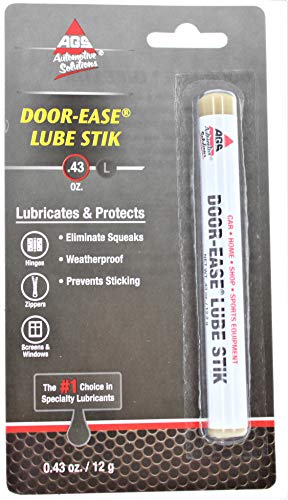
Best for: the lowest outlay on a proven wax stick Skip it if: you need published sizing before you buy
When cost is the whole decision, this is the answer. The DE-2 is the cheapest of the six, a wax stick from the same Door-Ease line as the pick at number three. AGS says to use it on all exposed surfaces, that it's clean and easy to apply, and that it works under all weather conditions. It's been around since 1997, so it's a long-proven format.
Like the other stick, it's a rub-on with no aerosol and no drips, which keeps it away from the mesh-and-glass problem entirely. Dimensions are listed as 1 x 6 x 4 in, model DE-2, and two sellers stock it. Its weight is listed at just 10 g.
The trade-offs are about the listing, not the wax. Size and colour both read "no size" and "no color," so you're buying on the brand's reputation rather than a clear spec sheet. And like any stick, it can't reach rollers set deep in a track. If you want the wax-stick approach and the lowest price, take it. If you want documented dimensions and a bigger stick, the DE-3 above is worth the step up.
Pros:
- Cheapest pick in the set
- No-aerosol wax stick, no drips
- Proven format on the market since 1997
- Two sellers stock it
Cons:
- Size and colour fields left blank
- Can't reach deep rollers
- Very small at 10 g listed weight
How I narrowed six lubricants down
I worked from the published listing details for each product, lining up formula, size, applicator and the surfaces each brand says it's safe on. No hands-on testing, just the specs and the manufacturer claims read side by side. Here's the weighting I applied, in order:
- Formula fit for an open track. Dry silicone and wax rank above wet oil, because an exposed screen channel collects dust and a tacky film turns to grime.
- Applicator control near mesh and glass. A needle tip or a rub-on stick scored above a broad aerosol for precision, though the aerosol wins on speed over a long run.
- Surface compatibility. I checked each listing for metal, vinyl, plastic and glass, the materials in a typical screen frame.
- Practical size. Enough to do the job without waste. A 2 oz bottle suits a roller; 13.5 oz suits a whole patio door.
What that surfaced: two silicone options, two wax sticks and two oil blends, each solving a slightly different version of the same sticky-door problem. The Rocket TT led because it pairs a dry silicone film with enough capacity to cover a full track in one go.
What to avoid on a screen door track
A few habits do more harm than the sticky door itself. Watch for these:
- Petroleum grease or heavy oil in an open track. It stays wet, and a wet film in an aluminium channel becomes a dust magnet. That grime jams rollers worse than dry friction did.
- Over-applying a liquid. Pooled lubricant runs onto the glass and mesh and drips to the floor. This is where the AGS sticks shine: the brand says the wax is impossible to over-apply.
- Skipping the clean. Lubricant over grit grinds the rollers. Wipe the track with a dry cloth before you apply anything.
- Spraying without masking. An aerosol near mesh drifts onto the screen. If you use the Rocket TT or 3-IN-ONE, shield the mesh or wipe it after.
The feature people overpay for is a big can. On a single screen door, the 2 oz Lemenyaa or a wax stick does the whole job. Size only earns its keep when you've got long tracks or several doors to service.
How much do you actually need?
Sizes in this group run from a 1.68 oz stick to a 13.5 oz can, and the right amount depends on the scope of your problem more than the door count.
- One squeaky roller: the 2 oz Lemenyaa is plenty, and its needle tip wastes nothing.
- A single screen door track: either wax stick, or a light pass of silicone, covers it with room to spare.
- A whole patio slider plus hinges: the 13.5 oz Rocket TT or the 8 oz UniSport gives you repeat applications.
- A screen door and a garage door: the 11 oz 3-IN-ONE is sized to handle both from one can.
A lubricant job isn't a one-time thing. Tracks pick up pollen and dust across a season, so most doors want a touch-up once or twice a year. That argues for a size you'll finish before it dries out in the can, which is another reason the small precision options make sense for a single door.
The verdict
If you're servicing a full sliding screen door track and want the cleanest long-term result, the Rocket TT Slide & Glide is the best lubricant for sliding screen doors. Its 100% silicone formula dries to a film that won't turn to paste in an open channel, and 13.5 oz covers the whole track with plenty left for next season. The cutoff is scope: for a full track it wins clearly.
If your problem is a single squeaky roller, the picture flips. The Lemenyaa Door Hinge Lubricant is the better buy there. Its exact advantage is the needle-tip applicator, which places 2 oz of silicone oil on one roller with zero overspray drifting onto the mesh. No aerosol, no waste, no cleanup on the glass.
Below those two, choose by preference. Want no spray at all near kids and pets? The AGS Door-Ease stick meters itself and can't be over-applied. Servicing a garage door in the same trip? The 11 oz 3-IN-ONE with its two-way straw does both. And if the lowest price decides it, the AGS DE-2 stick delivers the wax approach for the least outlay in the set.
FAQ
Is silicone the best lubricant for sliding screen doors?
Silicone is a strong default for screen doors because it dries to a thin, non-sticky film that gathers less dust in an open track. Both the Rocket TT spray and the Lemenyaa oil use a silicone base. A wax stick like the AGS Door-Ease is the other clean choice. Avoid heavy wet oils in an exposed channel, where they hold grit.
Is a wax stick worth it over a spray?
A wax stick is worth it when you want no aerosol near mesh, glass, kids or pets. The AGS Door-Ease sticks rub on as a solid, so nothing drips and, per the brand, you can't over-apply. The trade-off is reach: a stick only touches surfaces you can press it against, so rollers set deep in a channel stay dry. A spray or needle tip reaches those.
What size can do I need for one screen door?
The size you need for one screen door is small. A single squeaky roller needs no more than the 2 oz Lemenyaa bottle, and one full track is covered by a wax stick or a light pass of silicone. The 13.5 oz Rocket TT and 8 oz UniSport are sized for patio sliders or several doors, so a big can is overkill on a single light screen.
Rocket TT or Lemenyaa for a squeaky roller?
For a squeaky roller, Lemenyaa beats Rocket TT on control. Its needle-tip bottle drops 2 oz of silicone oil onto one roller with no overspray reaching the mesh, which is exactly what a single squeak needs. The 13.5 oz Rocket TT spray is the better call when you're covering a whole track fast, but its aerosol drifts onto glass unless you mask it first.
What should I avoid putting on the track?
Avoid putting heavy petroleum grease or wet oil on an open screen track. Those films stay tacky and turn into a dust magnet, which jams rollers worse than the original friction. Also avoid applying any lubricant over grit, since it grinds the rollers. Wipe the track clean and dry first, then use a dry silicone film or a wax stick that won't collect debris.
Start by matching the formula to your track, not the can to your wallet. For most sliding screen doors the dry silicone film of the Rocket TT is the safest default, because it lubricates without leaving the tacky residue that turns an open channel to grime. If a single roller is the whole problem, keep the little Lemenyaa bottle in a drawer and skip the spray entirely. Either way, wipe the track clean first, apply a thin film, and work the door a few times to spread it. Do that once or twice a year and the sticking won't come back.
Last updated: September 7, 2026. Product availability re-checked.
This page contains affiliate links. As an Amazon Associate we earn from qualifying purchases, at no extra cost to you.