Best Heavy Duty Paint Rollers: Wooster Leads
Seven heavy duty roller frames, sleeves and direct-feed systems compared on shank diameter, cage design and reach, with the picks tied to the exact job each one suits.
The best heavy duty paint roller for woodworkers is the Wooster R014-9 Shergrip, because its 5/16 in chrome shank and 5-wire cage are the two parts that decide whether a loaded 9 in cover stays round under pressure. If you'd rather stop refilling a tray altogether, the Wagner PowerFlow EZ pulls straight from a 1 or 5 gallon container through a 16 ft hose. What splits this field is shank diameter and cage construction, not handle padding. A 5/16 in shank flexes far less than the thin wire on a bargain frame, and that flex is what leaves tramlines down a primed panel.
Best heavy duty paint roller for woodworkers at a glance
| Pick | Shank / drive | Cage | Price |
|---|---|---|---|
| Best overall Wooster R014-9 Shergrip Paint Roller Frame 9" |
5/16 in chrome | 5-wire | Check Price |
| Best for heavy use ROLLINGDOG 9" Paint Roller Frame |
8 mm galvanized rod | 5-wire, 7 bearings claim | Check Price |
| Most versatile WAGNER 0530003 SMART Paint Roller |
22 oz handle reservoir | Integrated, 3 x 44 x 12.5 in | Check Price |
| Best premium Wagner Spraytech PowerFlow EZ Multi-Room Direct-Feed |
Electric, 16 ft hose | Integrated, direct-feed | Check Price |
| Best compact EUIJOIP 9 in Paint Roller Kit |
1.1 in screw-together pole | Metal frame, 3 covers | Check Price |
| Best for families Slip Doctors Blue Textured Paint Roller Sleeve |
Sleeve only, 9 in | Open mesh texture | Check Price |
| Best upgrade Allgala 9 Inch 5-Wire Heavy Duty Paint Roller Frame-3 |
1/4 in galvanized | 5-wire, 3-pack | Check Price |
Which buyer are you? Four profiles these seven picks map to
I screened these listings by asking who is holding the tool, not which brand shouts loudest. Four profiles came out of the published specifications, and each one points at a different pick.
- The shop painter finishing sheet goods. You roll primer onto plywood or MDF panels laid flat, then sand between coats. You need a stiff frame that keeps the cover round and a shank that accepts your existing pole. The Wooster R014-9 and its 5/16 in chrome shank is the pick here.
- The repeat user who washes the frame out weekly. Corrosion and a seized cage kill cheap frames first. The ROLLINGDOG frame's galvanized 8 mm rod and galvanized cage speak directly to that, and the angled frame claim helps you knock covers off against a bucket rim.
- The solo painter covering whole rooms. Refilling a tray is the time sink. The Wagner SMART Roller holds 22 oz in the handle, and the PowerFlow EZ removes the tray entirely with a 16 ft hose.
- The floor-coating job. Non-slip texture is a different tool. The Slip Doctors sleeve is the only open-mesh textured cover in this group.
Two picks sit outside those four. The EUIJOIP kit is a starter bundle with three microfiber covers and a screw-together pole. The Allgala three-pack is about quantity, not refinement.
Does a heavy duty paint roller belong in a wood shop at all?
Honest answer first: none of these seven products publishes a single woodworking-specific specification. There is no listing here that names hardwood, no cover nap figure quoted for a sanded panel, no claim about lacquer or shellac compatibility. So when you search for the best heavy duty paint roller for woodworkers, Amazon returns general-purpose painting gear and leaves the woodworking part to you. Judge it yourself against three things.
- The coating you're using. Water-based primers and latex roll fine with the standard covers here. Wagner's SMART Roller listing names latex paints, including paint-and-primer in one, and nothing beyond that. Solvent-based finishes are a question mark on every pick except the Slip Doctors sleeve, which states a black sleeve for solvent-based paints and a blue one for water-based.
- The surface size. Rolling is a large-flat-area technique. Panels, shop walls, workbench tops, cabinet carcass interiors, shelving, a floor. Face frames and profiled mouldings still want a brush or a spray gun.
- The finish you can live with. A roller leaves stipple. On a shop wall nobody cares. On a visible tabletop you will be sanding it back.
The picks that suit a wood shop best are the ones with a rigid cage and a standard thread, because you can pair them with whatever cover the coating needs. That is the Wooster, the ROLLINGDOG and the Allgala frames.
What actually decides a heavy duty roller frame?
Most guides to the best heavy duty paint roller for woodworkers compare handle comfort. Padding is real, and it matters at hour three, but it is not what separates a frame that lasts from one you throw out. Three things do.
Shank diameter is the headline number. The Wooster publishes a 5/16 in chrome shank. ROLLINGDOG publishes an 8 mm galvanized iron rod, which is a hair under 5/16 in. Allgala states 1/4 in galvanized metal. That difference sounds trivial written down. In the hand, a thinner shank deflects when you press a loaded 9 in cover against a wall, and the cover tips off-axis and skids.
Cage design keeps the cover round. Three of the four frame-based picks state a 5-wire cage. A 5-wire cage supports the cover at five points instead of three, so it resists collapsing into an oval when the nap is soaked. All three of the Wooster, ROLLINGDOG and Allgala frames make that claim.
Thread compatibility decides whether it works with what you own. Wooster names Sherlock GT and standard threaded extension poles. Allgala says threaded for a standard pole. ROLLINGDOG's listing does not state a thread at all, which is a real gap if you own a pole already.
Everything else is refinement. Sealed bearings, which ROLLINGDOG claims seven of, reduce friction and noise. Nice. Not decisive.
1. Wooster R014-9 Shergrip Paint Roller Frame 9" — Best overall
A 5/16 in chrome shank and a 5-wire cage in the cheapest frame here makes this the default pick for anyone rolling large flat surfaces.

Best for: anyone rolling primer or paint onto large surfaces for hours at a stretch Skip it if: you need the roller cover included in the box
This is the cheapest of the seven and the one buyers here choose most often, and those two facts rarely land on the same product. The 5/16 in chrome shank is the specification that earns it the top spot, because it is the thickest single-frame shank published in this group. Wooster states a sturdy 5-wire cage that maintains shape for smooth application, and a soft ergonomic grip that reduces fatigue. The pole compatibility is spelled out too: Sherlock GT and standard threaded extension poles, so a pole you already own most likely threads straight on.
Physically it ships at 14.5 x 10 x 1.5 in, which tells you the packaged length rather than the working handle. Colour is red and gray. Model is R014-9. Count is one, and that is the catch.
Against the rest of this set, the trade-off is scope. You get a frame and nothing else. The EUIJOIP kit hands you three microfiber covers and a pole; the Allgala pack hands you three frames; the two Wagner units remove the tray from the job entirely. Buy the Wooster if you already own covers and a pole and want the sturdiest bare frame here.
Pros:
- Thickest published shank in the set at 5/16 in
- Chrome shank resists corrosion after washouts
- 5-wire cage claim for cover shape retention
- Cheapest of the seven picks
- Named compatibility with Sherlock GT and standard poles
Cons:
- Count of 1 means no roller cover included
- No published weight figure
- Only one seller lists it
- Nothing in the listing addresses solvent-based finishes
2. ROLLINGDOG 9" Paint Roller Frame — Best for heavy use
Galvanized right through, with seven sealed bearings claimed per end, this is the frame built for repeated washouts.

Best for: repeat jobs where the frame gets washed out and reused weekly Skip it if: you already own a pole with a non-standard thread
Corrosion is what finishes most roller frames, not impact. ROLLINGDOG's listing addresses that head-on: an 8 mm galvanized iron rod and a 5-wire galvanized metal cage, with the galvanized surface described as protection against corrosion and everyday wear. That 8 mm rod sits just under the Wooster's 5/16 in, so the two are effectively matched on stiffness.
The bearing claim is the differentiator. ROLLINGDOG says seven sealed ball bearings at each end of the cage for smooth rolling with minimal friction and noise. It's the only pick here that publishes a bearing count. The handle is described as PP+TPE with a soft rubber grip and a flexible thumb tab for control. There's a practical detail too: a square angled frame the company says makes knocking covers off against a bucket edge easier. Packaged size is 1.57 x 15.4 x 9.84 in, colour black, model 30058.
Where it loses to the Wooster is documentation. The listing never states the thread type, and it costs more while sitting well down the popularity order in this set.
Pros:
- Galvanized rod and galvanized cage against corrosion
- Only pick publishing a bearing count, seven per end
- 5-wire cage for cover support
- Angled frame claim eases cover removal
- Thumb tab for added control
Cons:
- No stated extension pole thread
- Costs more than the sturdier-documented Wooster
- Slowest-moving frame of the three bare frames here
- No published weight
3. WAGNER 0530003 SMART Paint Roller — Most versatile
Twenty-two ounces of paint inside the handle and a 44 in body means you cover 8 ft ceilings without a ladder or a tray.
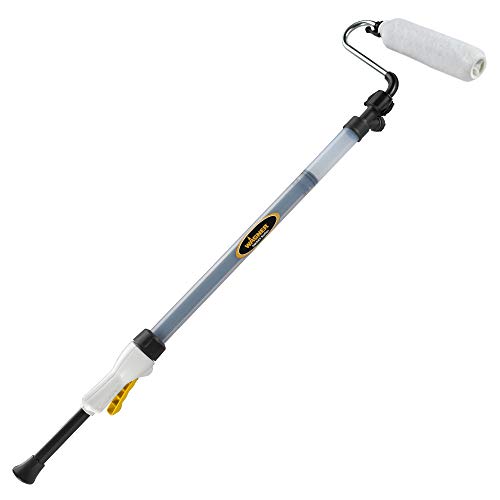
Best for: solo painters covering 8 ft ceilings without a ladder Skip it if: you are rolling thick textured or solvent-based coatings
Wagner's SMART Roller solves the part of the job that eats time: the walk back to the tray. It holds up to 22 oz of paint in the handle and Wagner states that covers up to 70 sq ft per fill. Dimensions are 3 x 44 x 12.5 in, so the tool itself is your extension pole. Wagner says the reach removes the need for ladders, step stools and poles for 8 ft ceilings. Weight is 3.09 lb dry, and the only pick in this set with a published weight figure, which matters because it climbs as the reservoir fills.
Filling works through a tube pressed onto the fill valve, and Wagner names latex paints including paint-and-primer in one. Cleanup is described as pushing leftover paint back into the can and flushing with water.
For shop use, the appeal is one-handed coverage of walls and ceilings while your other hand steadies a ladder or holds a light. The trade-off against the Wooster is control and coating range. A sealed reservoir tool is more to clean, it's one of the two most expensive picks here, and no water-based-only tool wants a solvent finish in it.
Pros:
- 22 oz handle capacity, up to 70 sq ft per fill claim
- 44 in body reaches 8 ft ceilings without a pole
- Only pick with a published weight, 3.09 lb
- No roller tray needed
- Water flush cleanup described in the listing
Cons:
- Latex only per the listing, no solvent-based use stated
- Among the most expensive picks here
- Reservoir adds cleaning steps a bare frame doesn't have
- Gets heavier as you fill it
4. Wagner Spraytech PowerFlow EZ Multi-Room Direct-Feed — Best premium
A 16 ft hose feeding straight from a 5 gallon pail is the only setup here that never stops to reload.

Best for: multi-room repaints straight out of a 5 gallon pail Skip it if: your job is one small room or a batch of cabinet doors
This is the most expensive pick here, and it's a different class of tool. The PowerFlow EZ is an electric direct-feed system that pulls paint from a 1 or 5 gallon container, so there is no tray and no reservoir to refill. Wagner describes auto-feed control on the handle for continuous painting and calls it drip-free. The 16 ft hose gives reach for tall walls and ceilings, with an optional extension pole connection for more. Wagner claims it's twice as fast as a traditional brush or roller with less mess.
The base unit measures 11.3 x 6.25 x 11.3 in, so it sits on the floor beside the pail while you work. Colour black, model 2461319. Two sellers list it, the only pick in this set with more than one.
The economics decide this one. Setup and flush-out on a pumped system is fixed overhead, and it doesn't pay back on a small job. Rolling four rooms and a stairwell, it does. Against the Wooster, you are buying pace and paying for a pump, a hose and a cleaning routine you don't otherwise need.
Pros:
- Feeds directly from a 1 or 5 gallon container
- 16 ft hose plus optional pole connection
- Auto-feed control on the handle
- Two sellers list it, unlike most picks here
- Built for multi-room and two-storey work
Cons:
- Most expensive pick in this set
- Pump and hose flush-out after every session
- Overkill for a single room or panel work
- No published weight or motor figure
5. EUIJOIP 9 in Paint Roller Kit — Best compact
A screw-together 4 ft pole, a frame and three microfiber covers in one bag: the only pick that arrives ready to paint.
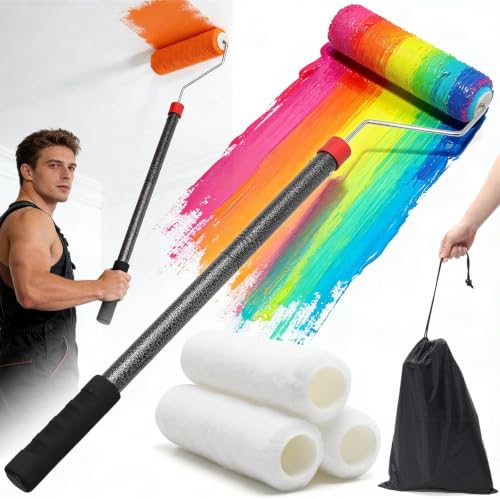
Best for: a first roller kit that stores in a bag between jobs Skip it if: you want a stiff professional cage you can lean on
Every other pick here needs something bought alongside it. This one doesn't. The kit lists screw-together extension pole sections reaching 4 ft, a metal roller frame, three low-shed microfiber covers, hardware and a storage bag. That last item matters more in a shop than it sounds: loose pole sections in a bag beat a fixed pole leaning in a corner collecting sawdust.
The design argument the listing makes is against telescoping poles. EUIJOIP says screw-together metal sections lock into a stable working length instead of collapsing under pressure, and describes a 1.1 in wider metal pole for a fuller grip during overhead work, with a cushioned grip and a rust-resistant hammered finish. The covers are microfiber, which the listing ties to smoother finishes with less lint. Size is listed as 1.1 in medium, colour black.
The published specifications are thin, and that's the honest weakness. Dimensions read 1 x 1 x 1 in, which is placeholder data, and the model reads 4 FT. Neither shank diameter nor cage wire count is stated, so you can't compare the frame against the Wooster on the numbers that decide stiffness.
Pros:
- Frame, 4 ft pole, three covers and bag in one purchase
- Screw-together sections instead of a collapsing telescope
- Microfiber covers stated as low-shed
- Rust-resistant hammered pole finish
- Second-cheapest pick after the Wooster and the sleeve
Cons:
- No shank diameter or cage wire count published
- Listed dimensions of 1 x 1 x 1 in are clearly not real figures
- Pole caps out at 4 ft
- Frame quality unverifiable from the listing
6. Slip Doctors Blue Textured Paint Roller Sleeve — Best for families
An open-mesh sleeve built for thick non-slip coatings, and the only pick here that names its solvent compatibility.

Best for: rolling non-slip texture onto a shop floor or ramp Skip it if: you want a smooth finish on walls or trim
Shop floors get slick. Sawdust on sealed concrete near a ramp or a doorway is a genuine hazard, and this 9 in sleeve exists to fix exactly that. Slip Doctors describes it as engineered for thick paint and coatings, creating a consistent slip-resistant texture with every pass, using an open mesh textured design for even distribution across floors, ramps and walkways.
It's also the only pick in this group that gets specific about chemistry. The blue sleeve is stated as ideal for water-based coatings, the black one for solvent-based paints, and you pick the sleeve to match your coating. The company says it works with paints from any manufacturer and performs especially well with its own Tuff Grip Extreme. Durable construction is claimed to resist matting and breakdown under heavy coatings. Dimensions are 1.5 x 9 x 2.5 in, model TXTRLLR.
One limitation is in the listing itself: for areas over 100 sq ft, multiple sleeves are recommended for consistent texture. Budget accordingly. And note what this is not. It's a sleeve, not a frame, so you need one of the frames above to run it, and it will never lay down a smooth wall finish.
Pros:
- Open mesh design built for thick coatings
- Blue for water-based, black for solvent-based, stated clearly
- Works with coatings from any manufacturer
- Second-cheapest pick in the set
- Resists matting under heavy coatings per the listing
Cons:
- Sleeve only, no frame included
- Textured finish is wrong for walls and trim
- Multiple sleeves needed above 100 sq ft
- Slowest-moving of the low-cost picks here
7. Allgala 9 Inch 5-Wire Heavy Duty Paint Roller Frame-3 — Best upgrade
Three galvanized 5-wire frames in one box, so each colour or coating gets its own dedicated cage.
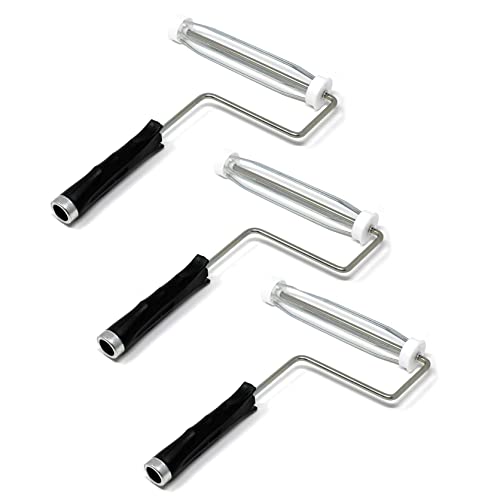
Best for: keeping three loaded frames going in different colours Skip it if: you want published weight and dimension figures before buying
The case for this one is arithmetic. Three frames, one purchase. In a shop running primer on one frame, topcoat on a second and a spare washed and drying, that beats stopping mid-session to clean the only frame you own. Allgala states 1/4 in galvanized metal for durability, a 5-wire cage to secure the cover while staying easy to remove, an ergonomic handle threaded for a standard extension pole, and a smooth rolling motion.
The thread detail is worth flagging, because it's the specification the ROLLINGDOG frame omits. Allgala says standard extension pole, so your existing pole should thread on.
Two problems, though. The shank is 1/4 in galvanized against the Wooster's 5/16 in chrome, and that's the thinnest published shank in this set: less rigidity exactly where flex shows up in the finish. And it's the highest-priced pick among the bare frames while publishing no dimensions, no weight and no colour at all. The tables above had to fall back on feature-bullet claims for this one. You are buying quantity and accepting less rigidity and thinner documentation than the Wooster offers.
Pros:
- Three frames in one purchase
- 1/4 in galvanized metal construction
- 5-wire cage on each frame
- Threaded for a standard extension pole
- Lets you dedicate a frame per coating
Cons:
- Thinnest published shank here at 1/4 in
- No published dimensions, weight or colour
- Highest-priced of the three bare frames
- Slowest-moving pick in the whole set
Frames, sleeves and direct-feed systems: which do you need?
These seven picks are not interchangeable, and the listings blur that. Three categories are in play.
- Bare frames. Wooster, ROLLINGDOG, Allgala. You supply covers and a pole. Maximum control over nap and coating, minimum cost per job, and the only route to running a solvent-safe cover on a stiff cage.
- Kits. The EUIJOIP bundle. Frame, 4 ft pole, three microfiber covers, bag. One purchase, everything present, less choice.
- Sleeves. Slip Doctors. A cover only, in blue for water-based and black for solvent-based, and textured rather than smooth.
- Paint-carrying tools. The Wagner SMART Roller with 22 oz in the handle, and the PowerFlow EZ pumping from a pail through 16 ft of hose. Both replace the tray. Both add cleanup.
If you're buying one thing today and you own a pole and covers, buy a frame. If you own nothing, the kit gets you painting. If your surface is a floor and the goal is grip, the sleeve is the only pick that does the job. And if the wall area runs into multiple rooms, the paint-carrying tools stop being a gadget and start being sensible.
What the listings do not tell you
I lined up the published specifications side by side, and the gaps are as telling as the figures.
Weight is missing almost everywhere. Only the Wagner SMART Roller publishes one, at 3.09 lb. For a tool held overhead for an hour, that's the number you actually want, and six of seven listings don't give it.
Cover nap is unstated on every frame. Nap length is what decides whether you get a smooth or a stippled finish, and no frame listing here specifies what covers to pair with it. Only the EUIJOIP kit names its covers as microfiber, and only the Slip Doctors sleeve names a texture.
Warranty appears in none of the seven listings. Not one publishes a term. So durability judgments have to rest on materials: chrome on the Wooster, galvanized rod and cage on the ROLLINGDOG, 1/4 in galvanized on the Allgala.
Availability is thin. Five of the seven picks are listed by a single seller. Both Wagner tools show two.
Solvent compatibility is a blank. Only the Slip Doctors sleeve addresses it directly, splitting blue for water-based and black for solvent-based. Every other pick leaves you to check the coating's own label before you dip.
The verdict
The best heavy duty paint roller for woodworkers is the Wooster R014-9 Shergrip, and the reason is one number: a 5/16 in chrome shank, the thickest published in this set, on a 5-wire cage that Wooster says holds the cover's shape. It's the cheapest pick here and the one buyers in this group choose most often. It threads onto Sherlock GT and standard poles, which means the pole in your shop corner probably fits. For rolling primer onto panels, coating shop walls or painting shelving, this frame plus the cover your coating needs is the whole answer.
Two conditions flip it. First, if the job is multiple rooms rather than panels, the Wagner PowerFlow EZ earns its cost by feeding from a 5 gallon pail through a 16 ft hose, and Wagner claims twice the pace of a traditional roller. Refilling a tray is what slows a big repaint, not rolling. Second, if the surface is a floor and the goal is traction, the Slip Doctors sleeve is the only pick here with an open-mesh texture and a stated split between water-based blue and solvent-based black.
The ROLLINGDOG frame's exact advantage over the Wooster is corrosion resistance through the whole frame, galvanized rod plus galvanized cage, and a stated seven sealed bearings per end. If you wash a frame out weekly, that's the one to buy instead.
FAQ
Is a heavy duty paint roller worth it over a cheap frame?
A heavy duty paint roller is worth it if you roll for more than an hour at a stretch. The difference lives in the shank: 5/16 in chrome on the Wooster against 1/4 in on the Allgala. A thinner shank flexes under a soaked 9 in cover, letting it tip off-axis and skid, which shows as tramlines in the finish. Stiffness is what you're paying for.
What size roller frame do woodworkers need for panels?
For panels, a 9 in frame is the standard, and six of these seven picks are built around 9 in covers. It clears a full sheet of plywood in few passes without becoming unwieldy on a 24 in shelf. For narrow stiles or cabinet interiors, a shorter cover on a mini frame works better, and none of the picks here covers that size.
Wooster Shergrip or ROLLINGDOG: which frame should I buy?
Choosing between the Wooster Shergrip and the ROLLINGDOG comes down to cleanup habits. The Wooster publishes a 5/16 in chrome shank, names Sherlock GT and standard pole compatibility, and costs less. The ROLLINGDOG counters with an 8 mm galvanized rod, a galvanized 5-wire cage and seven sealed bearings per end. Buy the ROLLINGDOG if you wash the frame out weekly, the Wooster otherwise.
Can I use these rollers with solvent-based finishes?
Using these rollers with solvent-based finishes needs care, because only one listing addresses it. Slip Doctors states a blue sleeve for water-based coatings and a black one for solvent-based. Wagner names latex paints including paint-and-primer in one for the SMART Roller and nothing else. The bare frames say nothing either way, so match the cover to your coating's label first.
What is the most common mistake buying a heavy duty paint roller?
The most common mistake buying a roller is treating the frame and the cover as one decision. The frame sets stiffness and pole fit; the cover sets nap, texture and coating compatibility. None of the frame listings here specifies a nap. Buy the stiffest frame with a standard thread, then choose covers per job. Also check the pole thread before you order.
Start with the Wooster R014-9 Shergrip and a small stack of covers matched to whatever you're spraying or rolling this month. It's the cheapest way into a frame with a 5/16 in shank and a 5-wire cage, and it threads onto the pole you already own. That combination is what keeps a loaded cover round, and a cover that stays round is the difference between a panel you sand once and a panel you sand three times. Add the ROLLINGDOG later if you find yourself washing one frame out every weekend, or the Slip Doctors sleeve the day the shop floor starts feeling slick underfoot.
Last updated: September 7, 2026. Product availability re-checked.
This page contains affiliate links. As an Amazon Associate we earn from qualifying purchases, at no extra cost to you.