Best Foldable Exercise Mat: CAP Barbell Leads
A folding mat that flexes underfoot is the one that causes a fall. I lined up five published spec sheets to find which folding mats give the firmest, thickest landing surface and which ones fold small enough to store in a closet.
The best foldable exercise mat for seniors is the CAP Barbell Folding Exercise Mat in black, because it pairs a full 2 in of high-density foam with a 4.08 lb carry weight and built-in nylon handles. If you need to lift the mat every single day, the BalanceFrom 6x2 Feet 3-Panel Folding Gymnastics Mat is lighter still at 3 lb and adds a 2-year warranty. Pick wrong here and the consequence is not a wasted purchase. It's a mat that compresses under a knee, shifts on a hard floor, or sits so heavy in the closet you stop pulling it out. Thin mats fail in a specific way: the padding bottoms out exactly where your weight concentrates.
Best foldable exercise mat for seniors at a glance
| Pick | Thickness | Carry weight | Price |
|---|---|---|---|
| Best overall CAP Barbell Folding Exercise Mat (Black) |
2 in | 4.08 lb | Check Price |
| Best minimal setup BalanceFrom 6x2 Feet 3-Panel Folding Gymnastics Mat |
2 in | 3 lb | Check Price |
| Best upgrade KEEP Foldable Yoga Mat |
0.28 in (7mm) | Not published | Check Price |
| Best premium RitFit Upgraded Folding Exercise Mat |
2 in | Not published | Check Price |
| Most versatile CAP Barbell Folding Exercise Mat (Blue) |
2 in | 4.08 lb | Check Price |
How I ranked these five folding mats
I weighted three criteria, in this order.
- Padding depth. Four of the five publish 2 in. One publishes 0.28 in. That gap is the largest single difference in the set, and it decides more than anything else here.
- Carry weight. Only two listings publish a figure: 3 lb and 4.08 lb. A mat you can lift with one hand gets used. One you have to drag does not.
- Footprint when open. Four mats measure 72 x 24 in. One measures 72 x 36 in. Width matters the moment you shift your weight sideways on a knee.
Why those three and not the surface material? Because the covers here are described in the manufacturers' own words, not to a shared standard. One listing claims a PU leather cover, another a double-sided vinyl cover, a third a water-ripple TPE texture. Those are three vocabularies for "grippy", and I can't rank them against each other from the page.
What I deliberately did not weight: colour, model number, or the number of sellers stocking each mat. Two of these five list only a single seller, which is worth knowing but tells you nothing about how the mat performs on a hardwood floor.
Does a foldable exercise mat actually suit seniors?
Amazon's results for the best foldable exercise mat for seniors return general-purpose folding mats. Not one of these five listings is designed, labelled or specified for older adults, and none publishes a weight capacity, a slip-resistance rating, or any accessibility feature. So I won't pretend otherwise.
What that means practically: you have to judge suitability yourself, from figures the listings do publish. Three questions worth answering before you buy.
- Can you lift it? Two listings publish a carry weight. Three don't. If lifting is the constraint, buy from the two that tell you.
- Is it thick enough under a knee or hip? 2 in of foam and 7mm of TPE are not comparable surfaces for kneeling.
- Will the surface move on your floor? Every listing claims non-slip. None of them quantifies it, and a claim is not a measurement.
If you're working with a specific balance or joint issue, the mat is one input and your physiotherapist is the other. Nothing in this data replaces that conversation.
1. CAP Barbell Folding Exercise Mat (Black) — Best overall
The full 2 in of high-density foam plus a published 4.08 lb carry weight makes this the most complete package here, and it's the cheapest of the five.

Best for: floor work that needs a thick, firm landing surface and a mat that stores upright Skip it if: you need a mat wider than 24 in for kneeling side to side
What separates this mat inside the set is that nothing about it is a compromise. It matches the thickest padding on offer at 2 in, it's the second-lightest of the five at 4.08 lb, and it sits at the bottom of the price ladder. Of the five picks, it's also the one buyers choose most often. The published dimensions are 2 x 72 x 24 in, so it opens to a full 6 ft length.
CAP describes the foam as high-density and engineered for impact absorption, and says the cover is free from ten phthalates, lead and mercury. That's the manufacturer's claim, and it's the same claim carried on the blue version. The nylon handles are built in rather than strapped on, which matters when the mat lives in a closet and comes out four times a week.
The trade-off against the RitFit is width. At 24 in you get a single lane. The RitFit gives you 36 in. And CAP publishes no warranty here, where BalanceFrom publishes 2 years.
Pros:
- Full 2 in padding, the thickest tier in this group
- 4.08 lb published carry weight
- Built-in nylon handles rather than add-on straps
- Cheapest of the five picks
- Hook-and-loop edges for joining a second mat
Cons:
- No published warranty
- 24 in width is narrow for side-to-side movement
- Only one seller lists it
- Cover material not named in the specifications
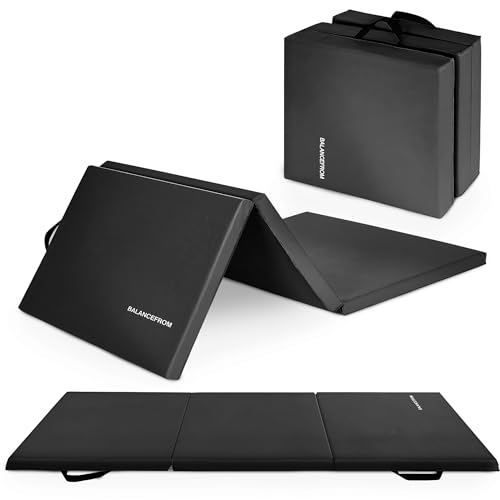
2. BalanceFrom 6x2 Feet 3-Panel Folding Gymnastics Mat — Best minimal setup
At 3 lb it's the lightest mat here with 2 in of padding, and it's the only one of the five with a published warranty.
Best for: anyone lifting the mat in and out of a closet daily Skip it if: you want the lowest price in this group
This is the one to buy if handling the mat is harder than using it. 3 lb is a full pound lighter than either CAP mat, and it still delivers the same 2 in of padding across 72 x 24 in. That combination doesn't exist anywhere else in this set.
It's also the only listing here that publishes a warranty: 2 years. Four of the five say nothing about coverage at all, which makes this the single most concrete piece of after-sale information in the whole comparison. The listing has been on Amazon since 2018, and BalanceFrom describes a three-panel fold that closes down to 2 x 2 x 6 ft with hook-and-loop edges holding it firm. The cover is described as double-sided vinyl that wipes clean.
The cost of that low weight is padding density you can't verify. 2 in of foam at 3 lb is less material per inch than 2 in at 4.08 lb, and the listing doesn't specify foam density. It's also the second most expensive pick here.
Pros:
- Lightest 2 in mat in the set at 3 lb
- Only pick with a published warranty, at 2 years
- Folded footprint stated as 2 x 2 x 6 ft
- Built-in handles for carrying
- Wipe-clean vinyl cover per the listing
Cons:
- Priced above three of the four alternatives
- Lower weight may mean less dense foam
- 24 in width, same narrow lane as the CAP mats
- No foam density figure published
3. KEEP Foldable Yoga Mat — Best upgrade
The only mat here that folds flat instead of thick, which makes it the pick for standing and seated stretching rather than knee work.

Best for: chair-supported stretching on a mat that must lie flat instantly Skip it if: you need real cushioning under a knee or hip
This is the outlier, and it earns its place by solving a different problem. At 0.28 in, or 7mm, the profile is a fraction of the other four. It's not competing on padding. It's competing on the fact that it lays out flat the moment you drop it, with no curled corners to catch a toe. A rolled mat that curls at the edge is a genuine trip hazard, and this design removes it.
KEEP claims a double-sided water-ripple texture for grip, SGS-certified TPE construction, and testing to over 100,000 folds without cracking. The listing also describes three usable modes: fully open at 72 x 24 in, half-folded for extra cushioning under a hip during crunches, and fully folded into a block for balance work or a seated cushion. That block trick is the most genuinely useful thing in this feature list.
The honest limit is padding. Seven millimetres under a kneecap on a tile floor is thin, and this is the second-cheapest pick rather than a step up in cushioning.
Pros:
- Lays perfectly flat with no curling edges
- Folds into a block for balance or seated support
- SGS-certified TPE per the listing
- Second-cheapest of the five picks
Cons:
- 0.28 in is far thinner than the 2 in alternatives
- No carry weight published
- Not suitable for kneeling on hard floors
- Slowest seller of the four cheapest picks here
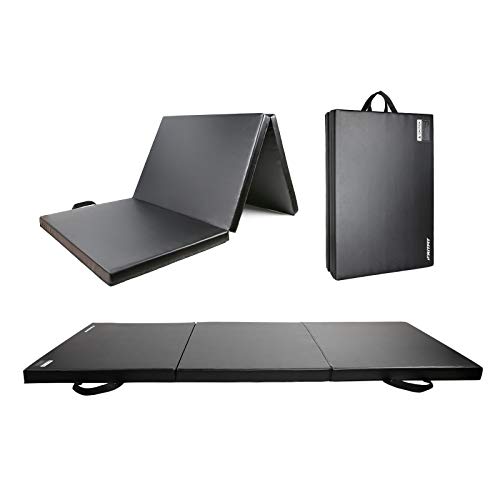
4. RitFit Upgraded Folding Exercise Mat — Best premium
The only mat here that opens to 36 in wide, which is the single spec that changes how much you can move.
Best for: anyone who needs the full 36 in of width to move sideways Skip it if: storage space is tight or you want a published warranty
Width is the reason to consider this one. Its dimensions are 2 x 72 x 36 in, so it's a full foot wider than the other four. On a 24 in mat, a hand placed wide during a kneeling stretch lands on the floor. On 36 in, it doesn't. If you shift weight side to side or use a hand on the ground for support, that extra foot is the difference between a mat and a strip.
RitFit describes a tri-density foam core under a PU leather cover it calls soft, sweat-resistant and non-slip, and states the foam is non-toxic with no latex or silicone. Nylon handles are integrated for carrying, and the brand advertises a satisfaction guarantee, which is a returns policy rather than a warranty on the mat itself.
Two costs. It's the most expensive pick here, and being wider it takes up more closet depth when folded. It also publishes no weight figure at all, which for a mat you'll be lifting is a real gap, and it's the slowest seller in the group.
Pros:
- Widest open surface here at 36 in
- Full 2 in padding depth
- Tri-density foam and PU leather cover per the listing
- Integrated nylon carry handles
Cons:
- Most expensive of the five picks
- No carry weight published anywhere in the listing
- Larger folded footprint than the 24 in mats
- No stated warranty term, only a satisfaction guarantee
- Only one seller lists it
5. CAP Barbell Folding Exercise Mat (Blue) — Most versatile
Identical specifications to the winner in blue, and worth buying as the second mat when you want to link two together into one wide surface.

Best for: linking two mats into one wide padded area Skip it if: you only ever need one mat and want to pay less
Spec for spec this is the winner in a different colour: 2 x 72 x 24 in, 4.08 lb, the same high-density foam, the same nylon handles, the same phthalate-free claim. Model MTIS-9263-BL10P against MTIS-9263-BK10P. So the case for it is situational rather than technical.
Here's where it makes sense. CAP's hook-and-loop closures let you attach multiple mats edge to edge, and two of these side by side give you 72 x 48 in of continuous 2 in padding. That's a genuinely different training surface, wide enough to roll or shift across without hunting for the edge. Buying the second one in blue also makes the two mats visually distinct, which sounds trivial until you're trying to work out which one goes back in the closet.
The catch: it costs more than the black version of exactly the same mat, and it's the second-slowest seller here. If you need one mat, buy the black one and keep the difference.
Pros:
- Same 2 in padding and 4.08 lb weight as the winner
- Hook-and-loop edges expand to 72 x 48 in with a second mat
- Built-in nylon handles
- Phthalate, lead and mercury free per CAP
Cons:
- Costs more than the identical black version
- No published warranty
- Nothing here the black model doesn't already do
- Sells far more slowly than the black version
How thick does the padding need to be?
This set splits cleanly at one number. Four mats publish 2 in of padding. One publishes 0.28 in. There is no middle option here, which makes the choice unusually easy.
Two inches is what you want under a knee, hip or elbow on a hard floor. It's the depth that keeps a bony landmark from finding the tile underneath. Seven millimetres is a yoga-mat profile: fine for standing balance work, a plank on carpet, or seated stretching, and thin under a kneecap on hardwood.
The trap is assuming thickness alone tells you about firmness. It doesn't. A 2 in mat at 3 lb and a 2 in mat at 4.08 lb contain different amounts of foam across the same footprint, and none of these listings publishes a density figure. So use thickness to pick your tier, then use published weight as your only available proxy for how much material is actually in there.
- Kneeling, lying down, transitions on and off the floor: 2 in.
- Standing balance, seated stretching, chair-assisted work: 7mm is enough.
- Both: buy the 2 in mat. It does the thin mat's job. The reverse isn't true.
Getting down and back up: what the folded size tells you
The moment that decides whether a mat gets used is not the workout. It's the two minutes before and after, when you're carrying it and setting it down.
Only two of these five publish a carry weight: 3 lb for the BalanceFrom and 4.08 lb for both CAP mats. That 1.08 lb gap sounds small on paper and feels different when you're holding the mat away from your body at arm's length. The RitFit and the KEEP publish nothing, and for a product whose whole selling point is portability, that's a meaningful omission.
Folded footprint is the other half. BalanceFrom states its folded size as 2 x 2 x 6 ft, the only listing here that gives you the number outright. The two CAP mats and the RitFit fold with hook-and-loop closures but don't publish folded dimensions, so measure your closet and allow for a 2 ft square block roughly 6 in deep on the 24 in mats.
The KEEP is the different case entirely. At 7mm it folds down to a slim rectangle you could slide behind a door, and it folds into a block you can actually sit on. Storage is a non-issue with it.
What the listings do not tell you
Five gaps worth knowing about before you commit to the best foldable exercise mat for seniors.
- No weight capacity. Not one of these five publishes a maximum user weight. Folding mats are generally cushioning products rather than load-bearing platforms, but the figure isn't here to check.
- No slip rating. Every listing claims non-slip. Nobody quantifies it against a standard, and a textured vinyl cover on tile behaves differently to the same cover on carpet.
- No foam density. Four mats claim 2 in. None states density, so 2 in is a dimension, not a firmness spec.
- Two mats publish no weight at all. The RitFit and the KEEP leave it blank.
- Four of five publish no warranty. Only BalanceFrom states a term, at 2 years.
The practical response: buy from the listings that publish the figure you care about most. If lifting is your limiting factor, the two mats with published weights are the two real candidates. If long-term coverage matters, there's exactly one answer in this group.
The verdict
The CAP Barbell Folding Exercise Mat in black is the best foldable exercise mat for seniors in this group, and it wins on completeness rather than a single standout number. It matches the thickest padding in the set at 2 in, publishes a carry weight of 4.08 lb, includes built-in nylon handles, and costs less than the other four. Nothing else here does all of that at once.
Two conditions flip it. First, if lifting the mat is genuinely difficult, take the BalanceFrom 6x2 Feet 3-Panel Folding Gymnastics Mat instead. Its advantage is precise: 3 lb rather than 4.08 lb with the same 2 in of padding, plus the only published warranty in the comparison at 2 years. Second, if you shift your weight sideways on a knee or plant a hand for support, the RitFit's 36 in width is the spec that matters, and no other mat here comes close to it.
A third case: if you're doing standing balance and seated stretching rather than floor work, the KEEP Foldable Yoga Mat's flat-lying 7mm profile removes the curled-edge trip hazard that rolled mats create, and folds into a block you can sit on.
Skip the blue CAP unless you're buying a second mat to link alongside the first.
FAQ
Is a foldable exercise mat worth it over a regular yoga mat?
A foldable exercise mat is worth it when you need padding depth a rolled yoga mat can't provide. Four of these five publish 2 in of foam, roughly seven times the 0.28 in profile of the KEEP. That depth is what protects a knee on hardwood. If you only stretch standing or seated, a thin mat is enough.
How much does the best foldable exercise mat for seniors cost?
The best foldable exercise mat for seniors doesn't have to be the expensive one. In this set, the mat I'd recommend first is also the cheapest of the five, and the widest option is the most expensive. Extra money here buys width and warranty coverage, not more padding, since four of the five mats already publish the same 2 in depth.
Which is better for daily use, CAP Barbell or BalanceFrom?
Better for daily use depends on one thing: whether lifting the mat is hard. BalanceFrom weighs 3 lb against CAP's 4.08 lb, publishes its folded size as 2 x 2 x 6 ft, and carries a 2-year warranty. CAP costs less and sells far more often. Both deliver 2 in of padding across 72 x 24 in.
Will a 24-inch wide mat be wide enough?
A 24-inch wide mat is wide enough for straight-line work: lying down, bridges, leg raises, planks. It gets tight the moment you place a hand or knee out to the side, because your support hand lands on bare floor. The RitFit is the only pick here at 36 in wide, a full foot more surface for lateral movement.
What is the most common mistake when buying a folding mat?
The most common mistake is treating thickness as firmness. Two of these mats both claim 2 in of padding but weigh 3 lb and 4.08 lb, which means different amounts of foam in the same space. None of these listings publishes a foam density figure. Use thickness to choose your tier, then compare published weights.
Start with the black CAP mat. It gives you the thickest padding tier on offer, a weight you can actually check before you buy, and handles that mean the mat comes out of the closet instead of staying in it. That last point decides more than any spec: the mat you use three times a week beats the better mat you leave folded. If a pound of carry weight is the difference between using it and not, spend the extra on the BalanceFrom and take the 2-year warranty as a bonus. Measure your closet depth first either way.
Last updated: September 7, 2026. Product availability re-checked.
This page contains affiliate links. As an Amazon Associate we earn from qualifying purchases, at no extra cost to you.