Best Digital Calipers for Machinist Precision Work
Six digital calipers compared on resolution, reference retention and build. One reads 0.001", one keeps its zero after power-off, and one charges over USB-C. Here's which fits your bench.
The best digital calipers for machinist work are the HARDELL Digital Caliper 6 Inch, which pairs a 0.01mm resolution with a 0.001″ readout and ships as a five-piece kit. If you need to log numbers to a computer, the iGaging Absolute Origin with its SPC/USB output port is the smarter buy. Pick the wrong tool and you learn the cost the first time a reading drifts on a critical part, so resolution and reference behaviour matter more than any bundled extra.
Best digital calipers for machinist work at a glance
| Pick | Resolution | Range | Price |
|---|---|---|---|
| Best overall HARDELL Digital Caliper 6 Inch |
0.01mm / 0.001″ claim | 6 in | Check Price |
| Best upgrade Jiavarry Digital Caliper Measuring Tool |
0.01mm claim | 6 in | Check Price |
| Runner-up iGAGING Absolute Origin 0-6″ Digital Caliper |
not listed | 0-6″ | Check Price |
| Best for pros Preciva Digital Caliper 6″ |
0.01mm claim | 0-6″ | Check Price |
| Best minimal setup Preciva Digital Caliper 12 Inch |
0.01mm claim | 12 in | Check Price |
| Best premium HARDELL Digital Caliper 12 Inch |
0.0005″ claim | 12 in | Check Price |
How I scored these six calipers
I compared the published specifications for all six side by side, weighting them the way a machinist actually chooses a caliper. Here are the criteria and roughly what each one counted for.
- Resolution and stated accuracy, first. The whole job is reading small differences reliably. A tool that publishes 0.001″ resolution earns more trust than one that only names a range.
- Reference behaviour, second. Whether the tool holds its zero after power-off decides how often you re-establish datum during a session.
- Build and body, third. Stainless steel or all-metal construction resists the abuse of a working bench.
- Range and daily fit, fourth. A 6-inch tool suits small parts; a 12-inch reaches longer stock.
- Extras last. Cases, spare batteries and data ports break ties, not decisions.
Two things got picks docked hard. The Preciva 6″ publishes almost no dimensional data, and two of the 12-inch tools trade tight accuracy for reach. I chose these criteria because a caliper you cannot trust to 0.001″ is not a machinist tool, whatever the listing calls it.
Resolution vs. accuracy: which number actually matters?
These two figures get confused constantly, and the confusion sends buyers to the wrong tool. Resolution is the smallest increment the display shows. Accuracy is how close the reading sits to the true dimension.
A caliper can display 0.0005″ and still be off by more than that. Read both numbers together.
- The HARDELL 6-inch lists 0.01mm resolution and a ±0.02mm / 0.001″ accuracy claim.
- The HARDELL 12-inch lists 0.0005″ resolution but a ±0.04mm / 0.002″ accuracy claim.
Notice the second tool shows finer increments yet claims looser accuracy. That is the trap. For machinist work on small parts, the tighter accuracy number wins. A finer display on a longer bar does not make the reading truer. When a listing names only a range with no accuracy figure, treat that as a gap and plan to verify against a gauge block you trust.
Does the machinist label really apply here?
Several of these listings use the word machinist in their marketing. That is a claim, not a certification. None of these tools publishes a calibration certificate, traceability statement, or the sub-thousandth repeatability a hard machinist tolerance demands. So judge the machinist fit yourself, against your own tolerances.
Here is how to read it honestly:
- For general shop measuring to 0.001″, the HARDELL 6-inch and the iGaging Origin both make a reasonable case.
- For tolerances tighter than the published accuracy claims, none of the six is enough on its own; you'd pair it with a micrometer.
- The best digital calipers for machinist duty in this set are the ones with the tightest stated accuracy and the most consistent reference behaviour, not the ones with the word on the box.
Read the accuracy figure, not the adjective. That single habit protects you from every overstated listing here.
1. HARDELL Digital Caliper 6 Inch — Best overall
The HARDELL 6-inch pairs the tightest accuracy claim in the set with a full starter kit, making it the safest default for machinist measuring.

Best for: a machinist wanting 0.001″ resolution and a full kit out of the box Skip it if: you need a documented reference-retention feature
What sets this one apart within the group is the combination. HARDELL states ±0.02mm / 0.001″ accuracy with 0.01mm resolution over the 0-6″ / 0-150mm range, which is the tightest accuracy claim among the six. The body is solid stainless steel, so it shrugs off bench wear the way a machinist needs. Its listed dimensions are 0.1 x 10.4 x 1.18 in.
The kit is the second reason it leads. HARDELL says the package includes the caliper, a case, two batteries with one spare, a mini screwdriver, and a stainless steel ruler, a count of five items where most rivals ship one. That spare battery matters on a bench where a dead cell mid-job costs you time. It also carries four measurement modes for ID, OD, depth and step, and one-click metric to imperial switching.
It sells faster than any other pick here. The trade-off against the iGaging runner-up is data: this HARDELL has no output port, so you copy readings by hand.
Pros:
- Tightest stated accuracy in the set, ±0.02mm
- Five-piece kit with a spare battery
- Solid stainless steel body
- 0.01mm resolution with quick unit switching
- The cheapest of the six
Cons:
- No data output port for logging
- Runs on button cells, not rechargeable
- Reference retention not documented
2. Jiavarry Digital Caliper Measuring Tool — Best upgrade
The Jiavarry adds a third readout unit and a lighter body, a sensible step up when you switch between fractions often.
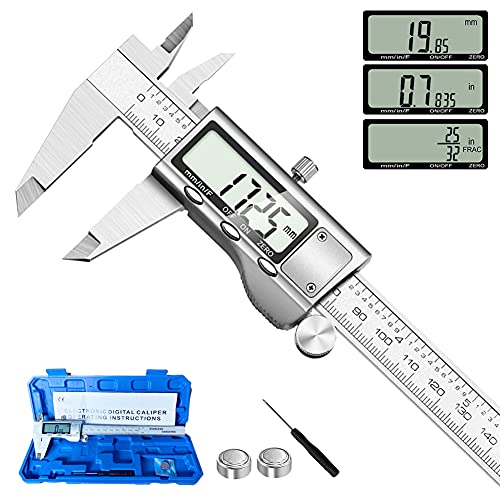
Best for: someone who wants inch, metric and fraction readouts on a light body Skip it if: you need a range longer than 6 inches
The Jiavarry's differentiator in this set is its readout flexibility. It switches between inches, fractions and millimeters with one key, which the second-cheapest position here makes easy to justify. Jiavarry states a measuring range of 0-6″ / 0-150mm, ±0.02mm accuracy and 0.01mm resolution. The stainless steel body is described as waterproof and dirt-proof.
At 0.75 lb it is a defined, modest weight, and its listed dimensions of 0.04 x 6 x 6 in point to a slim slide. Four measurement modes cover inside and outside diameter, depth and step, using two jaw sets and a probe. For a woodworker or hobby machinist who thinks in fractions, that third unit removes a mental conversion step every measurement.
It sells faster than any other pick in this group, edging out even the overall winner on that count. The trade-off is scope: the ships-alone package includes just the caliper, so there is no spare battery or case bundled the way the HARDELL 6-inch offers.
Pros:
- Three units including fractional inches
- Defined 0.75 lb weight, slim body
- ±0.02mm accuracy claim
- The one buyers choose most often here
Cons:
- Single item, no case or spare battery
- Capped at 6-inch range
- Reference retention not documented
3. iGAGING Absolute Origin 0-6″ Digital Caliper — Runner-up
The iGaging is the only pick here with a data port and a stated ingress rating, which is why it takes the runner-up slot for anyone logging numbers.

Best for: anyone logging measurements to a PC or spreadsheet Skip it if: you want the finest published resolution here
This is the feature-rich choice in the group. iGaging says the Absolute Origin retains its zero reference point even after the caliper is off, the one documented reference-retention claim among the six. For a machinist re-checking a run of parts, that means less time re-zeroing. It also carries an SPC/USB output port, so iGaging says you can export readings straight into CAD software or a spreadsheet.
The body carries an IP54 rating against dust and moisture, again the only stated ingress figure here. Its listed dimensions are 0.1 x 10 x 3.75 in over the 0-6″ range, and iGaging describes a high-contrast LCD readable in low light. The model number is 100-700-06.
It sits mid-pack on price and sells briskly. The catch is what the listing leaves out: no resolution or accuracy figure is published, so you cannot compare its precision directly against the HARDELL's 0.001″ claim. If the numbers matter more than the port, the winner is the safer pick.
Pros:
- Only pick with SPC/USB data output
- Documented absolute reference retention
- IP54 dust and moisture rating
- High-contrast display for low light
Cons:
- No published resolution or accuracy figure
- Bulkier 3.75-inch listed width
- Mid-range price for uncertain precision spec
4. Preciva Digital Caliper 6″ — Best for pros
The Preciva 6-inch swaps button cells for a rechargeable lithium-ion pack, a real convenience for a pro measuring all day.

Best for: a pro tired of swapping button cells mid-job Skip it if: you want published size and weight before buying
The Preciva 6″ earns its place on power. Preciva says it uses a built-in high-efficiency lithium-ion battery that recharges quickly, removing the frequent cell swaps that plague button-cell calipers. For a working machinist, that is one fewer interruption across a shift. Preciva states ±0.0005″ / 0.01mm accuracy across the 0-6″ / 150mm range, with a matching 0.0005″ resolution.
The stainless steel body is described as waterproof and dirt-proof, and a thumb roller plus locking screw are claimed to steady each reading. It switches instantly between decimal inches, fraction inches and millimeters, so it handles mixed drawings without fuss. The model number is 11-15487.
It sits mid-pack on price but is the slowest seller of the six by a wide margin. The honest weakness is documentation: this listing publishes no size, weight or dimensional data, so you buy on the accuracy claim and the recharge feature alone. If you want the numbers spelled out before you commit, the HARDELL picks are clearer.
Pros:
- Rechargeable lithium-ion, no button cells
- ±0.0005″ accuracy claim
- Three-unit instant switching
- Thumb roller and locking screw for steady reads
Cons:
- No published size, weight or dimensions
- The slowest seller in this set
- Reference retention not documented
5. Preciva Digital Caliper 12 Inch — Best minimal setup
The Preciva 12-inch stretches to a full foot of range with USB-C charging and the fewest extras to fuss over.

Best for: measuring long stock up to 12 inches with USB-C charging Skip it if: you need tight accuracy on small parts
Range is what this Preciva brings to the set. It measures 0-300mm / 0-12″, double the reach of the 6-inch tools, which suits longer stock and larger fixtures. Preciva says it charges through a built-in 3.7V 100mAh battery over a Type-C port, so you top it up with the same cable as your phone. The package is deliberately spare: caliper, storage box, charging cable and manual, nothing more.
Preciva states 0.01mm resolution with ±0.03mm accuracy. That accuracy claim is looser than the HARDELL 6-inch's ±0.02mm, which is the price you pay for the longer beam. The jumbo LCD is described as easy to read in a well-lit space, and the hardened stainless steel body is called rust-proof. Its listed dimensions are 0.04 x 5.12 x 1.18 in.
It is the second-most expensive pick here and the second-slowest seller. The trade-off is precision for reach: on small parts, a 6-inch tool with a tighter accuracy claim serves you better.
Pros:
- Full 12-inch measuring range
- USB-C rechargeable, no cells to buy
- Minimal package, nothing to lose
- Hardened rust-proof stainless steel
Cons:
- Looser ±0.03mm accuracy claim
- Second-most expensive pick here
- LCD leans on ambient light
6. HARDELL Digital Caliper 12 Inch — Best premium
The HARDELL 12-inch combines a backlit screen with all-metal build and long recharge intervals, the most equipped 12-inch option in the group.

Best for: a dim workshop where a backlit 12-inch reach matters Skip it if: your bench only handles small parts under 6 inches
This is the most expensive pick here, and it justifies the position on features rather than raw precision. HARDELL says a bright backlit LCD reads clearly in dark garages or bright sun, which none of the other 12-inch tools claims. It also states a 4-month battery life from a 20-minute charge, with just 2 minutes enough to get going. That is the longest recharge interval described in the set.
The all-metal body, including the screen housing, is said to resist magnetic interference near drills and motors. It carries three units and four modes: inch, millimeter and fractional inch, with internal, external, depth and step. Range is 0-12″ and the finish is orange, so it is easy to spot on a cluttered bench. Listed dimensions are 0.04 x 11.8 x 1.57 in.
HARDELL claims ±0.04mm / 0.002″ accuracy with 0.0005″ resolution. That accuracy is the loosest of the group despite the fine display, the resolution-versus-accuracy trap in action. For small precise parts, a 6-inch pick reads truer.
Pros:
- Backlit LCD for dim or bright light
- 4-month battery from a 20-minute charge
- All-metal body resists magnetic interference
- Three units and four measurement modes
Cons:
- Loosest accuracy claim, ±0.04mm
- The most expensive pick here
- 12-inch body overkill for small parts
6-inch or 12-inch: which range fits your bench?
Range is the fastest way to split this set in half. Four of the six are 6-inch tools; two reach 12 inches. The choice is not about wanting more, it is about what you actually measure.
- Under 6 inches, most days: stay with a 6-inch tool. The HARDELL 6-inch, Jiavarry, iGaging Origin and Preciva 6″ all cover 0-150mm.
- Long stock or large fixtures: step up to the Preciva 12-inch or HARDELL 12-inch for the 0-300mm reach.
- Precision on small parts is the priority: the 6-inch tools here carry tighter accuracy claims, so range costs you nothing but you gain a truer reading.
A longer beam flexes more and both 12-inch picks here claim looser accuracy. Buy the range you need, not the range you might use once.
Battery, charging and the reference-zero question
Power and reference behaviour separate a caliper you grab without thinking from one that fights you. Three of these tools recharge; the others run on button cells.
- USB-C rechargeable: the Preciva 6″, Preciva 12-inch and HARDELL 12-inch skip cell swaps entirely.
- Button cells with a spare included: the HARDELL 6-inch ships two batteries, so a dead cell does not stop the job.
- Reference retention: only the iGaging Absolute Origin documents holding its zero after power-off.
That last point matters more than it sounds. A caliper that forgets its zero makes you re-establish datum every time you power up, and on a run of identical parts that adds up. If you re-check many parts against one reference, the iGaging saves the most fiddling. If you just want to never hunt for a button cell, the rechargeable trio wins.
The verdict
If you measure small parts to 0.001″ and want a tool that works the moment it arrives, the HARDELL Digital Caliper 6 Inch is the pick. It carries the tightest accuracy claim here, ±0.02mm, in a solid stainless steel body, and it ships as a five-piece kit with a spare battery. That combination is why it leads.
If your work runs through a computer, the iGaging Absolute Origin is the better track. Its SPC/USB output port is the only data connection in the group, and it is the sole tool that documents holding its zero reference after power-off. The cutoff is simple: if you log readings, choose the iGaging; if you read and record by hand, the HARDELL.
For long stock, the 12-inch picks take over, with the backlit HARDELL 12-inch the equipped choice and the USB-C Preciva 12-inch the leaner one. Both trade tighter accuracy for reach. None of the six carries a calibration certificate, so match any of them against your own gauge before you trust a tight tolerance.
FAQ
Are these digital calipers worth the money for a machinist?
These digital calipers are worth the money for general shop measuring to about 0.001″, which the HARDELL 6-inch claims at ±0.02mm. The entry-priced picks cost little yet cover ID, OD, depth and step. For tolerances tighter than the published accuracy figures, pair one with a micrometer rather than relying on the caliper alone.
Is the iGaging Absolute Origin worth it over a cheaper caliper?
Whether the iGaging Absolute Origin is worth it comes down to two features nothing cheaper here offers: an SPC/USB output port and documented reference retention after power-off. If you log measurements to a spreadsheet or re-check runs against one zero, those justify the mid-range price. If you record by hand, a cheaper pick with a published accuracy figure serves you as well.
What resolution and accuracy do these calipers actually offer?
The resolution and accuracy differ across the set. The HARDELL 6-inch claims 0.01mm resolution with ±0.02mm accuracy, the tightest here. The two 12-inch tools show finer 0.0005″ resolution but looser accuracy, ±0.04mm on the HARDELL and ±0.03mm on the Preciva. Read accuracy, not resolution, when precision on small parts matters most.
HARDELL 6-inch or Jiavarry: which should I pick?
Choosing HARDELL 6-inch or Jiavarry depends on what you value. The HARDELL ships a five-piece kit with a spare battery and holds the tightest accuracy claim. The Jiavarry adds fractional-inch readout, weighs a defined 0.75 lb, and is the fastest seller here. Want the fuller kit, take the HARDELL; want the three-unit readout, take the Jiavarry.
What mistake do first-time caliper buyers make?
The mistake first-time caliper buyers make is chasing the finest resolution number instead of the accuracy number. A tool displaying 0.0005″ can still read looser than one showing 0.01mm, as the 12-inch picks here show. Always read the ±accuracy figure, and when a listing omits it, verify against a gauge block before trusting a tight tolerance.
Start by matching the range to your bench, then let the accuracy claim decide within that range. For most machinist work on small parts, that lands you on the HARDELL 6-inch: the tightest ±0.02mm claim in this group, a stainless body built for daily abuse, and a kit that includes the spare battery you would otherwise buy separately. Log your numbers to a PC and the iGaging Origin earns the swap instead. Measure your own critical parts against a trusted gauge first, and either tool will hold up on the bench.
Last updated: September 7, 2026. Product availability re-checked.
This page contains affiliate links. As an Amazon Associate we earn from qualifying purchases, at no extra cost to you.