Best Compact Label Printer by Weight and Size
Five compact label makers compared on published weight, footprint, warranty and how you type on them. The Brother PT-N10 leads on keyboard independence; the Phomemo D30 undercuts everything at 5.64 oz.
The best compact label printer for students is the Brother P-Touch PT-N10, because its full QWERTY keyboard and 12-character preview screen mean you never need a phone to print a shelf label, and it still weighs just 1 lb. If you'd rather design labels on your phone and want the smallest possible body, the Phomemo D30 is the better buy at 5.64 oz.
This is not the category for everyone. If you label two notebooks a semester, a marker does the job and costs nothing to feed. If you run an Etsy shop from your dorm and need 4x6 postage labels, only one pick here handles that width, and it's the heaviest of the five. Everyone in between, the person with a shared fridge, a cable drawer and three identical black chargers, is who these five are for.
Best compact label printer for students at a glance
| Pick | Input method | Weight | Price |
|---|---|---|---|
| Best overall Brother P-Touch PT-N10 |
QWERTY keyboard 12-char screen |
1 lb | Check Price |
| Best for families Nelko P21 Label Maker |
Phone app Bluetooth |
0.72 lb | Check Price |
| Best for heavy use SUPVAN E11 Label Maker |
Keyboard + app Bluetooth |
8 oz | Check Price |
| Best budget pick Phomemo D30 Label Maker |
Phone app only Bluetooth |
5.64 oz | Check Price |
| Best premium KNAON Bluetooth Thermal Printer |
Phone app or USB | 2.75 lb | Check Price |
Keyboard or phone app: which suits a compact label printer for students?
Most guides to the best compact label printer for students compare print resolution. That's not what decides it. Four of these five have no keyboard at all, so the real question is whether you're happy opening an app every time you want one label.
Here's the split in this set:
- Keyboard only: the Brother PT-N10. Type, preview on the 12-character screen, print, cut. No phone, no pairing, no app account.
- Keyboard and app: the SUPVAN E11. Type quick labels on the device, switch to Bluetooth for anything designed.
- App only: the Nelko P21, the Phomemo D30 and the KNAON Y813BT. Nothing prints until your phone connects.
App-only is genuinely faster for a batch of twenty labels with icons and mixed fonts. It's slower for one label, because pairing and app loading sit between you and the print. Think about which of those two jobs you actually have. A student labelling a shared fridge shelf, a charger and a textbook is doing the one-label job, over and over, for two years.
The second thing to weigh is what happens when the app changes. A keyboard machine keeps working regardless. That's the quiet argument for the Brother, and it's why it leads this list despite being the heaviest of the four truly pocketable picks.
1. Brother P-Touch PT-N10 Personal Handheld Label Maker — Best overall
The only pick here that prints a label without a phone in the room, and that independence outweighs its extra ounces.

Best for: someone who wants to label without unlocking a phone Skip it if: you need the lightest thing in your bag
What separates the PT-N10 from the rest of this set is the input method. Brother built a full QWERTY keyboard and a 12-character display into a body measuring 2.8 x 7.6 x 4.7 in, so text entry, preview and cutting all happen in one place. The listing says it holds 10 saved labels for reprinting, which matters if you relabel the same four cable ends every term.
Brother also states 3 fonts in 6 styles, 10 frames and 200 symbols preloaded, plus two-line printing with a combined 7mm text height. It runs on batteries rather than a rechargeable cell, and it takes Brother's Btag tapes at roughly 1/2 in (12mm) wide, exclusively.
At 1 lb it's the heaviest of the four handhelds and the largest by footprint. The warranty is 1 Year Limited, half the coverage the SUPVAN and KNAON list. And that proprietary tape requirement is a real lock-in the app-driven picks avoid. You trade flexibility for a machine that just works when you press the key.
Pros:
- Full QWERTY keyboard, no phone needed
- 12-character preview screen cuts wasted tape
- Built-in cutter for clean label edges
- Saves 10 labels for repeat printing
- Two lines of text at 7mm combined height
Cons:
- Heaviest handheld here at 1 lb
- Largest footprint of the four portables
- 1 Year Limited warranty, shortest in this set
- Locked to Brother Btag 12mm tapes only
2. Nelko P21 Label Maker Machine with Tape — Best for families
The pick buyers choose most often in this group, and the one that makes sense when several people share the machine.
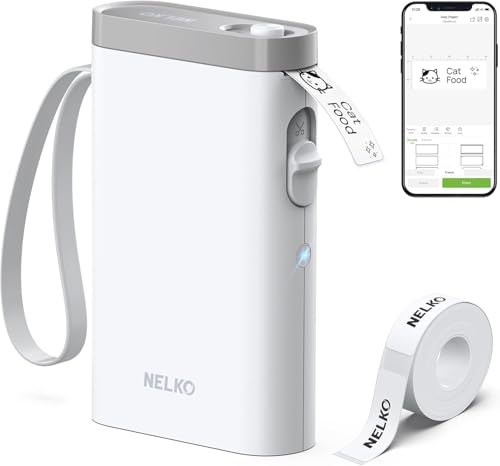
Best for: shared dorm or apartment labelling from several phones Skip it if: you want a physical keyboard
The P21 sells faster than anything else in this set, and the reason is easy to see in the specifications: 0.72 lb, a body of 1.9 x 6.65 x 4.5 in, and a stated 203 DPI print head. Nelko describes it as half the weight and size of traditional label makers, and against the Brother's 1 lb that holds up.
Because control lives entirely in the Nelko app on iOS and Android, any housemate can pair and print. That's a genuine advantage over a keyboard machine, which one person tends to claim. Nelko lists BPA-free direct thermal technology, so there's no ink or ribbon to replace, and the listing calls out classroom and school-supply organising specifically.
The catch is the same one every app-only pick shares. No phone, no label. There's no screen on the device, so you're previewing on glass rather than on the machine. Warranty is 1 year, and the model dates to 2023, which makes it the second-oldest design here. Against the SUPVAN it also gives up the keyboard fallback and a year of coverage.
Pros:
- 0.72 lb, second-lightest handheld here
- The pick buyers choose most often in this set
- 203 DPI thermal print head claimed
- No ink, toner or ribbon to buy
- Any paired phone can send a label
Cons:
- No keyboard and no on-device screen
- Every print needs the app open
- 1 year warranty, half the SUPVAN's
- 2023 design, older than three picks here
3. SUPVAN E11 Keyboard & Bluetooth Label Maker Machine with 4 Tapes — Best for heavy use
The only pick with both a keyboard and an app, and the only one shipping with four tapes in the box.

Best for: long labelling sessions and batch runs Skip it if: you only label a few things a term
The E11 is the hybrid. SUPVAN says you can type directly on the keyboard for quick one-off labels or switch to the app over Bluetooth for designed ones, which removes the trade-off the rest of this set forces on you. It's 8 oz and 1.54 x 5.79 x 3.07 in, making it the thinnest body here by a clear margin.
Power is the other reason it earns the heavy-use label. SUPVAN lists a 1200 mAh rechargeable battery rated at up to a month per charge, so there's no battery drawer to raid mid-session. The app claim runs to 30+ fonts, 50+ frames and 660+ icons across 17 languages, and SUPVAN says minimal-margin printing leaves only a 0.2 in edge, roughly a fifth of what it attributes to rivals. Four tapes ship in the box, the largest bundle of the five.
It's the second-priciest pick here, though, and it sits in the most expensive tier alongside the KNAON. For a student labelling a dozen things, the keyboard-plus-app flexibility is capability you paid for and won't use. The Brother does the keyboard job for less.
Pros:
- Keyboard and app, the only dual-input pick
- Thinnest body here at 1.54 in deep
- 1200 mAh battery, up to a month per charge
- Four tapes included, largest bundle in this set
- 2 Year Manufacturer warranty
Cons:
- Sits in the most expensive tier here
- Overkill for occasional labelling
- No dimensions given for the on-device screen
- No release year published in the listing
4. Phomemo Label Maker D30 — Best budget pick
The cheapest and lightest pick of the five, and the one that genuinely disappears into a backpack pocket.

Best for: a backpack pocket and small name labels Skip it if: you want a screen or a keyboard
At 5.64 oz the D30 is the lightest thing in this comparison, and the only one under 6 oz. Its 1.97 x 5.51 x 3.94 in body is small enough that it lives in the same pocket as a charger brick. It's also the cheapest of the five, which is the combination that makes it the obvious starter machine.
Phomemo lists Bluetooth printing to a phone, support for both continuous tapes and fixed-length die-cut labels, and inkless thermal printing with no ink, toner or ribbon to buy. The listing names classroom use and custom name stickers for school items directly, which is closer to the student brief than most of this set gets. It ships in green, the only non-white or non-black pick here.
The compromises are exactly what you'd expect at the bottom of the price ladder. There's no keyboard, no display, and no dual-input fallback. Phomemo publishes the warranty as "2" without stating the unit, so treat coverage as unconfirmed rather than assumed. Against the Nelko, which costs a little more, you give up the stated 203 DPI figure and a clearly documented warranty term.
Pros:
- Lightest pick here at 5.64 oz
- Cheapest of the five
- Handles continuous and die-cut labels
- No ink, toner or ribbon costs
- Listing targets classroom and school labelling
Cons:
- No keyboard, no display at all
- Warranty published as "2" with no unit
- No print resolution figure given
- Nothing prints without a paired phone
5. KNAON Bluetooth Thermal Shipping Label Printer — Best premium
The only pick that prints 4-inch labels, which makes it a different machine from the other four rather than a better one.
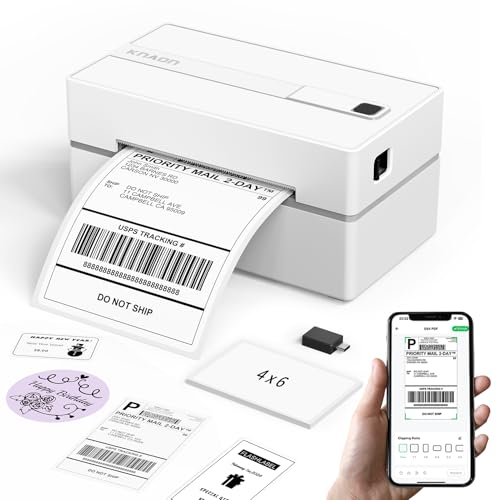
Best for: 4-inch shipping labels alongside small ones Skip it if: portability is the whole point
Everything else here prints narrow tape. The KNAON Y813BT prints at 4 in wide, which is shipping-label territory, and that single specification changes who it's for. If you resell textbooks, run a small print shop out of your room, or mail things weekly, this is the only pick in the group that can do it.
KNAON lists both Bluetooth to the FlashLabel Pro app and USB connectivity across macOS, Windows 7 and above, ChromeOS and Linux, which is the broadest desktop support in this set and the only mention of Chromebooks anywhere here. That matters if your school issued you one. The template claim runs to 3,000+ templates, 5,000+ icons and 100+ fonts, and KNAON names USPS, UPS, Etsy, Shopify and eBay compatibility. Warranty is 2 Year Manufacture.
Now the cost. It weighs 2.75 lb, nearly five times the Phomemo, and two sellers list it against one for most of the set. It's the priciest pick and the slowest seller of the five. For labelling a cable drawer, it's the wrong shape of tool entirely.
Pros:
- Only pick printing 4 in wide labels
- USB support for macOS, Windows, ChromeOS, Linux
- 2 Year Manufacture warranty
- 3,000+ templates claimed in the app
- Works with USPS, UPS, Etsy and Shopify workflows
Cons:
- 2.75 lb, heaviest here by a wide margin
- Most expensive pick in this set
- Slowest seller of the five
- Oversized for small organising labels
How I screened these five down
I compared the published specifications side by side rather than the marketing language, because every listing in this category claims to be a classroom essential. Four things decided which picks made the list.
- Published weight and dimensions. A machine with no stated footprint can't be judged on portability, and portability is the whole premise here. All five publish both.
- A stated input method. I needed to know whether a label prints from the device, from a phone, or both. That single fact splits this set more sharply than anything else.
- A published warranty term. Four of the five state a length in years. The Phomemo lists "2" with no unit, which I've flagged rather than assumed.
- Consumables you can actually buy. Proprietary tape isn't disqualifying, but it needs naming. The Brother takes Btag 12mm tapes and nothing else.
What got cut: anything with no published dimensions, anything over 3 lb that also lacked a desktop connection, and anything whose only distinguishing claim was a font count. Two of the five run in the entry tier, one mid, two premium, which gives you a real ladder rather than five near-identical picks.
How much desk and drawer space does each one take?
Dorm desks are small and shared shelves are smaller, so footprint is worth more attention than it usually gets. Here are the published dimensions, shortest depth first:
- SUPVAN E11: 1.54 x 5.79 x 3.07 in, 8 oz
- Nelko P21: 1.9 x 6.65 x 4.5 in, 0.72 lb
- Phomemo D30: 1.97 x 5.51 x 3.94 in, 5.64 oz
- Brother PT-N10: 2.8 x 7.6 x 4.7 in, 1 lb
- KNAON Y813BT: 2.61 x 5.46 x 3.03 in, 2.75 lb
The pattern is clear. The SUPVAN and the Phomemo are the two that slide into a pencil case or a laptop sleeve pocket. The Nelko is longer at 6.65 in but stays light at 0.72 lb. The Brother is the biggest handheld at 7.6 in long and 4.7 in tall, which is the price of the keyboard.
The KNAON is the interesting one. Its published box is compact at 2.61 x 5.46 x 3.03 in, yet it weighs 2.75 lb. That density tells you it's a desktop unit, not a bag unit. Note that KNAON's own feature text also quotes 7.17 x 3.9 in for the design, which doesn't match its specification block, so measure your shelf against the larger figure before you commit.
What does the extra money actually buy here?
Across these five, more money buys three specific things, and it's worth knowing which of them you'd use.
Warranty length. The SUPVAN and the KNAON, the two priciest picks, both publish 2-year terms. The Brother lists 1 Year Limited and the Nelko 1 year. That's a real, documented difference rather than a marketing one.
Input flexibility. Only the SUPVAN gives you a keyboard and an app. Every cheaper pick gives you one or the other. If you want both, that's what the step up costs.
Label width. Only the KNAON prints 4 in. Everything else is narrow tape, roughly 12mm on the Brother. Width is the one capability money genuinely unlocks in this category, and most students never need it.
What more money does not buy is print quality you can see on a shelf label. The Nelko, at second-cheapest, publishes 203 DPI and no pick here publishes a higher figure. The cheapest pick, the Phomemo, ships the lightest body of the five. If your budget is tight, you're giving up warranty documentation and convenience features, not legibility.
What the listings do not tell you
Three gaps are worth knowing before you order any compact label printer for students.
Ongoing tape cost is invisible here. Every listing mentions inkless thermal printing, and none of them tells you how much a replacement roll runs or how many labels it yields. The Brother's Btag lock-in is the clearest constraint: one tape family, one width, no third-party alternative named. The others accept continuous and die-cut rolls more generally, which usually means more sourcing options.
Battery type is only stated once. SUPVAN publishes a 1200 mAh rechargeable cell rated at a month per charge. Brother says battery operated without specifying a type or count. The Nelko, Phomemo and KNAON listings say nothing about power source in their specifications at all. If you're buying for somewhere without a spare outlet, that silence matters.
Label durability isn't addressed. None of the five states whether output survives a dishwasher, a water bottle or a laminated textbook cover. Thermal labels fade with heat and light as a rule of the technology, so assume a shelf label lasts longer than one stuck to a travel mug.
Also worth noting: only the KNAON mentions ChromeOS. If your school issued a Chromebook and you want desktop printing, that narrows the field to one.
The verdict
Three tiers, three answers.
At the entry level, the Phomemo D30 is the pick if pocket size and cost lead your list. It's 5.64 oz, the lightest here, the cheapest of the five, and it handles both continuous and die-cut labels. Accept that you'll open an app every time and that its warranty term is published without a unit.
In the middle sits the Brother P-Touch PT-N10, and it's the pick I'd start with for most students. The QWERTY keyboard and 12-character screen mean it prints on its own, and 10 saved labels covers the repeat jobs. It's 1 lb and 7.6 in long, so it's the least pocketable handheld here, and it only takes Brother Btag 12mm tape. That's the trade.
At the premium end, the choice depends entirely on label width. The SUPVAN E11 is the answer for volume: keyboard plus app, 8 oz, a 1200 mAh battery rated at a month, four tapes in the box and a 2-year warranty. The KNAON Y813BT is the answer only if you need 4 in shipping labels and USB desktop printing, and it costs you 2.75 lb of portability to get them.
The Nelko P21 is the outlier worth naming: it sells faster than anything else here, weighs 0.72 lb, and publishes 203 DPI. If several people share the machine, it wins outright.
FAQ
Is a compact label printer for students worth buying at all?
A compact label printer for students earns its place if you share a fridge, a cable drawer or a study space with other people. Labelling three identical black chargers, a food shelf and a set of notebooks solves an actual daily friction. If you'd label fewer than a dozen things a year, a permanent marker does the same job with no consumables to buy.
Which pick gives the best value for a tight budget?
The best value for a tight budget is the Phomemo D30. It's the cheapest of the five and the lightest at 5.64 oz, and it accepts both continuous tape and fixed-length die-cut labels with no ink or ribbon required. You give up any on-device screen and keyboard, and its warranty is published as "2" with no unit stated, so coverage is unclear.
Brother PT-N10 or Nelko P21: which should I choose?
Choose the Brother PT-N10 if you want a machine that prints without a phone. Its QWERTY keyboard, 12-character preview and built-in cutter work standalone, though it's 1 lb and 7.6 in long. Choose the Nelko P21 if weight and shared access matter more. At 0.72 lb with app-only Bluetooth control, several housemates can pair and print from their own phones.
Do any of these work with a Chromebook or a laptop?
Only one of these works with a Chromebook. KNAON states USB connectivity across macOS, Windows 7 and above, ChromeOS and Linux for the Y813BT, and it's the sole pick here mentioning ChromeOS anywhere. The other four are described as Bluetooth to iOS and Android phones. If desktop or school-laptop printing is a requirement, that narrows the field to the KNAON immediately.
What's the most common mistake when buying one of these?
The most common mistake is buying on print resolution instead of input method. Four of these five have no keyboard, meaning every single label requires unlocking a phone and opening an app. That's fine for a batch of twenty designed labels and tedious for one shelf tag. Decide which job you're actually doing before you compare anything else.
Start by counting how many labels you'll make in a typical month and whether your phone will be in your hand when you make them. If the answer is a handful, spread out, phone somewhere else, the Brother P-Touch PT-N10 is the sensible default: it's the one machine here that works the moment you pick it up, with no pairing step and no app dependency between you and a printed label. Its 1 lb weight is the honest cost of that keyboard. Everything else on this list asks you to trade convenience for ounces.
Last updated: September 7, 2026. Product availability re-checked.
This page contains affiliate links. As an Amazon Associate we earn from qualifying purchases, at no extra cost to you.