Best Brushless Generator for Beginners: Full Guide
A first-time buyer's shortlist of six brushless generators, ranked by what the listings actually publish, with the profile each one fits and where each one falls short.
The best brushless generator for beginners is the BUUBO 5KW Permanent Magnet Generator, a 68.3 lb permanent-magnet head rated at 1500 rpm and 50Hz that a first-time builder can pair with a modest engine or turbine without wrestling with brushes or slip rings. If you want a finished portable with outlets you can plug straight into, the WEN DF450i is the better call: 4500 surge watts, dual fuel, and a two-year limited warranty do more of the work for you.
Best brushless generator for beginners at a glance
| Pick | Output | Weight | Price |
|---|---|---|---|
| Best overall BUUBO 5KW Permanent Magnet Generator |
5KW at 1500 rpm, 50Hz | 68.3 lb | Check Price |
| Best upgrade ABLNLPYOC Low RPM 6KW Permanent Magnet Generator |
6KW, 48V, 24V motor | Not listed | Check Price |
| Best for pros WEN DF450i Dual-Fuel Inverter Generator |
4500 surge / 3500 rated watts | 100 lb | Check Price |
| Best minimal setup OLONETO 3500W Brushless Generator |
3500W, 220V, 50Hz claim | 13.2 lb | Check Price |
| Runner-up Mdxtog 300W Brushless Permanent Magnet Generator |
300W, 24V | Not listed | Check Price |
| Best budget pick CrocSee Micro 3-Phase Brushless AC Generator |
0.5-12W, 3V-24V | Not listed | Check Price |
What "brushless" actually means for a first-time buyer
A brushless generator uses permanent magnets or electronic excitation instead of carbon brushes riding on a slip ring. That is a maintenance win, not a magic one. Five of the six picks here are permanent-magnet heads: a rotor spun by an outside source, producing AC that you rectify, regulate, or feed into an inverter. Only the WEN DF450i is a complete, self-contained generator with its own engine, tank and outlets.
That split matters. If the word "generator" makes you picture a plug-and-go box on wheels, only one product in this set fits that picture. The other five are the electrical half of a project. You supply the mechanical half, which is a small engine, a wind turbine, a water wheel, or, in the smallest case, your own hand.
Three things a beginner should hold in mind:
- Rated speed decides everything downstream. The BUUBO 5KW wants 1500 rpm. The OLONETO 3500W wants 3000-4000 rpm. Match the driver to the head, not the other way round.
- Voltage is not the same as wattage. A "24V" or "48V" label describes what the head outputs, not the load it can carry.
- Frequency claims are only meaningful at the specified rpm. The BUUBO's 50Hz figure holds at 1500 rpm and nowhere else.
How I narrowed six brushless generators from a longer list
Rather than lean on subjective ranking, I sorted candidates by the buyer they map to, then picked the strongest listing for each profile. That is the honest way to compare a bench toy, five bare heads, and one finished portable.
The profiles I used:
- The first real build. Someone who wants a proven permanent-magnet head at meaningful wattage, with a published rpm and frequency they can match to a small engine. That is where the BUUBO 5KW landed.
- The next build up. A buyer who has already wired one small generator and wants more watts, higher voltage and lower rpm for a turbine. The ABLNLPYOC 6KW fits.
- The buyer who does not actually want a project. Somebody typing "beginner" who really means "easy". The WEN DF450i is the answer, and pretending otherwise would be dishonest.
- The absolute minimum viable setup. A light head that runs LED loads off a three-horsepower engine. The OLONETO 3500W claims exactly that use case, at 13.2 lb.
- The low-power specialist. Somebody building a small 24V system where low starting torque matters. The Mdxtog 300W head is designed for it.
- The learner. A student, a science-fair parent, a curious hobbyist who wants to see AC come out of spinning magnets before spending real money. The CrocSee is a hand-crank kit.
Any pick that could not be tied to a specific profile got cut.
1. BUUBO 5KW Permanent Magnet Generator — Best overall
A 5KW brushless head at a beginner-friendly 1500 rpm makes this the clearest first buy for anyone building a real generator from scratch.

Best for: a beginner pairing a permanent-magnet head with a small engine or turbine Skip it if: you want a ready-to-run portable with outlets and a pull cord
The BUUBO wins on published specifications, which is the fairest yardstick you have when you cannot get hands on a listing. It states 5KW output at 1500 rpm, two phases, 50Hz, and 68.3 lb. That is enough to size a driver and a mount before you spend anything else. Most competing bare heads publish less than half that. The 1500 rpm target is also friendly to first-time builders: it is slow enough that a governed small engine or a geared turbine can hit it without exotic transmission, and slow enough that you have time to react if something goes wrong. The 68.3 lb frame is not portable, but it also is not fragile, which is what you want for a fixed installation. The trade-off is price position: this is the most expensive pick here, and it is a bare head, not a finished product. You are paying for a spec sheet you can build against, not for outlets and a chassis.
Pros:
- Published 5KW output at a stated 1500 rpm
- 50Hz frequency stated with the rpm figure
- 68.3 lb frame suits a fixed installation
- Two-phase design documented in the listing
- Clearest specifications of the bare heads here
Cons:
- Most expensive pick in the set
- No outlets, chassis or engine included
- No warranty stated in the listing
2. ABLNLPYOC 6KW Permanent Magnet Generator — Best upgrade
A 6KW low-rpm head at 48V is where a beginner who has already finished one build should go next.

Best for: a second build stepping up to 48V and higher output Skip it if: you have not finished a first, smaller build yet
The ABLNLPYOC listing offers a permanent-magnet head at 6KW, with 12V, 24V and 48V options and the 24V motor configuration specified in this variant. The manufacturer positions it explicitly for wind-turbine and water-turbine home use, which is where the "low RPM" phrase earns its keep: a head that produces meaningful output at a turbine's natural speed saves you from an aggressive gear ratio. That is a real advantage over the BUUBO if your driver is a rotor, not an engine. The catch is that the listing publishes very little else. Weight is not stated. The dimensions field reads 0.39 x 0.39 x 0.39 in, which is clearly a placeholder rather than the real box, so plan the mount around the physical unit when it arrives. That is why this is the upgrade pick and not the overall winner: a first-time buyer benefits from more, not less, information on paper. Sitting in the middle of the pricing here, it is the right second step once you know what you are doing.
Pros:
- 6KW output at low rpm for turbine use
- 12V, 24V and 48V options published
- Explicit wind and water turbine use case
- Mid-range price position for the wattage
- Brushless permanent-magnet construction
Cons:
- Weight not published
- Dimensions field is a placeholder value
- No warranty stated
- Requires a turbine or engine you supply
3. WEN DF450i Super Quiet 4500-Watt Dual RV-Ready Inverter Generator — Best for pros
If "beginner" for you means easy, not project, the WEN DF450i is the honest answer: a finished, RV-ready inverter generator with a two-year warranty.
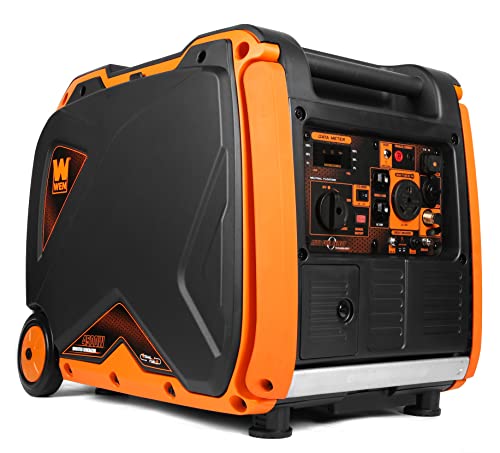
Best for: someone who wants a finished portable inverter with RV and 120V outlets Skip it if: you specifically want a bare permanent-magnet head to build around
This is the only pick you take out of the box and start. WEN publishes 4500 surge watts and 3500 rated watts on gasoline, with 4500 surge and 3150 rated watts on propane. Auto Fuel Selection is stated to switch from propane to gas for longer run times. The 212cc engine is called EPA III and CARB compliant, and WEN's own claim is 58 dBA at quarter load measured at 22 feet. Included outlets are two three-prong 120V receptacles, one RV-ready NEMA TT-30R, and a 12V DC receptacle. Weight is 100 lb, dimensions are 20.1 x 23.2 x 18 in, and there is a two-year limited warranty, the only stated warranty in this whole set. Among these six, WEN sells faster than any other finished-category pick. What you lose is the point of the roundup for a builder: this is a boxed appliance, not a permanent-magnet head to wire into your own project.
Pros:
- 4500 surge / 3500 rated watts on gasoline
- Dual fuel with automatic switch to gas
- Two-year limited warranty stated
- RV-ready TT-30R plus two 120V outlets
- Wheels and carrying handle included
Cons:
- Not a bare head for a build
- 100 lb is heavy for solo lifting
- Mid-price position, above the entry heads
- Noise figure is a manufacturer claim
4. OLONETO 3500W Brushless Permanent Magnet Generator — Best minimal setup
At 13.2 lb, this is the lightest real head in the set, and OLONETO tells you exactly which engine to bolt it to.
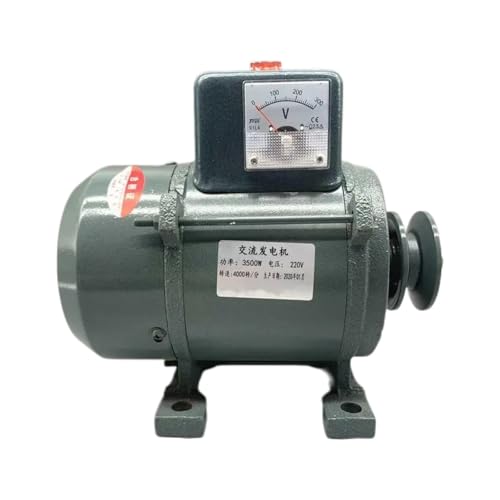
Best for: a beginner running LED and lamp loads from a small engine at 3000-4000 rpm Skip it if: you plan to power household appliances or sensitive electronics
OLONETO is refreshingly specific about scope. The listing says the 3500W head "requires a three-horsepower diesel or gasoline engine to drive a speed of 3000-4000 rpm" and describes the intended load as "lighting with lights such as LED lights, energy-saving lamps, tungsten lamps, and not household appliances". That last clause is the important one for a beginner: OLONETO itself excludes household appliances from the use case, so treat the 3500W figure as a headline for lighting loads and not as a green light for a fridge. Physical figures line up with a small setup: 13.2 lb, and a machine described as 22cm long, 21cm high and 15cm in diameter. The listing also claims a switch-type electronic voltage regulator built into the motor. Sitting at the entry price position here, it is a fair pick for a first, honest lighting rig. The trade-off against the BUUBO is obvious: a lot less headroom, an rpm target twice as high, and a scope the manufacturer itself narrows.
Pros:
- 13.2 lb, the lightest real head here
- Entry price position in the set
- Named driver: three-horsepower engine
- Built-in voltage regulator claim
- Physical dimensions published
Cons:
- Manufacturer excludes household appliances
- 3000-4000 rpm target is higher than most turbines
- 50Hz claim depends on holding rpm exactly
- No warranty stated
5. Mdxtog 300W Brushless Permanent Magnet Generator — Runner-up
A 300W 24V head aimed at small direct-drive builds where low starting torque matters more than headline wattage.

Best for: a light 24V build where low starting torque matters more than headline wattage Skip it if: you need published dimensions or weight before you commit
Mdxtog leans on design language a beginner should learn to read. The listing calls out low rated speed, low starting wind speed, a coreless winding, and low starting torque. Read together, those claims describe a head designed to begin producing power under a very light driver, which is the usual pain point on a small wind or hand-cranked build. If your problem is that a bigger head refuses to turn until the wind is already strong, a design like this is the honest answer. What it does not do is publish the numbers you would want to plan around: weight is not listed, and the size field is simply "300W 24V" rather than physical dimensions. That is why it is the runner-up rather than the overall pick, even though its position between the mid- and premium-priced options in this set suggests you are paying for the head, not the paperwork. Bring a tape measure and a scale to receiving day.
Pros:
- Explicit low-starting-torque design
- 24V output suits small battery banks
- Coreless winding claimed for smooth output
- Brushless, maintenance-free construction
- Clear scope: light direct-drive builds
Cons:
- Weight not published
- Physical dimensions not published
- No warranty stated
- 300W is not enough for household loads
6. CrocSee Micro 3-Phase Brushless AC Generator — Best budget pick
A hand-crank, three-phase micro head that lets a first-time buyer see brushless AC on a multimeter for the price of a science kit.
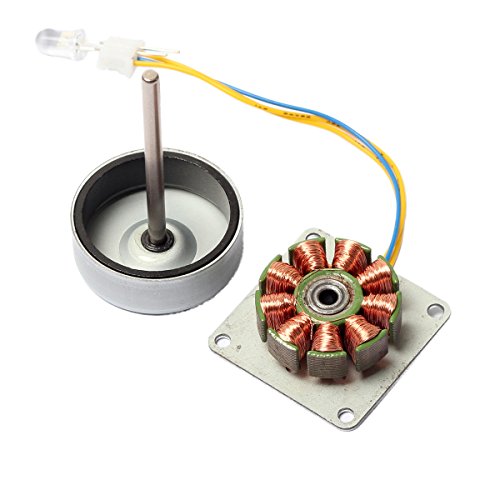
Best for: learning the basics on a bench before spending on a real build Skip it if: you want to actually power anything in the house
Amazon files this one under science kits, and CrocSee is honest about the scope. The listing calls it "a great way to teach or learn about generating electricity or as an experiment starting place for larger projects", and it is the cheapest of the six. Output is 3V to 24V and 0.1A to 1A, at a rated 0.5 to 12W and rated speeds from 300 to 6000 rev/min. A single AA-scale LED and a multimeter is the whole demo you can build. It is genuinely useful before a first big purchase, because it lets you feel what "three-phase" actually means in your hand, and it teaches the relationship between rpm and voltage without frying anything. Treat any purchase after this one as a step change, not a slightly larger version of the same thing. The trade-off is that this is a toy in the technical sense: a real load will do nothing.
Pros:
- Cheapest of the six picks
- 0.5-12W scale keeps mistakes harmless
- Three-phase output for genuine learning
- 300-6000 rpm working range published
- Filed as a science and education kit
Cons:
- Not a real power source
- Slowest seller of the six
- Output range too small for lighting
- No warranty stated
Which rating do beginners actually need?
Most beginner guides compare wattage. That is not what decides it. The deciding number is rated rpm, because it dictates the entire mechanical side of your build.
Consider the split in this set:
- 1500 rpm, on the BUUBO 5KW. Reachable by a governed small engine on a direct coupling, or by a modestly geared turbine.
- 3000-4000 rpm, on the OLONETO 3500W. Needs a small engine running near its own governor limit.
- 300-6000 rpm, on the CrocSee. Wide, because the output is tiny and the head does not care much.
- Not specified in rpm, on the ABLNLPYOC and Mdxtog, both of which lean on "low rpm" language and voltage instead.
A first-time buyer picks the rpm target first, sources the driver to match, and then checks that the wattage clears the load with room to spare. Trying to hit a stated wattage at the wrong rpm is the failure mode that turns a build into a paperweight.
What the listings do not tell you
Every brushless generator listing here leaves gaps a beginner would want closed before buying. Assume, before you commit:
- The rectifier is not included. A permanent-magnet head puts out raw AC. A DC application needs a bridge rectifier sized for the wattage and the voltage; that is your purchase, not the manufacturer's.
- The mount is not included either. Frames, couplings, keyed shafts and any belt or chain gear are on you. The BUUBO's 68.3 lb frame is a serious mounting job.
- The engine is almost never included. Only the WEN DF450i ships as a complete generator. The other five need a driver you supply and align.
- Voltage regulation varies. OLONETO claims a switch-type regulator built in. The others do not, so plan on external regulation if you care about stable voltage under a changing load.
- Warranty is usually silent. WEN publishes a two-year limited warranty. None of the bare heads here state one, so budget on your own tolerance for risk.
Two more habits worth building. Treat every wattage figure on a bare head as a ceiling under ideal drive conditions, not a rating you should size at. And read the "recommended use" clause on the listing carefully: OLONETO explicitly excludes household appliances, which is the sort of line that saves a fridge from being ruined.
Head-to-head: BUUBO 5KW versus WEN DF450i
These are the two picks a beginner is most likely to be torn between, because they answer different questions with the same word.
The BUUBO 5KW is a bare permanent-magnet head. You buy it, then you buy or borrow a small engine or turbine, a coupling, a frame, a rectifier if you need DC, and outlets or a distribution panel. In exchange, you get a spec sheet you can plan against: 5KW at 1500 rpm, 50Hz, 68.3 lb, two phases. It rewards a builder.
The WEN DF450i is a finished dual-fuel inverter generator. You buy it, add fuel, and pull the cord. You get 4500 surge and 3500 rated watts on gasoline, a stated 58 dBA claim at quarter load 22 feet away, RV-ready and 120V outlets, wheels, a carrying handle, and a two-year limited warranty. It rewards a user.
The tie-breaker is honest self-assessment. If you are reading this to learn how a permanent-magnet head works, the BUUBO is the better teacher. If you are reading it because a storm knocked out power last winter, the WEN is the better answer, and the word "beginner" in your search was really a search for "easy".
The verdict
Across the set, entry-priced picks buy you a bench toy or a light lighting head with published dimensions. The CrocSee is the cheapest and teaches the concept. The OLONETO sits just above it and gives you a real 13.2 lb head for LED loads driven by a three-horsepower engine at 3000-4000 rpm.
Mid-priced picks buy you either a finished portable or a bigger head with less paperwork. The WEN DF450i is the finished route, with 4500 surge watts, dual fuel, RV outlets and a two-year limited warranty. The ABLNLPYOC is the builder route, with a 6KW low-rpm head and 48V option but very little published beyond that.
Premium-priced picks buy you either the best-documented bare head in the set or a low-torque specialist. The BUUBO 5KW is the best brushless generator for beginners because it publishes what you need to plan a first build: 5KW, 1500 rpm, 50Hz, 68.3 lb. The Mdxtog 300W is the low-torque specialist for small 24V direct-drive rigs.
Pick the BUUBO if you are building. Pick the WEN if you are running. Pick the CrocSee before either, if you are still learning what "three-phase" means.
FAQ
Is a brushless generator worth it for a first-time buyer?
A brushless generator is worth it for a first-time buyer who values less maintenance over lower purchase price. Permanent-magnet heads have no brushes to wear, no slip rings to clean, and no field winding to excite separately. That simplifies your electrical side. You still supply a driver, a mount, and often a rectifier, so the savings are in service life, not setup.
How do I know which brushless generator matches my engine?
To know which brushless generator matches your engine, start with rated rpm. The BUUBO 5KW wants 1500 rpm. The OLONETO 3500W wants 3000-4000 rpm and calls for a three-horsepower engine. Match your engine's governed speed to the head's rated speed on a direct coupling, or plan a belt or gear ratio between them. Only then check whether the head's wattage clears your intended load.
Can the WEN DF450i actually replace a permanent-magnet head build?
The WEN DF450i can replace a permanent-magnet head build for anyone whose real goal is running loads, not building. It publishes 4500 surge watts, 3500 rated watts on gasoline, dual fuel, RV-ready NEMA TT-30R and two 120V outlets, a 100 lb chassis with wheels, and a two-year limited warranty. What it cannot do is teach you how brushless generation works. That takes a bare head.
What is the difference between the BUUBO 5KW and the ABLNLPYOC 6KW?
The difference between the BUUBO 5KW and the ABLNLPYOC 6KW is what each publishes and who each is aimed at. BUUBO states 5KW at 1500 rpm, 50Hz, two phases, and 68.3 lb, which is enough to plan a first build. ABLNLPYOC states 6KW with 12V, 24V and 48V options for turbine use, but leaves weight blank and lists a placeholder for dimensions.
What is the biggest mistake beginners make buying a brushless generator?
The biggest mistake beginners make buying a brushless generator is treating a bare permanent-magnet head as a finished product. Five of the six picks here ship without an engine, outlets, chassis, or rectifier. The wattage on the box is a target the head can reach when you drive it correctly. Read the listing's use clause carefully, and match the rated rpm before you spend anything else.
Ready to move? The BUUBO 5KW is the honest first buy for a beginner who wants to build, because its published 1500 rpm and 50Hz let you size an engine and a coupling on paper before anything ships. If your search for "beginner" really meant "easy", the WEN DF450i is the finished answer, with a two-year limited warranty and RV-ready outlets that make it usable the day it arrives. Start where your actual goal sits, not where the word points. Then, whatever you pick, buy the rectifier, the mount, and the fuel or driver you need before the head lands.
Last updated: September 7, 2026. Product availability re-checked.
This page contains affiliate links. As an Amazon Associate we earn from qualifying purchases, at no extra cost to you.