Best Affordable Trolling Motors by Thrust and Shaft
Five trolling motor picks compared on thrust, shaft length and warranty, with the deciding specs named up front and a clear winner for most small boats.
The best affordable trolling motor for most small boats is the Newport NV-Series 55lb Thrust Saltwater, which pairs a 30-inch shaft and 55 lb of thrust with a 2-year manufacturer warranty and a 23.2 lb head. If you fish only freshwater in a light dinghy and want the lightest rig here, the Minn Kota Endura C2 at 17 lb and 30 lb of thrust is the more sensible spend.
Affordable trolling motor at a glance
| Pick | Thrust | Shaft | Weight | Price |
|---|---|---|---|---|
| Best overall Newport NV-Series 55lb |
55 lb | 30 in | 23.2 lb | Check Price |
| Best for pros Minn Kota Endura C2 |
30 lb | 30 in | 17 lb | Check Price |
| Best premium Minn Kota Terrova with GPS |
55 lb | 54 in | 48.8 lb | Check Price |
| Best large-capacity Newport Kayak Series 55lb |
55 lb | 24 in | 23 lb | Check Price |
| Best budget pick besttruck Universal Kayak Mount |
Mount only, up to 3 HP | n/a | 3.25 lb | Check Price |
What buyers compare that does not decide it
Most shoppers looking for the best affordable trolling motor sort by thrust and stop there. Thrust matters, but it is not the whole picture. A 55 lb motor with the wrong shaft length is worse than a 30 lb motor with the right one, because a short shaft leaves the prop cavitating at the surface and a long one drags on the bottom of a shallow slough.
The real deciding criterion is the pairing of shaft length to your transom or bow height, then thrust to your hull length and total loaded weight. Shaft length is a hard geometry problem. Thrust is a scaling problem. Get the geometry right first, then buy the smallest thrust that comfortably pushes your boat, because bigger motors weigh more and drain batteries faster.
The rough rule of thumb for freshwater boats: 2 lb of thrust per 100 lb of fully loaded boat weight. A 1,500 lb rig wants at least 30 lb of thrust. A heavier hull, wind, or a headwind current, and you want a margin above that.
How I screened the field down to five
I set three criteria before comparing prices, and weighted them in this order. The point of an affordable trolling motor is not to be cheap. It is to be enough motor to move your boat without wasting money on features you cannot use.
- Shaft length must match a real hull. A 24-inch shaft is a kayak spec; 30 inches fits most small aluminum boats and inflatables; 54 inches is bow-mount territory. Anything shorter than 24 inches is a toy.
- Thrust must be honest. Manufacturer thrust ratings vary in how they are measured, so I compared the numbers as claims within a single set rather than as tested figures. The 55 lb rating on the Newport NV-Series is claimed at 12V, same as its 55 lb sibling for kayaks.
- Warranty must be published. Four of the five picks publish a warranty in the listing: two years on both Newports and the Endura, three years on the Terrova with registration, one year on the besttruck mount. That is a real screening signal because it separates real product listings from drop-shipped mystery hardware.
I cut anything without a published shaft length, anything without a warranty, and anything whose thrust rating I could not compare against something else in the set. What survived is five items: four motors and one mount that lets you use a motor on a kayak that was not built for one.
1. Newport NV-Series 55lb Thrust Saltwater — Best overall
The right default trolling motor for a small boat under 14 feet, with a 30-inch shaft, 55 lb of thrust and a 2-year warranty at a mid price for this set.

Best for: small aluminum or inflatable boats up to about 14 feet Skip it if: you need GPS anchoring or a bow mount
This is the pick because it lands the specifications where a small-boat owner actually needs them. The 30-inch shaft is the standard length for a transom mount on a jon boat or an inflatable. The 55 lb thrust rating is enough to push a loaded 12- to 14-foot hull against a light chop, and the 23.2 lb head weight is manageable for one person lifting it off a trailer.
Newport says the motor runs 8 speeds, 5 forward and 3 reverse, off a single 12V lead-acid or lithium deep-cycle battery, with 50Ah recommended. The saltwater rating and the 5-LED battery meter on the tiller are the two features that separate this from a purely freshwater budget motor. It is priced third of five here, which is the right position for a motor doing this much work.
The trade-off against the Terrova is obvious: no GPS, no Spot-Lock, no bow mount. Against the Endura, it is heavier by 6.2 lb, and its 3-blade prop is not billed as a weedless design.
Pros:
- 30-inch shaft fits standard small-boat transoms
- 55 lb thrust at 12V, saltwater rated
- 5-LED battery meter on the tiller
- 2-year manufacturer warranty
- 8 speeds, 5 forward and 3 reverse
Cons:
- No GPS or anchoring features
- Requires separate 12V deep-cycle battery
- Head weight is 6.2 lb heavier than the Endura
- Top speed is limited by hull shape and load
2. Minn Kota Endura C2 — Best for pros
The lightest motor here at 17 lb, matched to a 30-inch shaft and 30 lb of thrust for a freshwater dinghy where you value hoisting it in and out over raw power.
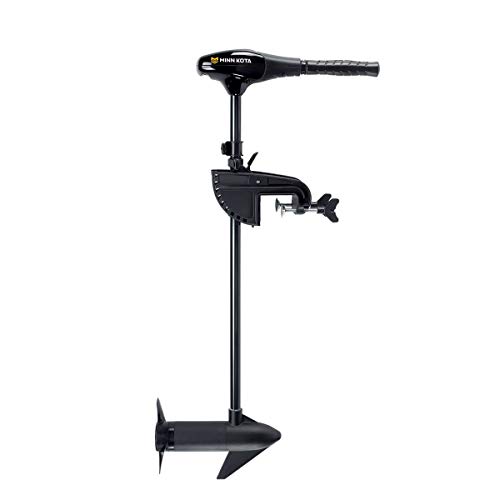
Best for: a light freshwater dinghy where 30 lb of thrust is plenty Skip it if: you fish saltwater or need to push a loaded 14-foot hull
The Endura C2 is the pick when you already know your boat is small and light. At 17 lb it is the lightest motor in this set, 6.2 lb less than the Newport NV-Series and 31.8 lb less than the Terrova. That matters if you carry a motor to the water rather than trailering to a ramp. It is also the second-cheapest of the five, which is the second reason it earns a spot.
Minn Kota lists 5 forward and 3 reverse speeds, a 6-inch telescoping tiller, a 10-position lever-lock bracket, and what the brand calls a Power Prop for heavy vegetation. The composite shaft carries a 2-year manufacturer warranty. The listing dates the model to 2012, so this is a mature design.
The catch is the thrust rating. 30 lb is enough for a small canoe, a light freshwater jon boat, or a two-person tender. It is not enough for a loaded 14-footer in wind, and the motor is not saltwater rated. If either applies to you, the Newport NV-Series is the safer buy for a little more money.
Pros:
- Lightest head in this set at 17 lb
- 6-inch telescoping tiller with battery test
- 10-position lever-lock mounting bracket
- 2-year manufacturer warranty
- Second-cheapest pick here
Cons:
- 30 lb of thrust limits hull size and wind tolerance
- Freshwater only, per the listing
- No LED battery meter on the tiller
- Older 2012 platform without modern controls
3. Minn Kota Terrova Bow-Mount with GPS — Best premium
A 54-inch bow-mount motor with Spot-Lock, a wireless remote and a 3-year warranty with registration, at the top of this set for price and capability.

Best for: serious anglers who want Spot-Lock and a 54-inch bow-mount shaft Skip it if: you actually want the cheapest way onto the water
Calling this affordable is a stretch, and I want to be honest about that. It is the most expensive pick here and the slowest seller of the five by a wide margin. But it belongs in the roundup because it is the only bow-mount motor in this set, the only one with GPS anchoring, and the only one that ends the debate about drift on a windy lake. If your budget can absorb it, the deciding features are real.
The 54-inch shaft is for a bow deck, not a transom. Minn Kota's Spot-Lock claim is that the motor holds a fixed GPS position and can jog 5 feet in any direction, with drift, follow and dodge modes for repeating a route. The brand says the Digital Maximizer power management extends run time up to 5x on a single charge. Weight is 48.8 lb at the head, and the wireless remote has an LCD screen. Released in 2023, so this is the newest platform here.
The trade-off is obvious: it is the heaviest, it needs a proper bow-mount deck, and only one seller lists it. If you do not have the deck, the Newport NV-Series is your motor.
Pros:
- GPS Spot-Lock with 5-foot jog claim
- 54-inch bow-mount shaft
- 3-year warranty with registration
- Wireless remote with LCD screen
- Newest platform in this set, released 2023
Cons:
- Most expensive pick here
- Heaviest at 48.8 lb
- Requires a bow-mount deck and rigging
- Only one seller lists it
- Slowest seller of the five
4. Newport Kayak Series 55lb Thrust — Best large-capacity
The short-shaft sibling of the Newport NV-Series, with the same 55 lb thrust and saltwater rating on a 24-inch shaft sized for kayaks.
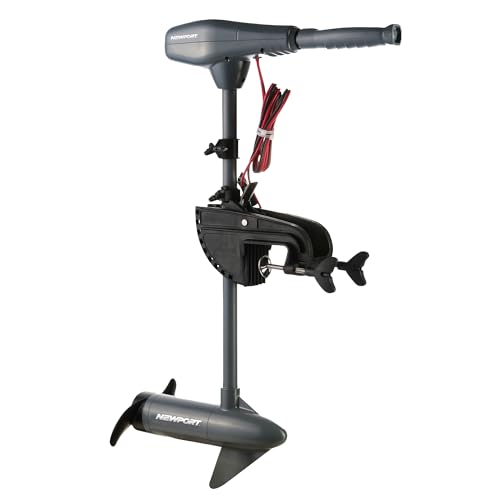
Best for: sit-on-top kayaks in salt water needing a short 24-inch shaft Skip it if: you have a taller transom that needs 30 inches or more
The Kayak Series exists because a 30-inch shaft is wrong for a kayak. Kayaks sit low, and a 30-inch shaft plants the prop deep enough to catch bottom in shallow water. The 24-inch fiberglass shaft here is the geometric answer. Newport keeps the 55 lb thrust rating and the saltwater-rated aluminum head with magnesium, zinc and stainless hardware, so the durability story is the same as the NV-Series.
Newport lists 8 speeds, 5 forward and 3 reverse, a 6-inch telescoping tiller, and 5-foot-6-inch battery cables that let you place the battery for weight balance. Weight at the head is 23 lb. The published warranty is 2 years. It is priced fourth of the five, which reads as premium for the kayak niche but honest for the specification set.
The catch is fit. A 24-inch shaft on a jon boat leaves the prop too high for anything but flat water. Do not buy this to save money on the NV-Series; buy it because you are mounting to a kayak, or to the besttruck bracket on a kayak that needs a transom substitute.
Pros:
- 24-inch fiberglass shaft sized for kayaks
- Same 55 lb thrust rating as the NV-Series
- Saltwater-rated head and hardware
- 5-foot-6-inch battery cables for placement
- 2-year warranty
Cons:
- Shaft is too short for most jon boats
- More expensive than the standard NV-Series
- Requires separate 12V deep-cycle battery
- No published sales rank in the data
5. besttruck Universal Kayak Motor Mount — Best budget pick
A clamp-on transom bracket for kayaks that do not have one, rated to 3 HP and 3.25 lb, so you can use one of the motors above on a hull that was not built for it.

Best for: a kayak owner adding a clamp-on motor to a hull without a transom Skip it if: you already have a proper transom or a bow deck to mount to
This is not a motor. It is the piece that lets an affordable motor solve a problem it otherwise cannot. If your kayak has no factory transom, you need a mount before you need thrust. The besttruck bracket is the cheapest of the five items here and the lightest at 3.25 lb, with a footprint of 8.5 by 5 by 6.8 in. The listing rates it to 3 HP, which is well above any electric trolling motor in this roundup.
The brand says it is stainless steel hardware with black nylon plastic, and installation is four holes drilled into the kayak. A 1-year warranty is published. Pair it with the Newport Kayak Series and you have a rigged kayak; the two are the natural buy-together in this set.
The trade-off is that you are drilling into your hull. That is not reversible, and it puts stress on the deck around the four bolts. It also does not include the motor, so it only makes sense as an add-on. The 1-year warranty is the shortest published here.
Pros:
- Cheapest item in this set
- Rated up to 3 HP capacity
- Stainless steel hardware, nylon body
- Four-hole install per the listing
- Lightest at 3.25 lb
Cons:
- Requires drilling into your kayak
- Shortest warranty at 1 year
- Does not include a motor
- Only one seller lists it
Thrust, shaft length and boat size: the real math
Here is the sequence that decides which of these motors is actually right for you.
- Measure your transom height, or your bow deck height above waterline. This is the number the shaft length has to match. You want the prop centre at least 12 inches below the waterline.
- Weigh your loaded boat, honestly. Boat, motor, battery, gear, passengers, cooler. Round up.
- Divide loaded weight by 100 and multiply by 2. That is your minimum thrust in pounds. Add 20% for wind and current.
- Match voltage. Every motor in this roundup runs 12V, so one deep-cycle battery is enough. Bigger boats step up to 24V or 36V systems, which are outside this affordable range.
- Confirm salt or fresh. The Endura is freshwater only. Both Newports are saltwater rated. The Terrova is freshwater only per the listing.
A worked example: a 12-foot aluminum jon boat, a battery, two adults and gear comes in near 900 lb loaded. That is 18 lb of minimum thrust, and 22 lb with margin. The Endura's 30 lb is comfortable. Add a headwind and a third person, and you want the NV-Series 55 lb instead.
What does affordable actually mean here?
Affordable is not a fixed figure. It is the smallest spend that gets you a motor you will keep using in three seasons. Two failure modes make a cheap motor expensive:
- Undersized thrust. You buy the 30 lb because it is cheaper, then you cannot fight a headwind and you upgrade to the 55 lb anyway. You paid twice.
- Wrong shaft length. You buy a 30-inch shaft for a kayak, or a 24-inch shaft for a jon boat, and the prop cavitates or drags. You either replace the motor or you accept a compromise that annoys you every trip.
The price positions in this set map to real capability. The entry tier is the Endura and the besttruck mount, each doing one job well. The middle tier is the Newport NV-Series, which is the widest-use motor here. The premium tier is the Kayak Series for its niche, and the Terrova for its features. Nothing in this roundup is a luxury purchase except the Terrova, and even that has a defensible case for anglers who fish tournaments or big lakes.
Which motor fits a kayak versus a jon boat?
The wrong pairing is the most common mistake in this category, so here is the flip:
- Sit-on-top kayak with a factory transom: Newport Kayak Series, 24-inch shaft.
- Sit-on-top kayak with no transom: besttruck mount plus Newport Kayak Series.
- 10- to 12-foot aluminum jon boat, freshwater only: Minn Kota Endura C2, 30-inch shaft.
- 12- to 14-foot aluminum or inflatable, fresh or salt: Newport NV-Series 55lb, 30-inch shaft.
- Bass boat with a bow deck and rigging for Spot-Lock: Minn Kota Terrova, 54-inch shaft.
The cutoff between the Endura and the NV-Series is boat length and water type. Under 12 feet, freshwater, calm days: the Endura is enough. Over 12 feet, or salt water, or wind: the NV-Series is the safer buy.
What the listings do not tell you
Product pages leave out the running costs. A trolling motor is only half of what you are buying. You also need a 12V deep-cycle battery (Newport recommends 50Ah for the NV-Series), a charger, and cabling. Budget for those before you decide any of these motors is affordable. A quality Group 27 deep-cycle lead-acid battery adds meaningful cost; a lithium equivalent adds more but weighs about a third as much.
The listings also omit runtime, because runtime depends on speed, boat weight, water conditions and battery quality, all of which vary. Minn Kota's Digital Maximizer claim of up to 5x longer runtime on the Terrova is a marketing figure, not a measured one. Plan for 2 to 6 hours of intermittent use per full 50Ah charge on any of these motors, and carry a second battery if you fish all day.
The verdict
The best affordable trolling motor for most small boats is the Newport NV-Series 55lb Thrust Saltwater. It hits the pairing that most buyers actually need: a 30-inch shaft, 55 lb of thrust at 12V, a saltwater-rated head, a 5-LED battery meter, and a 2-year manufacturer warranty at a mid price in this set. It is the widest-use motor in the roundup, and it does not cost you features you would not use.
Two conditions flip the pick. First, if your boat is under 12 feet, freshwater only, and you value the lightest possible head, the Minn Kota Endura C2 at 17 lb and 30 lb of thrust is more sensible. It is the second-cheapest here and the lightest to lift, and Minn Kota's 10-position lever-lock bracket and Power Prop make it a proper motor rather than a stripped one.
Second, if you fish from a kayak, ignore both of the above and buy the Newport Kayak Series with its 24-inch shaft, matched to the besttruck mount if your hull has no transom. Shaft length is geometry, not preference. The Terrova is the right buy only if you have a bow deck and want Spot-Lock, in which case affordable is not really what you are shopping for.
FAQ
What size trolling motor do I need for a 14-foot jon boat?
What size trolling motor for a 14-foot jon boat depends on loaded weight. A 14-foot aluminum hull with two adults, a battery and gear runs 1,000 to 1,400 lb loaded. Using the 2 lb of thrust per 100 lb rule, you want at least 28 lb of thrust, and 40 to 55 lb with wind margin. The Newport NV-Series 55lb is the safer pairing here.
Is a 30 lb thrust trolling motor worth it?
Is a 30 lb thrust trolling motor worth it depends on the boat. For a canoe, a small tender, or a light freshwater jon boat under 12 feet, 30 lb is plenty, and the Endura C2 saves weight and money. For a loaded 14-foot boat, for salt water, or for any headwind fishing, 30 lb runs out of push quickly and you will regret the choice within a season.
Can I use a freshwater trolling motor in salt water?
Can I use a freshwater trolling motor in salt water safely is a no from most manufacturers, including Minn Kota for the Endura C2. Salt water corrodes the aluminum, magnesium and steel components in a freshwater-rated motor much faster. If you fish salt or brackish water at all, buy a saltwater-rated motor. Both Newport picks in this roundup list saltwater ratings.
Newport NV-Series versus Minn Kota Endura: which is better value?
Newport NV-Series versus Minn Kota Endura comes down to boat size. The Endura is cheaper and lighter at 17 lb, but rates at 30 lb of thrust and is freshwater only. The Newport NV-Series rates at 55 lb, weighs 23.2 lb, and is saltwater rated. For a boat under 12 feet in freshwater, the Endura wins. For anything larger or any saltwater use, the NV-Series is better value despite the higher spend.
What battery do I need for a 12V trolling motor?
What battery do I need for a 12V trolling motor is a 12V deep-cycle marine battery, not a car starting battery. Newport recommends 50Ah for the NV-Series 55lb. Group 27 lead-acid batteries typically deliver 90 to 105Ah and run all five of these motors. Lithium deep-cycle batteries weigh about a third as much and last longer between charges, but cost significantly more upfront.
Once you have measured your transom or bow height and weighed your loaded boat, the pick almost writes itself. Match shaft length to geometry, then thrust to weight plus a wind margin, then salt or fresh to your water. The Newport NV-Series 55lb is the right default because it lands in the middle of every one of those decisions for a small boat, and because the 2-year warranty and saltwater rating give you room to be wrong about one variable without buying twice. Add a 50Ah deep-cycle battery and a charger, and you have a rig that will still be running three seasons from now.
Last updated: September 7, 2026. Product availability re-checked.
This page contains affiliate links. As an Amazon Associate we earn from qualifying purchases, at no extra cost to you.